This blog has previously informed South Carolina real estate practitioners about the Petition for Writ of Mandamus filed by the Finkel Law Firm against the Charleston County Register of Deeds because of the significant backlog in recording.
Attached here is a copy of the memorandum from the firm requesting affidavits from law firms, title abstractors, realtors, title companies and agencies, and other organizations associated with the real estate industry setting forth how they have impacted with these delays.
Please read this memorandum and help this law firm if you, your office, and your clients have been impacted.
Court of Appeals holds lender’s foreclosure action is not a compulsory counterclaim
South Carolina’s Court of Appeals ruled on a noteworthy foreclosure case* in August.
The facts are interesting. In 1998, the borrowers signed a fixed-rate note in the amount of $60,400 at a 9.99% interest rate secured by a mortgage on property in Gaston. The note contained a balloon provision requiring payment in full on July 1, 2013.
On June 27, 2013, days before the note matured, the borrowers brought an action against the lender alleging a violation of South Carolina Code §37-10-102, the Attorney Preference Statute. The complaint alleged that no attorney supervised the closing, that the loan was unconscionable, and that the borrowers were entitled to damages, attorney’s fees and penalties as provided in the Consumer Protection Code. In addition, the complaint asserted a claim under the Unfair Trade Practices Act. All the allegations were premised on the same alleged violation of the Attorney Preference Statute.
The borrowers immediately defaulted on the note, and the lender filed an answer asserting no counterclaims. At trial, the jury found for the lender. About a year later, the borrowers sent a letter by certified mail to the lender requesting that it satisfy the mortgage. The letter included a $40 check to pay the recording fee for the mortgage satisfaction. The lender refused to satisfy the mortgage and returned the check.
The lender brought the present action for foreclosure in October of 2016. The borrowers asserted defenses of res judicata, laches, unclean hands, waiver, and setoff, but admitted no payments had been made on the loan after July 1, 2013. The borrowers then sought a declaratory judgment that the lender held no mortgage on the property, or, alternatively, that the mortgage was unenforceable. They alleged that the lender was liable for failing to satisfy the mortgage and for noncompliance with the Attorney Preference Statute. The lender denied the allegations and argued that the claims under the Attorney Preference Statute were time-barred.
Both parties sought partial summary judgments before the master-in-equity. The master granter the borrower’s motion and denied the lender’s motion. He ruled that the mortgage was satisfied and instructed the lender to file a satisfaction.
On appeal, the lender argued the master erred by finding its foreclosure action was a compulsory counterclaim in the 2013 action. The Court of Appeals agreed, holding that the two claims arose out of separate transactions. The Attorney Preference claim arose from the closing, while the foreclosure arose from the borrower’s default, according to the Court. The Court reversed the master’s award of partial summary judgment to the borrower and remanded the case for further proceedings. Because of its decision on this issue, the Court determined that it did not need to address the remaining issues.
*Deutsche Bank National Trust Company v. Estate of Houck, South Carolina Court of Appeals Opinion 5844, August 11, 2021.
I am a planner. In November of 2019 I told my boss I planned to retire in February of 2021, giving us plenty of time to name and train my replacement. Thank goodness, Jennifer Rubin stepped up to learn more than I ever knew about my job. My husband, Frank, had already retired, and we had plans to travel.
But none of us planned for COVID!
Jennifer, the rest of our office and I all worked from home beginning March of 2020. We did manage to put everything in place for my retirement, and Jennifer has taken over like a champ…seamlessly.
After two COVID vaccines, Frank and I decided to put our toes timidly into the travel waters. Six adults flew with masks to Denver and toured Colorado for ten days. We drove over 1,700 miles and saw six National Parks, the Air Force Academy, and many other beautiful sites. (We crossed over to Utah on a whim to visit beautiful Arches National Park.)
Except for the challenges of breathing at heights up to 14,000 feet above sea level, Colorado is a delightful state! Having grown up in Georgetown, South Carolina, and Panama City, Florida, my lungs are accustomed to breathing at sea level. And compared to Columbia, the temperatures in September were wonderfully cool!
A dirt lawyer can’t travel without having lots of real estate thoughts and raising lots of real estate questions.
Here are just a few from Colorado: How was all that land accumulated for those National Parks? Were condemnations required? Who was displaced? What kinds of contracts are in place for care and maintenance of the parks? How does the Federal Government share and manage the Academy’s real estate with the City of Colorado Springs and the State of Colorado? Is the Academy’s real estate treated like the real estate of our Fort Jackson? (I once handled the legal work for the creation of a subdivision from surplus Fort Jackson land, so I learned a good bit about the technicalities.) Where do those people who live in the middle of nowhere buy groceries and deliver babies? How is that mountainous property surveyed?
I can do the research, but maybe some lawyers who are much smarter than I am will point me in a direction.
Of the six vaccinated, mask wearing adults, three came home and tested positive for COVID! Thankfully, the cases were minor, and everyone is fine by now.
After booster shots, Frank and I decided to travel again. This time, we struck out on our own and drove about 1,400 miles from Columbia to Asheville, Nashville, Memphis, Selma and back to Columbia. What a great trip!
We spent one night at an upscale, relatively new hotel in Asheville, and I was struck with how cramped it seemed, surrounded by busy Asheville streets. I, of course, thought about the developer’s thought process in accumulating the real estate and placing the hotel in that location.
Don’t judge, but it was Halloween week, so we took the “Spooky Asheville Walking Tour”. We didn’t see any ghosts, but I was struck with the stories of covering up cemeteries to create streets. I’m not sure I bought that story from a real estate standpoint. I’ve been involved in many claims involving missed cemeteries!
In fact, I couldn’t decide whether the tour guide was completely making up the stories or whether some of them were based in historical fact. Apparently, a lieutenant of Al Capone was pushed out of Asheville’s Flat Iron Building, and a United Methodist Church is haunted by a nun who predicts futures. I may need to check some of this out. Call me skeptical.
At Graceland, we saw Elvis’ Trust Deed with the notation, “A Title Policy is a Vital Policy.” I couldn’t agree more, and I’m attaching a picture for your enjoyment.
At the Peabody Hotel in Memphis, we watched the ducks leave their fountain in the hotel lobby to return to their “penthouse apartment” for the evening. We watched this show twice and dubbed it the best show in town. (The “rubber ducky” drinks I was imbibing may have added to the attraction.)
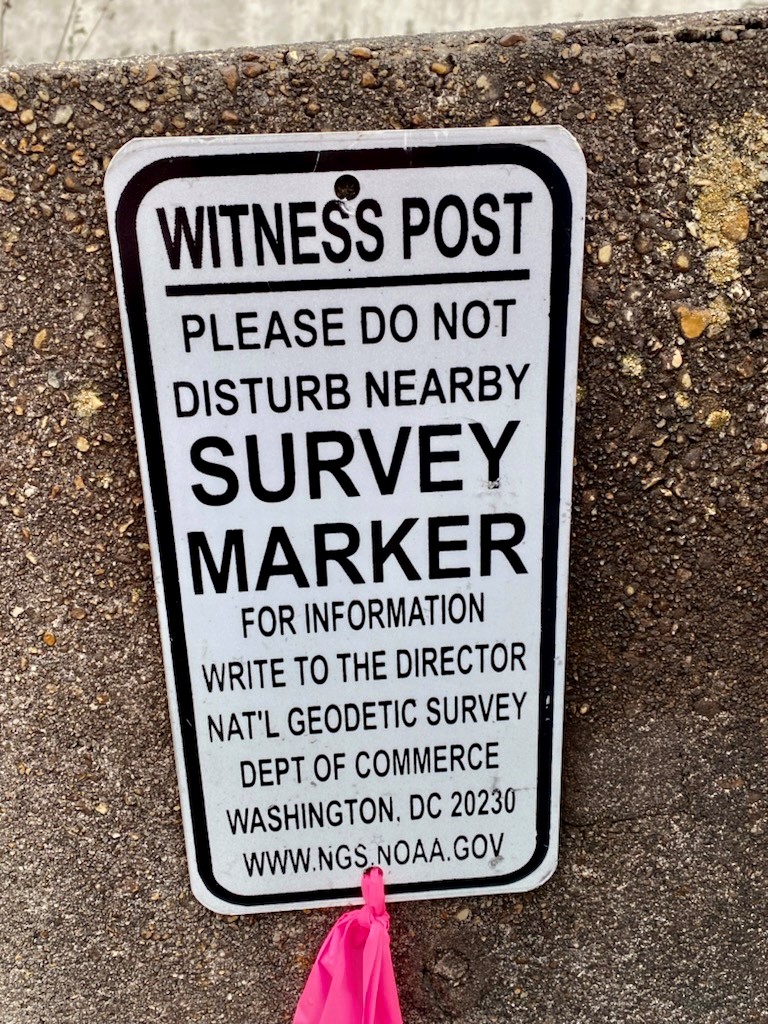
At the historic Edmund Pettus Bridge in Selma, we saw a “Witness Post” advising that we shouldn’t remove a survey market. What dirt lawyer could resist taking a picture of that? It is also attached for your enjoyment.
Thanks for indulging my real estate meandering thoughts and questions. Our next trip will be with children and grandchildren to Disney World for Thanksgiving week. Be prepared!
Although politics are important to me, I see absolutely zero benefit in discussing politics on social media or in this blog. For that reason, I raise this topic with some apprehension and definitely without taking a political position. I raise it for educational purposes only.
I invite you to put this term in your favorite search engine: “terminating single-family zoning”. You will find articles that range in tone and opinion from, “The conservative case for ending single-family zoning” to “Dems are set to abolish the suburbs”. The arguments are all over the place!
My purpose in raising this topic is simply to ensure South Carolina real estate practitioners have it on their respective radars. Like most extreme changes, this one is likely to be very slow to make it to The Palmetto State, but it’s important for us to be prepared to address if and when it arrives at our borders.
One interesting perspective comes from Journal of the American Planning Association (Volume 86, 2020 – Issue 1) which argues that the privilege of single-family homes “exacerbates inequality and undermines efficiency” by making it harder for people to access high-opportunity places and contributing to shortages of housing in expensive regions. In many cities, the paper argues, single-family zoning prevents housing development where development would be most beneficial and instead pushes expansion into denser, lower income neighborhoods, onto polluted commercial corridors, and into the undeveloped land outside city boundaries. The authors have no illusion that making this change will be simple or that every city can handle the controversy the same way.
Arguments against eliminating single-family zoning include the idea that most Americans prefer detached single-family houses, that it creates more aesthetically pleasing neighborhoods, that it protects against excessive density, and that eliminating it will be impossible. Many arguments are made against constructing a housing tower next to existing detached homes. But counter arguments are made that removing single-family zoning might reduce rather than increase the prevalence of high-rise development because tall buildings are a response to scarcity of development-friendly parcels.
The conservate argument against single-family zoning is apparently that there is no greater distortion of the free market than local zoning codes, and that there are few bureaucracies doing more harm to property rights and freedom than local zoning officers.
See what I mean when I said the arguments are all over the place?
That being said, jurisdictions in California, Washington State, Oregon, Massachusetts, Minnesota, and Maryland are apparently considering loosening zoning restrictions. In one of his first actions after surviving an election seeking to oust him from office, California Governor Gavin Newsom essentially abolished single-family zoning throughout California and signaled his approval of legislation seeking to increase California’s housing production.
I doubt we will deal with this issue any time soon, but proactively becoming familiar with the arguments on all sides will only improve our ability to discuss the issues when the time comes.
The United States Secret Service announced in a press release dated September 1 that on August 23, it was successful in thwarting a real estate related business email compromise (BEC) scheme that sought to defraud a purchaser of more than $21 million.
The scheme attempted to divert closing funds to a fraudulent bank account. After quick action by the Secret Service and its private sector partners, the funds were returned to the victim.
These schemes typically employ altered or fictitious payoff statements. The fraudster often impersonates a mortgage broker, lender, borrower, or an agent of the borrower to request a copy of the payoff statement. Alternatively, the fraudster may intercept the payoff statement by a hacking or phishing ploy.
Armed with the payoff statement, the fraudster will create and transmit a bogus “updated” payoff statement with wiring instructions intending to divert the funds to the fraudster. The statement may also alter contact information so that telephone calls to verify payoff information will be answered by the fraudsters.
Chicago Title’s memorandum advises closing attorneys to take the following proactive measures to minimize the risk that payoff funds will be diverted:
Obtain payoff statements early so they can be properly reviewed and verified.
Verify banking information and payoff amounts directly with the payee using known, trusted numbers rather than information from the payoff statement.
Refer to prior payoff statements from the same payee to confirm the banking information matches.
Maintain repetitive wire information within systems or databases to use for future wires. Lock this information to restrict alterations.
If it is impossible to make a verbal confirmation by a known trusted telephone number, consider sending overnighting a check.
The alleged successful purchaser seeks to void the sale!
I’ve always believed our courts will happily void any tax sale on the flimsiest of technicalities, but apparently not when the purported tax sale buyer is the party seeking to get out of the purchase.
Alterna Tax Asset Group, LLC v. York County* is a Court of Appeals case from July dealing with a 2014 tax sale. Alterna claims it was the successful bidder at the sale and sought to void the sale and cancel its ownership relying on §12-61-20 of the South Carolina Code, which reads, in part:
“Any…person…(that) has purchased at or acquired through a tax sale and obtained title to any real or personal property, may bring an action in the court of common pleas of such county for the purpose of barring all other claims thereto.”
The complaint alleged that the title to the property was clouded because of York County’s failure to provide proper notice. The complaint set up four causes of action: (1) declaratory judgment; (2) injunctive relief, (3) quiet title, and (4) unjust enrichment.
The Master consulted the County’s records and took judicial notice that Alterna was neither the purchaser of the property at the tax sale, nor the owner currently listed on the deed. The Master ruled Alterna was not a real party in interest and lacked standing. The Master also ruled that the quoted code section does not create a valid cause of action to void a tax sale.
Alterna appealed claiming the Master erred in taking judicial notice of the public records. The Court of Appeals termed this use of judicial notice “problematic” but decided the appeal on what it called a more fundamental issue: whether, as the alleged tax sale purchaser, Alterna may seek to rescind its successful purchase based on the facts in this case.
Since the purpose of the code section is to clear tax titles, the Court held that Alterna states to viable cause of action when it seeks to defeat rather than defend its title.
The Court accepted for the purposes of this appeal from a 12(b)(6) motion Alterna’s allegation that it purchased the property at the tax sale and concluded that no valid causes of action for declaratory judgment or injunctive relief existed.
The Court then stated that the remaining questions whether a winning bidder at a tax sale may use the quiet title doctrine or claim of unjust enrichment to defeat rather affirm the bidder’s title, are novel questions in South Carolina. The Court held that the complaint does not allege a proper cause of action for quiet title because there is no existing adverse claim. Neither the County nor anyone else was challenging Alterna’s tax title, so the claim is “imaginary or speculative”.
The unjust enrichment cause of action, which claimed the county was enriched by picketing the tax sale proceeds yet delivering a clouded title, collides, according to the Court, with South Carolina Code §12-51-160, which establishes as a matter of law the presumption that a tax deed is prima facie evidence of good title.
The Court further noted that Alterna’s alleged cloud on the title, that York County’s notification was defective, was a matter of public record visible to Alterna before the sale.
Finally, the Court held that Alterna’s claim was not a justiciable controversy. Alterna claimed its title was hopelessly clouded and would someday be snatched away by someone with a superior claim. The court resisted the request to “tame paper tigers or pass upon issues not subject to a genuine, concrete dispute.”
This is a very interesting case! I’ll keep you posed of future developments.
*South Carolina Court of Appeals Opinion 5836, July 14, 2021
Dirt Lawyers: take a look at this company’s website: www.pacaso.com
(Photo by Robbi Pengelly/Index-Tribune)
I try to keep abreast of trends in the real estate market, but I missed this interesting story entirely. Luckily, my husband, Frank, a voracious purveyor of the news, pointed this article from NPR out to me. The story, dated August 24, is entitled “A Startup is Turning Houses into Corporations, And the Neighbors Are Fighting Back”. You can read the story in its entirety here.
It seems a “unicorn” (a startup corporation with a billion-dollar valuation) called Pacaso, is buying homes, slightly refurbishing them, furnishing them, and creating limited liability companies to own them. The ownership of each house is then divvied into eight fractional shares, and each share is marketed on the company’s website. Each share entitles an owner to 44 nights per year. Each visit is limited to no more than 14 days.
The corporation offers an app to handle booking, maintenance, and cleaning. The cost is 12% of the value of the property up front and monthly maintenance fees. After ownership for a year, each fractional owner is entitled to sell its interest at a gain or loss. Gifts of stays at the houses can also be made to friends or family members. The company advertises that it only buys luxury and super-luxury homes and that it is not competing with middle-class families for housing.
The news story and the company’s website indicate the corporation was founded in 2020 by two former Zillow executives. One of the founders who lives in Napa bought a second home in Lake Tahoe and immediately became inspired with making the dream of second home ownership available for more people.
This type of ownership is not new to real estate practitioners who practice on South Carolina’s coast. For sale signs for beachfront houses touting “Interval Ownership” are common. In fact, intervals in these homes seem to be perpetually for sale.
My speculation about the frequency of these sales has always been that owning a home with multiple individuals and entities you don’t know can’t be much fun. It’s hard enough for two spouses to agree on when undertake major maintenance items. Imagine trying to decide when to spend the money on exterior painting with a large group.
The crux of NPR’s article is the opposition being mounted by neighbors of some of the houses. It’s not surprising that owners in nice single-family neighborhoods would oppose the parade of vacationers interval ownership might create. One group of neighbors in Napa printed signs reading “No Pacaso” for homes and cars, wrote opinion pieces for local newspapers and were otherwise extremely vocal in their opposition.
Valid legal arguments might be made in these neighborhoods if restrictive covenants or zoning ordinances exclude timeshares or Airbnb-types of ownership, but Pacaso insists its model involves neither form. All real estate law is, of course, local, so various arguments will be mounted in different locations.
In response to the opposition in the Napa neighborhood, the company agreed to sell the home in question in the traditional manner. It also agreed to beef up noise provisions in its documents, to create a local liaison dedicated to assisting neighbors, to refrain from buying homes in the area valued less than $2 million and to donate funds to a local nonprofit dedicated to affordable housing.
I didn’t see any South Carolina homes in a quick review of the company’s website, but I did see homes located in Florida. I can only imagine that South Carolina’s beautiful coastline will be discovered soon. Real estate practitioners will likely be involved in both sides of this controversy.
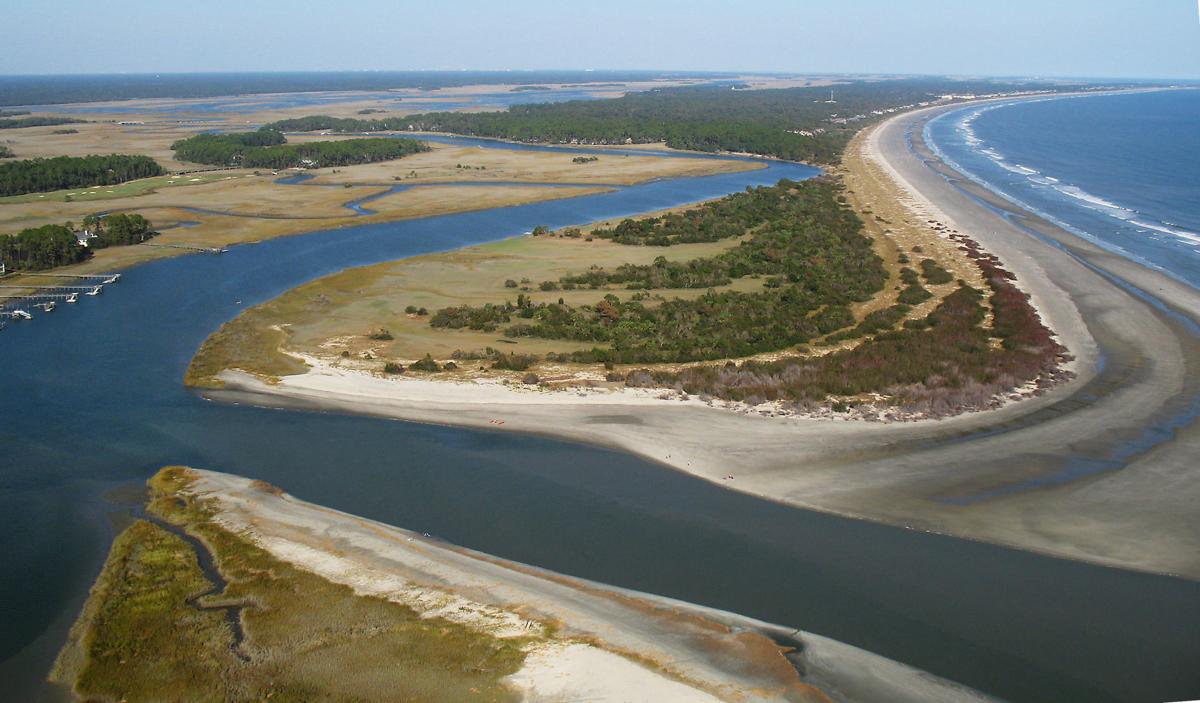
This blog has discussed “Captain Sam’s Spit” in Kiawah Island three times before. Googling that picturesque name will reveal a treasure trove of news, opinion and case law involving the proposed development of a beautiful and extremely precarious tract of pristine beach property on South Carolina’s coast.
In the latest case*, South Carolina’s Supreme Court refers to the property as one of our state’s only three remaining pristine sandy beaches readily accessible to the general public. The other two are Hunting Island State Park and Huntington Beach State Park. I enjoy the blessing of walking the pristine beach of Huntington Beach State Park on a regular basis, so despite having a career on the periphery of real estate development, I am in favor of maintaining these three state treasures.
The South Carolina Bar’s Real Estate Intensive seminar in 2016 and 2018 included field trips to Captain Sam’s Spit, from a distance at least. Professor Josh Eagle of the University of South Carolina School of Law was an excellent tour guide, and how many opportunities do we, as dirt lawyers, have for field trips? The South Carolina Environmental Law Project, located in Pawleys Island, fights these cases. Amy Armstrong, an attorney with that entity, joined our group to explain the environmental and legal issues.
Here are greatly simplified facts. Captain Sam’s Spit encompasses approximately 170 acres of land above the mean high-water mark along the southwestern tip of Kiawah Island and is surrounded by water on three sides. The Spit is over a mile long and 1,600 feet at its widest point, but the focal point of the latest appeal is the land along the narrowest point (the “neck”), which is the isthmus of land connecting it to the remainder of Kiawah Island. The neck occurs at a deep bend in the Kiawah River where it changes direction before eventually emptying into the Atlantic Ocean via Captain Sam’s Inlet.
The neck has been migrating eastward because of the erosive forces of the Kiawah River. The “access corridor”—the buildable land between the critical area and the ocean-side setback line—has narrowed significantly in the past decade to less than thirty feet. Googling this issue will lead to active maps which show the change over time. The width of the neck is significant because the developer needs enough space to build a road. At the base of the neck is Beachwalker Park, operated by the Charleston County Parks and Recreation Commission. Our fieldtrips were conducted on that Park.
Previously, the administrative law court (ALC), over the initial objection of DHEC, has granted permits for the construction of an extremely large erosion control device in the critical area. In the prior cases (citations omitted), the Supreme Court found the ALC erred. The current appeal stems from the ALC’s third approval of another structure termed “gargantuan” by the Supreme Court—a 2,380-foot steel sheet pile wall designed to combat the erosive forces carving into the sandy river shoreline in order to allow the developer to construct the road to support the development of fifty houses. The Court again reversed and, in effect, shut down the proposed development, at least temporarily. The economic interests of an increased tax base and employment opportunities do not justify eliminating the public’s use of protected tidelands, according to the Court.
After a motion for a re-hearing, the result is the same. The Court reaffirmed its earlier decision without further arguments. We’ve pondered whether each case is the end of the litigation. At this point, we don’t know. Creative developers and lawyers may make further attempts to proceed. Stay tuned.
*South Carolina Coastal Conservative League v. South Carolina Department of Health andEnvironmental Control, South Carolina Supreme Court Opinion 28031 (June 2, 2021); Re-Filed September 1, 2021.
Unpublished opinions don’t typically get my attention, but my friend, Bill Booth, sent this one* to me because he found it interesting, and I do, too. As a reminder, unpublished opinions have no precedential value, but they sometimes provide insight on how the Court might react in a similar situation, at least under the current makeup of the court.
The issue in this case was whether a notation on a subdivision plat that certain lots were “for agricultural use only” created a valid restriction of the use of the lots. Mikell Scarborough, Master-in-Equity for Charleston County, granted summary judgment, relying on extrinsic evidence to conclude that there was no intent to create a restriction despite the plain language on the face of the plat. That decision was affirmed.
The Court cited familiar cases holding that restrictive covenants are contractual in nature and must be strictly construed in favor of the free use of property. The Court also referred to cases holding that when a deed describes land as shown on a plat, the plat becomes a part of the deed. The interesting twist became whether the plat notation created an ambiguity that would allow the introduction of extrinsic evidence.
The Court found that the language in the plat was not ambiguous, but that the origin of the note created the ambiguity. The surveyor provided an affidavit to the effect that the Charleston County Planning Commission placed the agricultural use restriction on the plat “for the purpose of indicating that Charleston County would not, at that time, approve building permits for the lots because (the lots in question) did not meet current minimum standards for a modified conventional sub-service disposal system.”
When the plat was submitted for approval, the property owners included a letter explaining they were aware that the land possessed poor soil conditions for septic systems. The letter requested that the subdivision be approved with the stipulation that any lot that did not support a septic system would be restricted from becoming a building lot until public sewer service became available.
The case doesn’t make this point clear, but I am assuming the Appellant sued other lot owners who had built on their lots despite the plat notation. In other words, the Appellant wanted the restriction enforced as to other lots, not the lot the Appellant purchased. Interestingly, one house had been built before the Appellant purchased its lot.
A representative of the Appellant claimed he relied on the plat notation and that his title insurance company told him the lots were restricted. The Court found it significant, however, that the property owners who recorded the plat did not intend to restrict the property.
The Appellant argued that the deeds for all the lots specifically state that the property is subject to all restrictions, reservations, easements and other limitations that appear of record, including on the Plat. The Court held, citing 20 Am. Jur. 2d Covenants, Conditions, andRestrictions §151 (2015) that common “subject to” language does not create a restriction where none exists.
The Appellant also argued that an agricultural use exception in the title insurance policy was evidence that the restriction ran with the land, but the Court held that the title insurance company was merely noting the provision was on the plat so that it would not be liable if the Appellant could not build on its lot.
The Court concluded that the record does not contain a scintilla of evidence to support the imposition of a building restriction on the Respondents’ lots.
Carpenter Braselton, LLC v. Roberts, South Carolina Court of Appeals Unpublished Opinion No. 2021-UP-280.
Justice Few declares piping storm water under a house is “wrong”
I love a case where a separate opinion (usually a dissent) cuts to the chase and explains in a few words a multiple-page quagmire. That’s what we have in Ray v. City of Rock Hill*, a case decided on August 4 by the South Carolina Supreme Court.
Lucille Ray sued the City of Rock Hill for inverse condemnation, claiming her property was taken as a result of stormwater flowing through pipes under City streets into a terra cotta pipe that runs behind her property. The circuit court granted summary judgment to the City, and the Court of Appeals reversed, holding a genuine issue of material fact exists as to whether the City engaged in an affirmative, positive, aggressive act sufficient to support the inverse condemnation claim. The Supreme Court modified and affirmed that decision, remanding the case for a determination on that issue.
The facts are particularly interesting for dirt lawyers. Ray purchased her house on College Avenue in 1985. Before the house was built in the 1920s, someone—there is no record as to who—installed a 24-inch underground terra cotta pipe under the property. The property and the pipe are located at the topographical low point of a 29-acre watershed. Three stormwater pipes installed and owned by the City collect stormwater and transport it under various streets in the neighborhood. Stormwater runs through the pipe to a catch basin directly in front of Ray’s house. When the water reaches the catch basin, it is channeled under Ray’s house to the back of her property. The pipe has been channeling stormwater in this fashion for roughly 100 years although the record reflects no evidence of an easement.
You won’t be shocked that Ray’s property had a history of sinking and settling. In 1992, Ray saw her gardener fall waist-deep into a sinkhole. The house’s roof was subject to bending and movement. The steps on the front porch sank. In 2008, Ray contacted the City and was told about the pipe running under those steps. (This exchange supported the City’s claim that the statute of limitations had run on a damages claim.)
In 2012, Ray brought this action seeking inverse condemnation and trespass. Other relief was sought and the South Carolina Department of Transportation was added as a defendant, but those issues are not relevant to this appeal. Shortly after Ray brought the suit, the City began maintenance work on a sewer line beneath College avenue.
To get to the sewer line, the City had to dig up part of College Avenue in front of the property and to sever three stormwater pipes from the catch basin. The basis of the inverse condemnation claim is that the City’s reconnection of the pipes to the catch basin was an affirmative, positive, aggressive act. That issue was returned to the circuit court for determination.
Justice Few’s separate opinion (not categorized as a concurrence or a dissent) is cogent. He wrote to make two points. First, the City should not be piping stormwater under Ray’s house! It is wrong, he said, and he doesn’t care who built the pipe or whose fault it is that the house is sinking because of the water. “The City should do the right thing and fix the problem.”
Justice Few’s second point is that all wrongs are not subject to redress in our civil courts. To the extent Ray’s inverse condemnation theory is valid, he said, the taking occurred many years ago, either when the pipes were installed or when the deterioration of the pipes began to harm the property. He said it makes no difference that the pipes were reconnected in 2012. The effect of that act was to continue to run storm water under property Ray alleges had already been taken.
Justice Few concluded that there is simply no right of action available under an inverse condemnation theory and that the circuit court correctly dismissed that claim
I look forward to what happens next!
* South Carolina Supreme Court Opinion 28045, August 4, 2021











 Let's Talk Dirt