
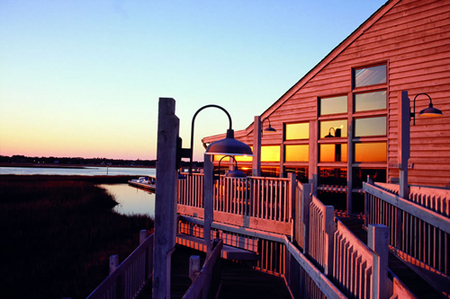
Commercial real estate lawyers know that disputes over parking lot use are common. The long-running legal battle between the owners of Gulfstream Café and Marlin Quay Marina, recently addressed by the Supreme Court, nearly escalated into a literal parking lot showdown given its contentious history.
In 2022, this blog discussed the continuing legal saga in two installments that some of you may wish to check out. A fight over attorney’s fees! Criminal contempt for the malicious parking of a golf cart! The drama!
To catch readers up to speed: In 1982, Georgetown County approved the Marlin Quay Planned Development, which contained two distinct businesses: the Gulfstream Café and its 17 parking spots; and the Marlin Quay Marina, which consisted of 60 boat slips, a marina store, a restaurant, and 62 parking spaces.
The businesses operated in seeming harmony for many years. In 1986, the Marina owner even granted Gulfstream a right of ingress/egress over and the non-exclusive use of Marina’s parking lot and parking spaces, which seemed very neighborly indeed. This easement implied in part: “[i]t is anticipated by the parties that while they will each have joint and non-exclusive use of the area covered by this easement that the Grantor will primarily utilize the premises during the daytime and [Gulfstream] will primarily use these premises in the evening.”
Things went downhill in 2016 when the Marina was sold to a new owner with a different vision for its property. The new owner wished to demolish the existing buildings at the Marina and build a new restaurant and store in its place. Making matters worse for Gulfstream, the new owner also intended on operating the new restaurant in the evenings, created direct competition for customers and for parking spaces at night.
The County Council approved Marina’s request to modify the Planned Development according to this initial set of plans over the objection of Gulfstream. However, the Marina withdrew its petition after it became known that the Marina’s architect, a Georgetown County Council member, failed to recuse himself from the deliberations and vote[1].
After the County approved the re-submitted plans, Gulfstream filed suit against the Marina alleging that the proposed expansion of the restaurant violated the terms of its existing easement. After a full trial, the Circuit Court ruled that the Marina must revise its plan so that it did not exceed the footprint of the existing building with respect to the parking lot if it chose to move forward.
The Marina revised its plans to comply with the Court’s order. It chose to build a bigger vertical space with a larger outside seating area waterside. Gulfstream again objected and maintained that the increased square footage would make the difficult parking situation worse. The County eventually approved the revised plans over Gulfstream’s objection finding that the new construction would be in better condition, bring the Marina into compliance with current building codes, and be a net benefit to tourism and the community over the existing structure.
Not backing down, Gulfstream then filed suit against the County alleging that it had violated its own parking requirements under the zoning ordinance by approving the new plans. Gulfstream asserted that the County’s approval violated its right to substantive and procedural due process and amounted to a taking of its rights under the easement, all of which substantially diminished the value of its property.
The case ultimately reached the South Carolina Supreme Court, which found in favor of the County. The Court agreed that Gulfstream’s easement created a property right, but found that Gulfstream did not have an exclusive right to the use of the Marina’s parking spaces in the evening. Further, Gulfstream had exactly as many parking spaces available to its customers after the approval of the new plans as it did before. The Court was unconvinced by Gulfstream’s arguments that the approval of the additional square footage of seating had overburdened its easement rights and determined that the County had not deprived Gulfstream of any property interest.
The Court found that the General Assembly had given Counties the option to approve “planned developments” so that they could be flexible in adopting innovative planning solutions for benefit of their local communities.[2] The County complied with all hearing requirements for approving the amendment to the planned development and Gulfstream had a full opportunity to present its opposition to the plan. Therefore, the County had not violated any substantive or procedural due process right.
The Court also ruled against Gulfstream on its claim that the County had engaged in a “taking”. The County had not engaged in a “per se” taking because Gulfstream had not been deprived of all economically or productive use of its easement. Gulfstream still retained the same non-exclusive right it had always enjoyed concerning the parking spaces in the Court’s view.
Further, the County had not engaged in a regulatory taking under the Penn Central test.[3] The County approved the plans in its estimate of the best interest of the community. The County had not appropriated the parking to its own use. County approval of the plans did not prevent Gulfstream from continuing to do business as before. The Court further rejected Gulfstream’s offered expert testimony that valued the property based on the assumption that Gulfstream did not have any use of the easement parking[4]. Finally, the Court reasoned that because Gulfstream did not have an exclusive right in the use of the parking spaces that the County’s ruling could not have upset any investment backed expectation in the use of the parking spots at night.
Finally, the Court majority declined to hold that the councilman’s participation in the initial approval of the plans invalidated the subsequent approvals that took place after he recused himself. The majority found the subsequent approvals of the completely revised project by the Council, acting this time with the councilman’s recusal, were sufficient to overcome any impropriety in the first vote.
The two dissenting Justices, though concurring in ultimate result, were much more skeptical of the councilman’s conduct and made it plain that the Justices believed County made unique concessions in its review of the Marina project.[5] The Court questioned whether the Council had properly re-examined the basis for approving the concessions after the recusal.
In any event, the legal duel between the restaurants seems to be over for now. The next time you are in Garden City, you may just want to take a fact-finding mission to sample the cuisine. Just be sure to arrive early as you know that the parking may be an issue.
[1] The Court’s opinion tells us that Gulfstream separately filed an ethics complaint that resulted in an official sanction and fine being levied against the council member.
[2] See S.C. Code 6-29-740.
[3] Penn Central Transport Corp. v City of New York, 438 U.S. 104 (1974). Some attorneys may vaguely recall from the boring semester of Constitutional Law that under the Penn Central test, a court, in considering whether a state action amounts to a regulatory taking, must consider 1) the character of the state’s action; 2) the economic impact of the regulation on the claimant; and 3) the extent the regulation interferes with an investment backed expectation. Partial credit to you though if the name seemed familiar!
[4] The entire Court seemed to find the expert’s testimony as lacking in credibility. The Court characterizes his testimony as indicating that the new Marina restaurant had rendered the Gulfstream property as almost entirely without value. The expert seems to have bitten off more than he could chew there.
[5] The dissent seemed especially concerned that the councilman had asked for $72,000 from the Marina as additional compensation for his role in shepherding the matter through County Council.

 Let's Talk Dirt