Happy New Year!

Standard

Watch out for those recurring dreams…

And don’t forget the mortgage subordinations!

As the last blog of the year, I thought I’d tell you the story of one of my recurring dreams, or more accurately, one of my recurring nightmares, for your entertainment.

Do you have recurring dreams? I grew up in Georgetown where everyone makes routine pilgrimages to Charleston for shopping, dining, and medical appointments. My first recurring nightmare as a child involved the fright of crossing that rickety, two-lane bridge between Mt. Pleasant and Charleston. Thank goodness that monstrosity was replaced by the beautiful suspension bridge we cross today!

Later came the dreams involving college at Carolina. I dreamed I couldn’t get into the mailbox in my dorm. I have no idea why I had that dream because nothing very important was ever there. I dreamed my meal card wouldn’t work but that was also a useless dream because missing those dorm meals would have been no great loss.

Then came law school. In those dreams, it was always time for the exam for a class I had forgotten I signed up for. A more accurate dream would have involved a class I knew I signed up for but failed to attend class because I didn’t understand a word the professor said (think international law). Thank goodness my boyfriend had a great “skinny” on that topic and I somehow made it through that class. And I later married that boy.

But my most vivid recurring dreams involve my professional life, and the stories are always based in fact. I’ll tell you the factual, not the fantasy version of this dream. And I’ll avoid the names for attorney-client and other confidentiality reasons. This is the biggest professional mistake I made or, more accurately, the biggest professional mistake I made that I know about. As dirt lawyers, we plant time bombs every day, right?

I represented real estate developers. They developed malls, shopping centers, residential subdivisions, residential condominiums, outlots for McDonalds and other fast-food restaurants and other properties. The story involves a very large tract that was developed into an upscale residential subdivision, a Walmart, a movie theater, a church, and a shopping center.

The development was complicated. It involved environmental issues that could have derailed the entire project. Multiple individuals formed various entities for buying, holding and selling the real estate. The underlying property was purchased from the Federal government, which created its own set of complications. The acquisition, for example, involved a bid process that was foreign to me at the time.

It all finally fell into place, and the residences and businesses are still in place in 2021.

The problem that I thought might derail my career came to light when one of the individual developers declared bankruptcy. When that happened, every legal step I had taken for that person in the prior three years was scrutinized. The main lawyer scrutinizing my work, along with a team of associates, was a law school classmate, and, thankfully, a very kind and smart lawyer. But I spent lots of time worrying that I had missed something important.

I can remember the phone call from my friend all these years later down to the clothes I was wearing and the coffee cup in my hand.

The commercial properties required easements because of the private roads the properties shared. They also had easements for maintenance, pedestrian access, shared utilities, etc. Here’s the pitfall. When properties with these legal connections are owned and mortgaged separately, the lenders almost always must subordinate their mortgages to the easements to ensure the easements remain in place in the event of foreclosure, or in this case, bankruptcy.

I knew that!

I routinely obtained mortgage subordinations at every step of the development, except for one commercial tract. To this day, I have no idea how I missed one set of subordinations. And I think I lost several years off my life between the phone call from my kind classmate until I was able to obtain the subordinations very much after the fact. I was very lucky because the lender I had to approach (hat in hand) was a local lender. I even knew the person I had to persuade to cure my problem. And the good Lord must have smiled on me that day because it all worked out. I kept my license and my clients.

So, as I wish you a very happy, healthy, and prosperous 2022, I remind you to avoid the mistake I made. Always obtain the necessary mortgage subordinations!


Finkel Firm seeks affidavits in support of its lawsuit against Charleston ROD

Standard

This blog has previously informed South Carolina real estate practitioners about the Petition for Writ of Mandamus filed by the Finkel Law Firm against the Charleston County Register of Deeds because of the significant backlog in recording.

Attached here is a copy of the memorandum from the firm requesting affidavits from law firms, title abstractors, realtors, title companies and agencies, and other organizations associated with the real estate industry setting forth how they have impacted with these delays.

Please read this memorandum and help this law firm if you, your office, and your clients have been impacted.

Should law firms use mascots in advertising?

Standard

Should limitations be imposed on the use of mascots?

One South Carolina law firm claims to have been unfairly targeted

Left Shark Law?

Several news sources (The Post and Courier, The State, AP News) have recently published stories involving a South Carolina law firm with a mascot problem.

According to the news reports, South Carolina attorney John Hawkins said he has been unfairly targeted by the Office of Disciplinary Counsel because of his law firm’s mascot, a hawk. You have probably seen the television ads showing the hawk and actors flapping their arms like hawks to promote the firm’s personal injury practice.

Hawkins has purportedly sued the ODC in Federal Court complaining that the ODC has reached a settlement with another legal entity that uses a tiger as a mascot for a national network of motorcycle accident attorneys styled “Law Tigers.”

Mr. Hawkins has complained in court filings that his mascot is a three-pound bird that eats mice, squirrels, and other small animals, while Law Tiger’s mascot is a 400-plus pound animal that mauls, attacks and eats people. Which mascot, he questions, unfairly represents the ability to “obtain results” in the personal injury arena?

The news reports indicate that two rival law firms and a former employee all filed complaints with the ODC about the hawk mascot in 2017. This year, the ODC filed formal disciplinary charges.

Hawkins’ lawsuit purportedly makes constitutional arguments against the ODC’s enforcement action. I’m not a litigator, but it seems to me that the place to make this argument is in the disciplinary action itself. It never occurred to me that the ODC could be sued in Federal Court.

What do you think, dirt lawyers? Will that suit be dismissed? Can advertising using mascots unfairly tout a law firm’s strength and ability? Are potential clients confused or unduly influenced by the use of mascots? It will be interesting to see how this story plays out.

The hazards of drafting survivorship deeds for consumers

Standard

Pay attention to tricky South Carolina law!

More than a decade has elapsed since our Supreme Court surprised dirt lawyers with Smith v. Cutler,* the case that told us there were already in place two survivorship forms of ownership in South Carolina. We apparently missed that day in law school! The two forms of ownership are joint tenancy (which we knew and loved) and tenancy in common with an indestructible right of survivorship (which slipped by us somehow). This is a mini-history lesson about how we got to this state of the law and a reminder for dirt lawyers to carefully draft deeds.

Under the common law in South Carolina, tenancy in common is the favored form of ownership. A deed to George Clooney and Amal Clooney (whether George and Amal are married or not) will result in a tenancy in common. At the death of George or Amal, the deceased’s fifty percent interest in the property will pass by will or intestacy laws. Joint tenancy was not favored in South Carolina, and there was no tenancy by the entirety that would have saved the property from probate (and creditors) for a married couple.

A rather convoluted 1953 case** interpreted a deed that intended to create a tenancy by the entirety as creating a shared interest in property between husband and wife referred to as a tenancy in common with an indestructible right of ownership. This is the case that the Smith v. Cutler Court referred to as creating the form of ownership we missed.

It’s not technically true that all of us missed this form of ownership. Some practitioners did use the language from the 1953 case to create a survivorship form of ownership. The magic language is “to George Clooney and Amal Clooney for and during their joint lives and upon the death of either of them, then to the survivor of them, his or her heirs and assigns forever in fee simple.”  Other practitioners routinely used the common law language: “to George Clooney and Amal Clooney as joint tenants with rights of survivorship and not as tenants in common.”

Conveying title from a person to himself and another person establishing survivorship was not possible in South Carolina prior to 1996 because the old common law requirement of unities of title could not be met. To create a survivorship form of ownership, the property owner conveyed to a straw party, who would then convey to the husband and wife, complying with the unities of title requirement and establishing survivorship.

A 1996 statutory amendment to §62-2-804 rectified this problem by providing that a deed can create a right of survivorship where one party conveys to himself and another person. The straw party is no longer needed. This statute was given retroactive effect.

In 2000, our legislature added §27-7-40, which provides that a joint tenancy may be created, “in addition to any other method which may exist by law” by the familiar words “as joint tenants with rights of survivorship and not as tenants in common”.  The statute addresses methods for severing joint tenancies which typically results in a tenancy in common. For example, unless the family court decides otherwise, a divorce severs a joint tenancy held by husband and wife, vesting title in them as tenants in common.  A deed from a joint tenant to another severs the joint tenancy. A conveyance of the interest of a joint tenant by a court severs the joint tenancy.

Following the enactment of §27-7-40, most practitioners used the language set out in the statute to create a joint tenancy, “as joint tenants with rights of survivorship and not as tenants in common.” Five years later, Smith v. Cutler required us to examine our drafting practices with fresh eyes. The court held that a joint tenancy with a right of survivorship is capable of being defeated by the unilateral act of one tenant, but a tenancy in common with an indestructible right of survivorship is not capable of being severed by a unilateral act and is also not subject to partition.

Real estate lawyers in the resort areas in our state are often asked to draft survivorship deeds because couples from other states as accustomed to tenancy by the entirety. Until Smith v. Cutler, most practitioners did not believe different estates were created by the different language commonly in use. We believed joint tenancy was created in both cases.

Now, clients should be advised about the different estates and should choose the form of ownership they prefer. I’ve discussed this issue with many lawyers who advise married couples to create the indestructible form of ownership. Others who seek survivorship are often advised to create joint tenancy under the statute.  I see many deeds from the midlands and upstate that use the traditional tenancy in common form of ownership. I’ve heard estate planners prefer tenancy in common so the distribution at death can be directed by will. Lawyers who draft deeds for consumers need to be aware of and need to address the various forms of ownership with their clients.

One final thought on the survivorship issue in South Carolina. Do we now have a form of ownership that protects property from creditors of one of the owners? If a tenancy in common with an indestructible right of survivorship is not subject to partition, then it may not be reachable by the creditors of one of the owners. Let me know if you see a case that makes such a determination. It would be an interesting development.

*366 S.C. 546, 623 S.E.2d 644 (2005)

**Davis v. Davis, 223 S.C. 182, 75 S.E.2d 45 (1953)

Finkel Firm files suit against Charleston ROD for neglect of duties

Standard

Real estate practitioners don’t often get excited about litigation, but this lawsuit should bring cheers from dirt lawyers in every part of the Palmetto State! The Finkel Law Firm, LLC, as plaintiff, filed suit on November 24 against Michael Miller, individually and in his official capacity as the Charleston County Register of Deeds. You can read the complaint in its entirety here.

The complaint points to Miller’s chronic and willful failure to timely record real estate documents within one month of delivery. The allegations state that Miller has allowed substantial delays since late 2019, and that these delays have increased significantly in 2021, sometimes amounting to as long as four months.

Further, the complaint states the Charleston ROD routinely files documents that are hand delivered immediately while allowing hundreds or even thousands of documents delivered to his office by mail or parcel delivery to be stored for later filing.

We all know that South Carolina is a race notice state. Delay in filing real estate documents will, of course, create liability for parties and their lawyers. The complaint makes this point clearly.

The law firm alleges that these failures have substantially interfered with its ability to meet its professional obligations to protect the interests of its clients and has exposed the firm to potential liability for correcting title problems resulting from the ROD’s dereliction of duty.

The complaint seeks a writ of mandamus ordering the ROD:

  • To immediately file all real estate documents that have been delivered and have not been filed within one month of delivery;
  • To mark the recorded real estate documents as being recorded on the same date that they were delivered; and
  • To record all real estate documents in the order of the times at which they were brought to the ROD, regardless of whether they are personally delivered or are delivered by U.S. mail or parcel post.

The complaint asks the court to maintain jurisdiction for a reasonable time to monitor the continued operations of the ROD.

Every real estate practitioner in South Carolina should thank their friends at the Finkel Firm for taking this action. And every ROD in the State should take notice!

Did Columbia destroy an archeological structure?

Standard

Court of Appeals holds the City is not responsible

On November 10, the South Carolina Court of Appeals affirmed a summary judgment order in favor of the City of Columbia concerning the alleged destruction of an archeological and historical bridge abutment during a sewer rehabilitation project*.

The Brinkmans, Colemans, Fosters and Collins (property owners) own real estate on Castle Road on the banks of the Broad River in Richland County. The City of Columbia owns and operates sewer lines that run beneath portions of the property and has a permanent, 15-foot easement across the property for the purpose of maintaining the sewer lines. In 2014, the City began a sewer rehabilitation project which required access to the sewer lines.

According to the property owners, two bridge abutments stood on their property located outside the easement. The owners claim these abutments, which were made of carved rock, were built in the 1700s and were the “oldest existing structures in the Midlands.”

One of the owners testified that he shouted to the City’s contractors and said there was a valued monument on the property. Unfortunately, while the City and the contractors were clearing the land, they destroyed the stones that allegedly comprised the bridge abutments. The City acquiesced to the owner’s request that all work cease, and the property owners brought the subject lawsuit alleging various causes of action, including the destruction of archaeological resources in violation of §16-11-780 of the South Carolina Code.

This statute states that it is unlawful for a person to willfully, knowingly, or maliciously enter upon the lands of another and disturb or excavate a prehistoric or historic site for the purpose of discovering, uncovering, moving, removing or attempting to remove an archaeological resource.

The property owner’s expert testified that he believed the structures were historic abutments from the 1700s or early 1800s and likely to be the “Compty bridge abutment.” He explained that additional excavation and review of other properties across the river would have been the appropriate “next step”.

The property owners submitted an application in 2008 to the National Register of Historic Places, but the Department responded that a great deal more research and archeological investigation was needed before a determination of eligibility could be made.

The record contains a screenshot from the website “ArchSite. The property owner’s expert testified that ArchSite is a multi-agency website that allows access to the archaeological resources database. He explained that when ArchSite receives information about historic sites, it verifies the information and posts it to the website. The image in the record shows a rendering of part of the Broad River and Castle Road, and it includes the notation “Historic Areas: Broad River Ferry and Bridge Site.”

The trial court found no governing preservation or conservation authority had recognized the structures as either archaeological resources or historical structures. In granting the City’s motion for summary judgment, the court found that the City was not liable under the statute.

The Court of Appeals agreed, holding that no evidence exists that the City cleared the land “for the purpose of” discovering, uncovering, moving, removing or attempting to remove an archaeological resource. Clearly, the City was attempting to clear the easement area to access the sewer lines. In addition, the owners provided no evidence that the City had any knowledge of the historic nature of the site.

The owner who shouted at the contractors could not testify that the contractors heard him and did not know whether this incident took place before or after the destruction of the stones. In addition, the Court held that the owners failed to show the City was obligated to consult ArchSite. The Court also questioned whether the entry on ArchSite contained sufficient information to conclude the property is historic because the entry indicates the site is “not eligible or requires evaluation.”

Finally, the Court held that regardless of whether any preservation or conservation authorities designed the structures as archaeological resources, the property owners failed to demonstrate the City had either actual or constructive knowledge of the existence of such resources.

*Brinkman v. Weston & Sampson Engineers, Inc., South Carolina Court of Appeals Opinion No. 5870, November 10, 2021

Borrower sues mortgage lender for violation of attorney preference statute

Standard

Court of Appeals holds lender’s foreclosure action is not a compulsory counterclaim

South Carolina’s Court of Appeals ruled on a noteworthy foreclosure case* in August.

The facts are interesting. In 1998, the borrowers signed a fixed-rate note in the amount of $60,400 at a 9.99% interest rate secured by a mortgage on property in Gaston. The note contained a balloon provision requiring payment in full on July 1, 2013.

On June 27, 2013, days before the note matured, the borrowers brought an action against the lender alleging a violation of South Carolina Code §37-10-102, the Attorney Preference Statute. The complaint alleged that no attorney supervised the closing, that the loan was unconscionable, and that the borrowers were entitled to damages, attorney’s fees and penalties as provided in the Consumer Protection Code. In addition, the complaint asserted a claim under the Unfair Trade Practices Act. All the allegations were premised on the same alleged violation of the Attorney Preference Statute.

The borrowers immediately defaulted on the note, and the lender filed an answer asserting no counterclaims. At trial, the jury found for the lender. About a year later, the borrowers sent a letter by certified mail to the lender requesting that it satisfy the mortgage. The letter included a $40 check to pay the recording fee for the mortgage satisfaction. The lender refused to satisfy the mortgage and returned the check.

The lender brought the present action for foreclosure in October of 2016. The borrowers asserted defenses of res judicata, laches, unclean hands, waiver, and setoff, but admitted no payments had been made on the loan after July 1, 2013. The borrowers then sought a declaratory judgment that the lender held no mortgage on the property, or, alternatively, that the mortgage was unenforceable. They alleged that the lender was liable for failing to satisfy the mortgage and for noncompliance with the Attorney Preference Statute. The lender denied the allegations and argued that the claims under the Attorney Preference Statute were time-barred.

Both parties sought partial summary judgments before the master-in-equity. The master granter the borrower’s motion and denied the lender’s motion. He ruled that the mortgage was satisfied and instructed the lender to file a satisfaction.

On appeal, the lender argued the master erred by finding its foreclosure action was a compulsory counterclaim in the 2013 action. The Court of Appeals agreed, holding that the two claims arose out of separate transactions. The Attorney Preference claim arose from the closing, while the foreclosure arose from the borrower’s default, according to the Court. The Court reversed the master’s award of partial summary judgment to the borrower and remanded the case for further proceedings. Because of its decision on this issue, the Court determined that it did not need to address the remaining issues.

*Deutsche Bank National Trust Company v. Estate of Houck, South Carolina Court of Appeals Opinion 5844, August 11, 2021.

Thoughts of a traveling dirt lawyer in the days of COVID

Standard

I am a planner. In November of 2019 I told my boss I planned to retire in February of 2021, giving us plenty of time to name and train my replacement. Thank goodness, Jennifer Rubin stepped up to learn more than I ever knew about my job. My husband, Frank, had already retired, and we had plans to travel.

But none of us planned for COVID!

Jennifer, the rest of our office and I all worked from home beginning March of 2020. We did manage to put everything in place for my retirement, and Jennifer has taken over like a champ…seamlessly.

After two COVID vaccines, Frank and I decided to put our toes timidly into the travel waters. Six adults flew with masks to Denver and toured Colorado for ten days. We drove over 1,700 miles and saw six National Parks, the Air Force Academy, and many other beautiful sites. (We crossed over to Utah on a whim to visit beautiful Arches National Park.)

 Except for the challenges of breathing at heights up to 14,000 feet above sea level, Colorado is a delightful state! Having grown up in Georgetown, South Carolina, and Panama City, Florida, my lungs are accustomed to breathing at sea level. And compared to Columbia, the temperatures in September were wonderfully cool!

A dirt lawyer can’t travel without having lots of real estate thoughts and raising lots of real estate questions.

Here are just a few from Colorado:  How was all that land accumulated for those National Parks? Were condemnations required? Who was displaced? What kinds of contracts are in place for care and maintenance of the parks?  How does the Federal Government share and manage the Academy’s real estate with the City of Colorado Springs and the State of Colorado? Is the Academy’s real estate treated like the real estate of our Fort Jackson? (I once handled the legal work for the creation of a subdivision from surplus Fort Jackson land, so I learned a good bit about the technicalities.) Where do those people who live in the middle of nowhere buy groceries and deliver babies?  How is that mountainous property surveyed?

I can do the research, but maybe some lawyers who are much smarter than I am will point me in a direction.

Of the six vaccinated, mask wearing adults, three came home and tested positive for COVID! Thankfully, the cases were minor, and everyone is fine by now.

After booster shots, Frank and I decided to travel again. This time, we struck out on our own and drove about 1,400 miles from Columbia to Asheville, Nashville, Memphis, Selma and back to Columbia. What a great trip!

We spent one night at an upscale, relatively new hotel in Asheville, and I was struck with how cramped it seemed, surrounded by busy Asheville streets. I, of course, thought about the developer’s thought process in accumulating the real estate and placing the hotel in that location.

Don’t judge, but it was Halloween week, so we took the “Spooky Asheville Walking Tour”. We didn’t see any ghosts, but I was struck with the stories of covering up cemeteries to create streets. I’m not sure I bought that story from a real estate standpoint. I’ve been involved in many claims involving missed cemeteries!

In fact, I couldn’t decide whether the tour guide was completely making up the stories or whether some of them were based in historical fact. Apparently, a lieutenant of Al Capone was pushed out of Asheville’s Flat Iron Building, and a United Methodist Church is haunted by a nun who predicts futures. I may need to check some of this out. Call me skeptical.

At Graceland, we saw Elvis’ Trust Deed with the notation, “A Title Policy is a Vital Policy.” I couldn’t agree more, and I’m attaching a picture for your enjoyment.

At the Peabody Hotel in Memphis, we watched the ducks leave their fountain in the hotel lobby to return to their “penthouse apartment” for the evening. We watched this show twice and dubbed it the best show in town. (The “rubber ducky” drinks I was imbibing may have added to the attraction.)

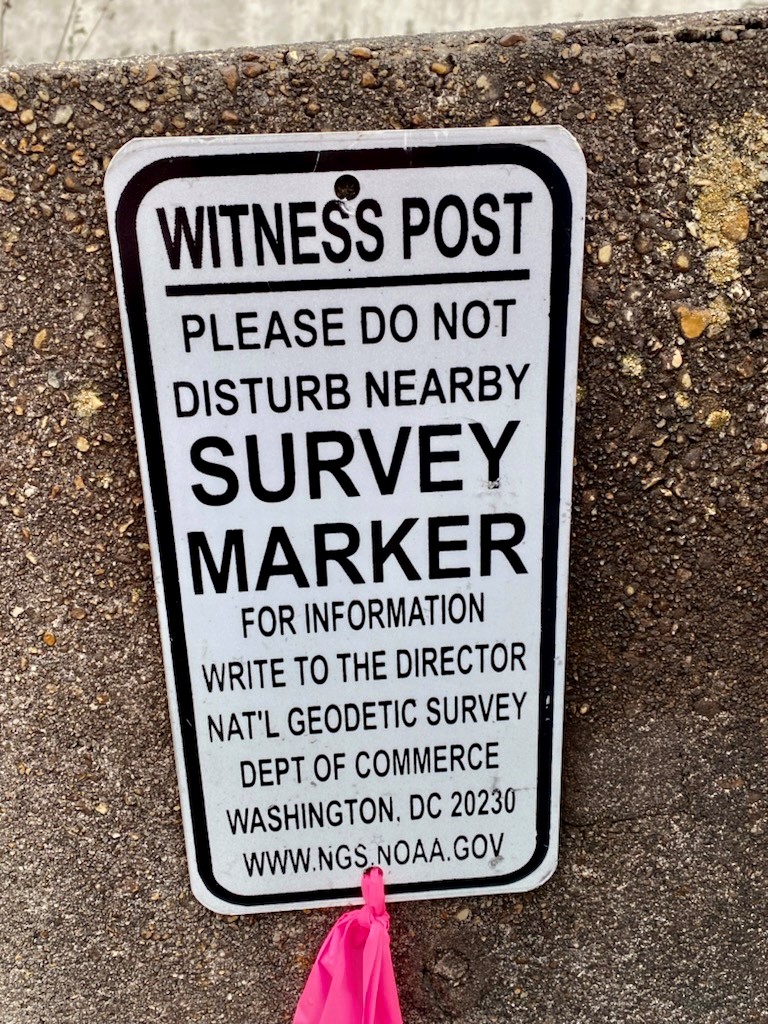
At the historic Edmund Pettus Bridge in Selma, we saw a “Witness Post” advising that we shouldn’t remove a survey market. What dirt lawyer could resist taking a picture of that? It is also attached for your enjoyment.

Thanks for indulging my real estate meandering thoughts and questions. Our next trip will be with children and grandchildren to Disney World for Thanksgiving week. Be prepared!

We have our second Ethics Advisory Opinion of 2021

Standard

It answers two specific trust account disbursement questions

Ethics Advisory Opinion 21-02 deals with two questions posed by a lawyer concerning a trust account disbursement issue.

The lawyer received settlement funds in a significant amount subject to a valid lien, but the exact amount of the lien has not yet been determined. The parties agreed that the funds will not be disbursed until the lien amount is determined. It is expected that the funds will be held for more than a year. The fee agreement provides that the attorney will receive a contingency fee of a specific percentage plus costs. The client wishes to earn interest of the funds.

The questions presented to the Ethics Advisory Opinion are: (1) Is the lawyer permitted to open a separate account for the funds; and (2) Should the entire amount be held in trust or the entire amount minus the attorney’s fees and costs?

The Committee begins with an examination of South Carolina Appellate Court Rule 412 (a)(3) which requires an IOLTA account for “pooled nominal or short-term funds of clients or third persons.” The opinion states that there is no requirement for a long-term trust account to be an IOLTA account.

Rule 412 (d)(1) says a lawyer must exercise good faith judgment in determining whether funds are nominal or short-term. The rule then states that client or third person funds shall be deposited into an IOLTA account unless funds can earn income for the client more than the costs incurred to secure such income. If the funds can be invested in an interest-bearing account for the benefit of the client at an expense less than the costs of securing that income, then a separate account is permitted.

The Committee opined that a separate account is permitted in this case because the funds in question are not nominal, and they are not short-term because they are expected to be tied up for more than a year. The Committee advised that since the attorney has the duty of keeping client funds secure, it would be the best practice to invest the funds in a government insured account. The Committee then reminded the attorney that all normal trust account recordkeeping rules will apply to the separate account.

Finally, the Committee opined that the attorney is free to disburse attorney’s fees and costs immediately. Since those amounts are not subject to the lien, leaving those funds in the account would amount to improper commingling in violation of Rule 1.15(a).