This blog recently discussed the Missouri class action by residential real estate sellers against the National Association of Realtors (NAR), a real estate agent trade association, and several real estate agent entities, which resulted in a judgment of $1.8 billion. The plaintiffs argued that commissions are rarely negotiable and that the seller is required to pay commissions for both sides of transactions
A South Carolina lawyer posted on a listserv I read on the subject that litigation like this wouldn’t happen in South Carolina because standard residential contracts leave a blank for the percentage of the buyer’s agent’s commission. This poster was, sadly, wrong.
Housingwire reported on November 10 that Shauntell Burton has filed a lawsuit in the U.S. District Court for South Carolina alleging that the NAR and Keller Williams colluded to artificially inflate agent commission rates. You can read the story here.
The plaintiff is seeking class action status for all home sellers in South Carolina who have sold a home on the MLS with a Keller Williams agent since November of 2019. The 107-page complaint states that NAR’s “clear cooperation” policy leads to the commission problem because that policy requires agents to provide a blanket offer of compensation to the buyer’s agent to list a property on the MLS.
Apparently, similar suits are being brought in multiple states.
Dirt lawyers, what do you think about this? Is Keller Williams the only broker involved in the practice, or will other brokers be named in the future? Is it your experience that commissions paid by sellers to buyers’ agents are negotiated, as the poster mentioned above suggested? I’d love to hear your thoughts and learn from your experience.
I hate to report that any South Carolina law firm has fallen victim to fraud, but my friend and successor at Chicago Title, Jennifer Rubin, tells me that fraud is a daily challenge for closing attorneys in South Carolina. I am going to discuss this case delicately, because I believe this might happen to anyone who handles closings. I have sympathy for each closing law firm because they remain under constant pressure. But I also believe that everyone needs all the warnings we can collectively muster! This blog is yet another warning.
First, let me thank my friend, Bill Booth, Columbia attorney who keeps me posted on cases he follows. I appreciate being kept informed. This is an unpublished South Carolina Court of Appeals case* Bill brought to my attention. Bill said, “The fraudster was very clever in how he changed the seller’s email by a single letter.” Clever indeed! I stared at the real email address and the fraudulent email address for several minutes and failed to find the discrepancy. I handed the opinion to my husband and asked him to see if he could find it. He did, but it took him awhile.
Here are the two email addresses: mail4marvin@gmail.com vs. mail4rnarvin@gmail.com. Do you see it? The “m” in marvin was changed to “rn”. The Court of Appeals called this discrepancy “cunning”. I’ll say!
At trial, the seller was awarded a $10,306 verdict against the law firm, and the Court of Appeals affirmed. I assume the law firm will appeal to the South Carolina Supreme Court, and we may get further guidance.
Here are the facts. In 2016, Marvin Gipson contracted to sell his property to Clyde and Betty Williamson for $12,000. Gipson lived in Texas, and his local real estate agent recommended the closing firm, which represented both sides. Gipson testified that his only contact with the law firm was by mail, telephone, and email, mostly with an assistant.
Prior to closing, according to Gipson, the assistant told Gipson that she had received wiring instructions. Gipson testified he told her that he had never sent wiring instructions and expected to receive a check. He said he never received a phone call informing him that the closing had been completed and never received the check. He waited eleven days before contacting the law firm to report that he hadn’t received his seller’s proceeds.
Investigation revealed that the assistant had emailed the fraudulent address that the closing had taken place. By return email, she received fraudulent wiring instructions.
At trial, the law firm presented expert witness testimony to the effect that the law firm’s server was not hacked, and that the theft was facilitated by a “man in the middle attack”, wherein the thief was privy to information possibly obtained through a breach of Gipson’s or the real estate agent’s systems or by overhearing information. But the law firm was held liable at the trial level and by the Court of Appeals.
Lawyers, here is my advice. Please give your closing paralegals time. They need time to discover issues. They need time to investigate discrepancies. Please also give them training, not just once but weekly or even daily. They need to know about this case! No amount of training is too much. Talk to your title company. They have resources to assist! Use those resources! Stay up to date yourself! We spent three years in law school learning to spot issues. Apply those skills to your closing practices to spot those difficult issues.
The preacher started his sermon on Sunday by saying: “I love a good story.” I love a good story, too, and even though this one is about a South Carolina tax sale, not a twin’s stolen blessing from Genesis, it makes for a pretty good tale.
I’ve often said that our courts of appeal will overturn a tax sale on the flimsiest of technicalities. The technicalities in this case are not flimsy, and a claim of slander of title gives us a different slant on the typical tax sale case.
The opinion in Gleason v. Orangeburg County* starts, “This story began with a flawed tax sale, but there were several mistakes for years after.” It’s not a John Grisham-worthy beginning, but it’s not bad for a South Carolina Court of Appeals case.
Bank of America began foreclosure proceedings in 1998 on property owned by Debra Foxworth. When the foreclosure was finalized, the bank sold the property to Wilton Gleaton. The opinion refers to Wilton Gleaton as “Wilton” because his wife will become a later player in the story. When Wilton bought the property, the 1998 taxes had not been paid.
In a classic tale of the left hand not knowing what the right hand is doing, Orangeburg County began proceedings in March of 1999 to collect the delinquent taxes. The County sent Foxworth notices for failing to pay taxes in March and May, shortly before the foreclosure sale to the bank, but long after the bank began foreclosure proceedings. The County sold the property at a delinquent tax sale to James Fields in February 2000.
The County sent three required “Dear Property Owner” letters to give notice of the redemption period. Two of the letters were addressed to Foxworth and the third was addressed to Wilton but mailed to Foxworth’s address.
In an interesting twist, Wilton’s wife, Sara, visited Orangeburg County in January 2001—before the redemption period expired—and went there precisely because she had not received a tax notice in the mail. She paid the 2000 property taxes. That tax bill listed a Charleston address at which neither Sara nor Wilton had ever lived. Sara gave the County her correct address and asked if any other taxes were owed. The County initially told her that no other taxes were due but later informed her the 1999 taxes had not been paid. She paid those taxes the next month, February 2001. In an “asleep at the wheel” move, the County employee did not inform her of the 2000 tax sale to Fields or of the right to redeem the property.
The redemption period expired in February 2001, not long after Sara paid the 2000 property taxes, but before she paid the 1999 taxes. In May 2001, The County issued a tax deed to Fields. The tax deed listed Foxworth as the defaulting taxpayer and “record owner against whom warrant was issued.” The tax deed made no reference to the Gleatons.
The Gleatons paid subsequent taxes as they came due.
In 2006, the County discovered Wilton—the record owner at the time of the 2000 tax sale—had not been noticed. In another interesting twist, the tax collector had Fields convey the property back to Foxworth via quitclaim deed in an effort to “reverse” the tax sale. The Gleatons were not notified about any of this.
In 2007, the Gleatons listed the property for sale. (Dirt lawyers, this is where the facts get “real” for us.) In October 2009, Donnie and Connie Hall contracted to buy the property for $33,000. It’s shocking, I know, but the Halls discovered a title problem! The County’s attorney offered to bring a declaratory judgment on the Hall’s behalf seeking rulings that the tax sale and quitclaim deed were void.
Wilton filed this suit against the County after the Halls backed out of the sale. In December 2014, the master issued an order finding the tax sale was flawed and invalid and the tax deed to Fields was improper. But the master left open the issues of liability and damages and ordered the Gleatons to attempt to sell the property within four months. Wilton died shortly after this order and Sara was substituted as a party. The property did not sell, and the master issued a final order in 2019. He found that the County’s actions were not malicious and “made no publication” that was intended to harm the Gleatons and made no statement that was knowingly false or in reckless disregard of its truth or falsity.
The master found that the only statement slandering Wilton’s title was the quitclaim deed from Fields to Foxworth, and that this deed was done for the purpose of returning the property to the defaulting taxpayer, not for the purpose of damaging Wilton’s title. The master also found that a proper title search would have revealed the 1998 taxes were due and owing at the time of the Gleatons’ purchase.
On appeal, Sara argued:
The tax deed and subsequent deed to Foxworth disparaged the title.
The County knew Wilton owned the property because the deed and mortgage were recorded before the tax deed.
The master erred in failing to find malice because malice, in a slander of title action, includes publications made without legal justification.
The Halls plainly refused to purchase the property because of the cloud on the title.
Citing an earlier case, the Cout of Appeals set out the elements of slander of title as:
The publication
with malice
of a false statement
that is derogatory to plaintiff’s title and
causes special damages
as a result of diminished value of the property in the eyes of third parties.
The Court held the master’s findings that the County’s actions did not result in any publication and did not contain any statement that was knowingly false or made in reckless disregard of the truth were not supported by the evidence. The Court also disagreed with the master’s finding that malice requires an intent to injure. The County’s numerous missteps were at least reckless, according to the Court, stating that the situation should have been resolved in a logical and reasonable manner when the mistakes were discovered.
The case was remanded for the master to consider each element in a slander of title action and the proper standard for malice.
Please note that more than 20 years have passed since this tale of woe began. The County should have discovered and fixed its mistakes when Sara visited in 2001 with the express purpose of paying taxes. And there is no excuse for the County’s continued failure to correct its errors in 2006 when the tax collector discovered Wilton’s ownership of the property.
*South Carolina Court of Appeals Opinion 6003 (July 26, 2023)
On July 12, South Carolina’s Court of Appeals issued an opinion* in favor of multiple property owners in a railroad abandonment case.
The properties at issue abutted a 24-mile railroad line extending from McCormick County to Abbeville County. In 1878, the State chartered the Savannah Valley Railroad Company (SVR) to construct the railroad. Prior title holders granted SVR easements to allow the construction and operation of the railroad. The documents stated the easements would be void in the event the railroad was not erected and established. Each successive title holders’ deed was subject to the easements. SVR conveyed its interest to Seaboard Coastline Railroad Company.
In the late 1970’s Seaboard decided to close the track and seek permission from the Interstate Commerce Commission (ICC) to abandon the line. The ICC granted the request in 1970. The company wrote a letter to the ICC dated February 25, 1980, indicating the track was abandoned as of February 15, 1980.
Calhoun Falls and Savannah Valley Trails (SVT) were the ultimate owners of the railroad’s interests. When SVT began to construct a walking trail on the former line, property owners adjoining the line in McCormick County filed suit in 2016 seeking a declaratory judgment that the properties reverted to them when the track was abandoned. Abbeville County property owners filed a similar suit in 2018.
The trial court issued two orders finding (1) the railroad abandoned the line; (2) when the railroad abandoned the line, the easements were terminated, and the property rights reverted to the adjoining title holders; and (3) the doctrine of laches did not bar the property owners’ claims.
SVT argued on appeal that the trial court lacked subject matter jurisdiction because the abandonment failed to follow the details of the ICC order. The Court of Appeals disagreed, holding that SVT had the burden of proving the railroad’s abandonment was incomplete and failed to meet that burden.
SVT also argued on appeal that laches barred the property owners’ claims. The Court of Appeals noted that SVT failed to plead laches as an affirmative defense, and that the trial court could have declined to address the issue. But, ultimately, the appeals court agreed with the lower court that SVT failed to present evidence that would equip the trial court to make a finding of prejudice to support the laches claim.
Finally, SVT argued that the trial court erred in finding the railroad had abandoned the line. The Court of Appeals noted that the railroad ceased operations, sought permission for abandonment from the ICC, removed the tracks, and transferred its property interests. Further, nothing in the record showed that the railroad failed to comply with the requirements of the ICC. Citing prior cases, the Court stated that to rule otherwise would gut the longstanding rule that an easement is extinguished when the railroad abandons the right of way for railroad purposes.
As a dirt lawyer, I like this opinion! If you run into railroad abandonment issues in your chains of title, consult your friendly, intelligent title company underwriters.
*Myers v. Town of Calhoun Falls, South Carolina Court of Appeals Opinion 5998 (July 12, 2023)
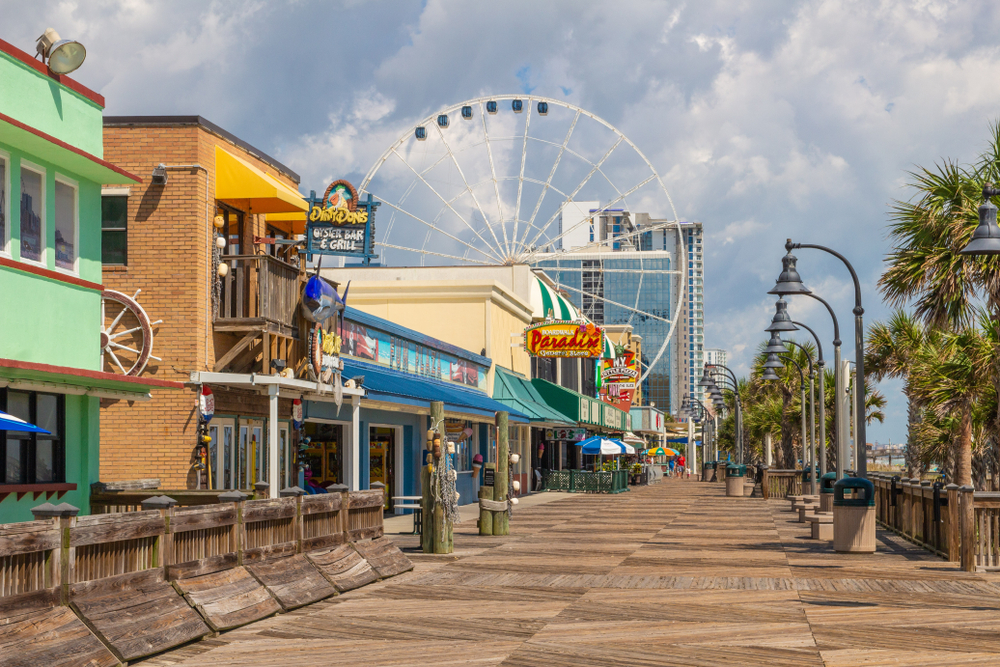
In May, this blog discussed Ani Creation, Inc. v. City of Myrtle Beach,* a case where the South Carolina Supreme Court upheld an ordinance that imposed a zoning overlay district intended to bolster the “family friendly” nature of Myrtle Beach’s historic downtown area. The ordinance targeted smoke shops and tobacco stores and the merchandizing of tobacco paraphernalia, products containing CBD, and sexually oriented material.
The opinion begins, “The City of Myrtle Beach (the city) is a town economically driven and funded by tourism.” The facts indicate that the city received frequent criticism from tourists and residents that the proliferation of smoke shops and tobacco stores repelled families from the area. The city passed a comprehensive plan that aimed at increasing tourism and concluded that all businesses needed to encourage and support a “family beach image”. The city passed an ordinance which created a zoning overlay district known as the Ocean Boulevard Entertainment Overlay District that encompassed the historic downtown area.
The prohibited uses in the district were declared immediately nonconforming when the ordinance was passed on August 14, 2018, but an amortization period was allowed which gave affected businesses until December 31, 2019, to cease the nonconforming portions of their businesses.
The zoning administrator issued citations to the nonconforming businesses. Nine of the 25 affected stories appealed to the Board of Zoning Appeals which found (1) it did not have jurisdiction to declare the ordinance unconstitutional; (2) it could not grant a use variance because it would allow the continuation of a use not otherwise allowed in the district; and (3) the businesses were engaged in one or more of the prohibited uses. On appeal, the circuit court affirmed the Board’s opinion, finding the appellants’ 25 grounds for challenging the ordinance meritless. The businesses appealed directly to the South Carolina Supreme Court.
The appellants raised a “host” of constitutional and procedural challenges, all of which fell on deaf ears at the Supreme Court. The Court held that the ordinance was a valid exercise of the city’s police powers. According to the Court, municipal governing bodies clothed with authority to determine residential and industrial districts are better qualified by their knowledge of the situation to act upon such matters than are the courts, and they will not be interfered with in the exercise of their police power to accomplish their desired end unless there is a pain violation of the constitutional rights of the citizens.
The Appellants petitioned for a rehearing and in an opinion re-filed on June 28, the court again affirmed the Court of Appeals.
A comment on the Dirt Listserv said, “S. Carolina is OK with cancel culture after all.” A store selling sexually oriented materials was removed from Garners Ferry Road in Columbia (about three miles from my house) using similar legal arguments. I was delighted to see that store torn down before I had to explain it to my grandchildren! But I do understand the “cancel culture” argument. What do you think?
Court of Appeals reverses Circuit Court on this issue
In Rivers v. Smith*, South Carolina’s Court of Appeals reversed Orangeburg County’s Circuit Court order affirming a magistrate’s order of eviction.
Rufus Rivers and Merle Rivers have lived on property once owned by Jessie Mae Smith since 2009, although there was no record of a written lease. In 2013, Jessie Mae Smith signed a power of attorney in favor of her son, James Smith. In 2014, James Smith conveyed his mother’s property to himself by quitclaim deed using the power of attorney.
(The opinion contains no discussion of whether the conveyance of the property by the attorney in fact to himself was a valid transfer, but that would have been my first question.)
Jessie Mae Smith died in 2016. In 2018, James Smith sent the Rivers a letter demanding they vacate the property within 30 days. The Rivers refused. They asked James to cease and desist his efforts to displace them. They argued that James had an invalid power of attorney and alleged he had breached fiduciary duties. Competing lawsuits followed.
The Rivers’ lawsuit in the Circuit Court challenged James’ ownership of the property and alleged constructive fraud, unjust enrichment and other causes of action. The Rivers amended their complaint, alleging that James used an invalid power of attorney and that Jessie Mae Smith had orally given or promised the property to the Rivers.
James filed the subject case in the magistrate court, seeking eviction. The Rivers made various arguments to the magistrate opposing the eviction, including alleging that Jessie Mae Smith had promised the property to them. The Rivers also alerted the magistrate of their claims against James Smith in the circuit court.
James Smith’s main argument to the magistrate centered around the statute of limitations because the alleged gift would have occurred more than three years before the lawsuits were brought. The magistrate ruled that James Smith was the lawful owner of the property and ordered eviction.
On a motion by the Rivers to reconsider, the magistrate found that the case did not involve a question of title and that she had jurisdiction to hear the case. The circuit court affirmed, and this appeal followed.
The issue on appeal was whether South Carolina Code §22-3-20(2), which bars a magistrate from hearing a case when title to the property is in question, prohibited the magistrate from hearing this case.
The Court of Appeals acknowledged that Smith has defenses to Rivers’ claims, and that those defenses may be valid ones, but held that the magistrate’s jurisdiction ended as soon as it became clear that there was a challenge to title. The opinion further stated that the case may end in a second and successful eviction, but they refused to say that outcome is certain.
I will be curious to learn what the future holds in the litigation between these parties. I hope the property is worth the litigation, and I note with interest that the Rivers represented themselves pro se in the subject case.
*South Carolina Court of Appeals Opinion 5992 (June 21, 2023)
Real estate related issues should be kept to a minimum
My husband and I just returned from the 2023 annual meeting of the South Carolina United Methodist conference. We attended as lay members from our church, but my eyes and ears were open, as always, for real estate issues.
Dirt lawyers in South Carolina witnessed the real estate issues raised by the schism in the Episcopal Church several years ago. We made lists of church properties that could be sold or mortgaged without the involvement of any entity beyond the local congregation. We made lists of properties involved in a hierarchical church structure requiring agreements and signatures of persons in distant locations. We advised real estate practitioners to work in close connection with underwriting counsel of the title insurance companies to avoid title issues.
I have no inside information on this matter, but my guess is that the Methodists were able to learn from the Episcopalians and managed to avoid the extensive litigation involved in that earlier schism.
United Methodist churches exist under a hierarchical structure. Anyone who has handled a closing involving a United Methodist property has learned that the District Superintendent must be involved in closing documents. The church properties are, in effect, owned by the conference.
When issues began to arise about LGBT members and pastors and it became apparent that there would be a separation of congregations, South Carolina’s Bishop and the administrators surrounding him negotiated with the churches who desired to leave the conference. After months of talks, the parties agreed to a payout that would free the real estate of the local church from the involvement of the conference.
Churches who wanted to leave the conference were required to pay ten percent of the value of their real properties and other assets. They were also required to pay some funds related to pastor pensions and some funds related to “apportionments” (the money paid to the conference to support the work of the conference as opposed to the work of the local congregation.)
Prior to the meetings this week, we had heard that several churches decided to leave the conference. But we were surprised to learn that there are, in fact, 113 churches who made arrangements with the conference to separate from United Methodism. On the last day of the meetings, we were asked to vote to approve the separation. Thankfully, the meeting, although very sad, was handled in a respectful manner. We witnessed an amicable divorce.
If you are asked to handle any transaction involving a church that is or formerly was a United Methodist congregation, you should, of course, investigate the title issues as usual. You should involve the friendly underwriting counsel from your title insurance company. But, after these appropriate investigations, you should learn that there are no title issues arising from the involvement of the conference.
Never say never, though. I wouldn’t be shocked to learn that some of the 113 church congregations failed to tie up all the details of the separation. So be even more diligent than usual in examining the authority documents of the church. I assume that real estate practitioners will see numerous transactions as these churches, now separated from the administrative arm that supported them and having paid out substantial funds for the separation, will need real estate loans.
In Ani Creation, Inc. v. City of Myrtle Beach, * the South Carolina Supreme Court upheld an ordinance that imposed a zoning overlay district intended to bolster the “family friendly” nature of Myrtle Beach’s historic downtown area. The ordinance targeted smoke shops and tobacco stores and the merchandizing of tobacco paraphernalia, products containing CBD, and sexually oriented material.
The opinion begins, “The City of Myrtle Beach (the city) is a town economically driven and funded by tourism.” The facts indicate that the city received frequent criticism from tourists and residents that the proliferation of smoke shops and tobacco stores repelled families from the area. The city passed a comprehensive plan that aimed at increasing tourism and concluded that all businesses needed to encourage and support a “family beach image”. The city passed an ordinance which created a zoning overlay district known as the Ocean Boulevard Entertainment Overlay District that encompassed the historic downtown area.
The prohibited uses in the district were declared immediately nonconforming when the ordinance was passed on August 14, 2018, but an amortization period was allowed which gave affected businesses until December 31, 2019, to cease the nonconforming portions of their businesses.
The zoning administrator issued citations to the nonconforming businesses. Nine of the 25 affected stories appealed to the Board of Zoning Appeals which found (1) it did not have jurisdiction to declare the ordinance unconstitutional; (2) it could not grant a use variance because it would allow the continuation of a use not otherwise allowed in the district; and (3) the businesses were engaged in one or more of the prohibited uses. On appeal, the circuit court affirmed the Board’s opinion, finding the appellants’ 25 grounds for challenging the ordinance meritless. The businesses appealed directly to the South Carolina Supreme Court.
The appellants raised a “host” of constitutional and procedural challenges, all of which fell on deaf ears at the Supreme Court. The Court held that the ordinance was a valid exercise of the city’s police powers. According to the Court, municipal governing bodies clothed with authority to determine residential and industrial districts are better qualified by their knowledge of the situation to act upon such matters than are the courts, and they will not be interfered with in the exercise of their police power to accomplish their desired end unless there is a pain violation of the constitutional rights of the citizens.
A comment on the Dirt Listserv said, “S. Carolina is OK with cancel culture after all.” A store selling sexually oriented materials was removed from Garners Ferry Road in Columbia (about three miles from my house) using similar legal arguments. I was delighted to see that store torn down before I had to explain it to my grandchildren! But I do understand the “cancel culture” argument. What do you think?
Pending legislation in South Carolina may affect your transactions
Remember the Chinese surveillance balloon the United States shot down off the coast of the Palmetto State in February? That incident and other rising tensions between our government and China over several issues (the war in Ukraine, recognition of Taiwan, to name only two) have resulted in politicians proposing to broaden state law bans on foreign ownership of real estate.
According to a New York Times article dated February 7, entitled “How U.S-China Tensions Could Affect Who Buys the House Next Door”, legislation in Texas was proposed after a Chinese billionaire with plans to create a wind farm bought more than 130,000 acres of land near a U.S. Air Force base.
Proposed legislation is also pending in Florida, California and now South Carolina to restrict ownership of real estate by “hostile nations” or “foreign adversaries.” Some have suggested that such bills may run afoul of due process and equal protection issues.
Chicago Title published an Underwriting Memorandum on April 5 entitled “Foreign Ownership of Property in South Carolina” to advise agents of the pending legislation in our state.
You may recall that we have an existing statute (S.C. Code §27-13-30) prohibiting any “alien” or corporation controlled by an “alien” from owning or controlling more than 500,000 acres of land in South Carolina. Recently, the South Carolina Senate passed Senate Bill 576 that amends the existing statute by expressly prohibiting any citizen of a foreign adversary or corporation controlled by a foreign adversary from acquiring any interest in South Carolina property. The proposed legislation will now be considered by the House.
The term “foreign adversary” is defined in the bill as “any foreign government or nongovernment person determined by the United States Secretary of Commerce to have engaged in a long-term pattern or serious instances of conduct significantly adverse to the national security of the United States or the security and safety of United States citizens.”
And there are other bills pending along the same lines.
Senate Bill 392 would amend our existing statute to reduce the amount of property allowed to be owned by an “alien” to 1,000 acres. House Bill 3566 would add a statute to reduce to 1,000 acres the amount of land that can be owned or controlled by China, the Chinese Communist Party, or an entity whose principal place of business is located within China. House Bill 3118 would prohibit any company owned or controlled by China or the Chinese Communist Party or that has a principal place of business in China from owning, leasing, possessing, or exercising any control over real estate located within 50 miles of a state or federal military base for the purpose of installing or erecting any type of telecommunications or broadcasting tower.
All dirt lawyers will know immediately that all versions of the proposed legislation will create uncertainty in our market. I have only two pieces of advice at this point. First, let’s all monitor the proposed legislation. And, second, let’s pay attention to guidance provided by our excellent title insurance underwriters.
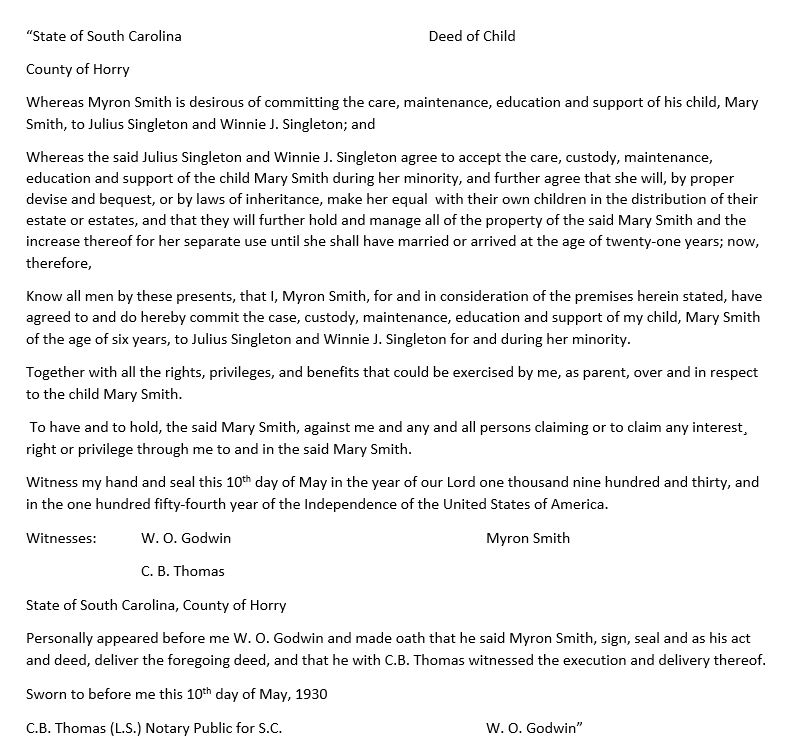
My friend and self-professed “fellow title nerd”, Lacey Higginbotham, who practices in Myrtle Beach, sent to me a “Deed of Child” she found in the Horry County records. The document is dated May 10, 1930, recorded June 3. 1930, and purports to convey a child from a father to another family .
Because the document is difficult to read, I’ll squint for you and set it out here for your reading pleasure:
I can imagine Professor Spitz presenting this document to us as an exam in our first- year property law class. He might ask for us to spot all the issues concerning the enforceability of this document. Thanks, Lacey, for this diversion!









 Let's Talk Dirt