Supreme Court to hear CFPB Constitutionality Challenge

Standard

Seila Law, LLC v. Consumer Financial Protection Bureau likely to be heard by mid-2020

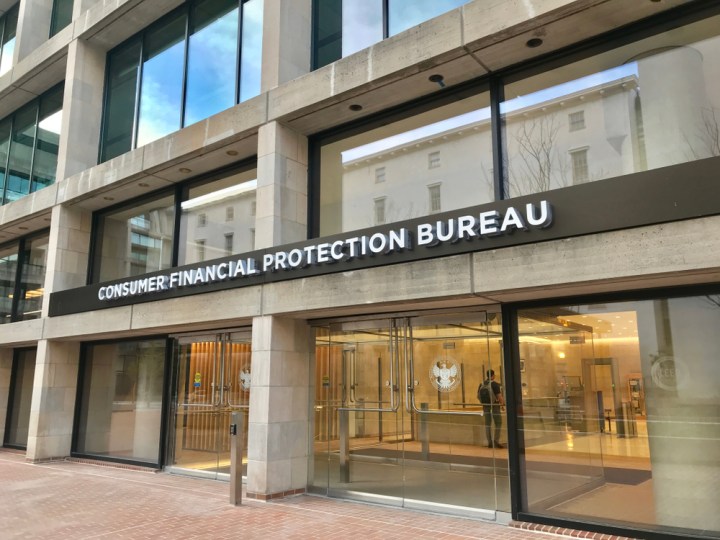
CFPB building

The United States Supreme Court has chosen a case to decide the constitutionality of the CFPB. The case is Seila Law LLC v. Consumer Financial Protection Bureau (U.S. Supreme Court 19-7). The announcement was made on Friday, December 27. The allegation in question is that the structure of the agency grants too much power to its director, in violation of the Constitution’s separation of powers doctrine.

Under the current structure, the director of the CFPB cannot be fired by the president absent “inefficiency, neglect of duty, or malfeasance in office.” The heads of other federal agencies may be removed at the pleasure of the president.

The order posted by the Court requested that both sides address the following question: “If the Consumer Financial Protection Bureau is found unconstitutional on the basis of separation of powers, can 12 U.S.C §5491(c)(3) be severed from the Dodd-Frank Act?”

The United States House of Representatives’ motion to file an amicus curiae brief because the Department of Justice has chosen not to defend the constitutionality of the agency.

Concern about the structure of the agency has been voiced since its inception based on the fact that such huge power has been placed in the hands of one individual director. The argument continues that the CFPB has more power than any agency ever created by Congress. While most federal agencies are controlled by commissions or by a director who serves at the pleasure of the President, the CFPB’s sole director is removable only for cause. Also, since all of the funding of the agency is not controlled by Congress, there is little legislative oversight.

In previous hearings, when the CFPB has been asked what the appropriate remedy should be if the structure of the agency is held to be unconstitutional, the CFPB has maintained that formative statute would have to be amended to allow the President to remove the director with or without cause.  Some have suggested that all of the actions of the CFPB might be suspect if its structure is held unconstitutional. Others have suggested that agency should be headed by a multi-person, bi-partisan commission rather than a single director for greater transparency and accountability.

If a decision in the case is announced in mid-2020, the presidential election could be affected since Sen. Elizabeth Warren’s role in creating the agency is a central pillar of her presidential bid.

Justice Brett Kavanaugh has made clear in a previous dissent that he believes the structure of the agency is unconstitutional.

SC Supreme Court may have eradicated HOA foreclosures

Standard

Third party bid was held grossly inadequate

gavel house

On December 18, the South Carolina Supreme Court decided a case that will force homeowners’ association attorneys to carefully consider whether they will initiate foreclosure actions in the future*. This blog discussed the Court of Appeals case last April. You can read that blog here but the very short version is that the Court of Appeals did not upset any apple carts and left the foreclosure process status quo.

The facts are simple. Mr. and Mrs. Hale bought their home in Richland County in 1998 for $104,250. In the next 20+ years, they built up $60,000 in equity, and the property now has a fair market value of $128,000.

In 2011, the Hales fell behind on their homeowners’ association payments. The HOA initiated a foreclosure complaint seeking a sale of the property in exchange for $566.41 in principal and interest. The Hales defaulted.

Interestingly, after the affidavit of default was filed, the HOA sent the Hales a bill for $250, which they paid. Also interestingly, the law firm representing the HOA sent the Hales a notice that the lien had been satisfied.

Three months after the HOA filed the affidavit of default, the Master entered a default judgment, calculating the amount due to the HOA as $2,898.67, comprised of $250 in principal, $80.87 in interest, $542.80 in litigation costs and $2,025 in attorneys’ fees. The property was sold at auction two weeks later to a third party, Regime Solutions, LLC.

This is the Hale’s explanation of the facts in their motion to vacate the sale:

“When we were served with the lawsuit to take away our home, I put the papers in a drawer and forgot about them. Some time after that, we received a bill from the HOA asking for the $250.00. I paid that without a problem. In November, we received a letter from the law firm of (the HOA) telling us that the Lien had been Satisfied…I thought that everything was OK after that. The next thing I know, someone is knocking on my door telling me that they bought my home and that me and my family were being evicted.”

The Master denied the Hales’ motion and adopted the position that the “effective sales price” was $69,040, consisting of the successful bid plus the balance of the mortgage. In his order, Richland County’s Master-in-Equity, Joseph Strickland, stated that “the practice of homeowners’ association foreclosures would effectively be eradicated if (the Hale’s) position came to bear.”

The appeal was handled by the law office of my friend, Brian Boger, a Columbia lawyer and well-known champion of consumers’ rights. The appeal argued that the $3,036 bid “shocked the conscience” and violated equitable principles.

The Court of Appeals affirmed.  Chief Justice Lockemy dissented, saying:

“A buyer at a judicial sale in which a senior lienholder is not a party takes the property subject to that lien, but the buyer is not responsible for its payment. The evidence in this cases shows (the Hales) have continued to pay the mortgage for a home for which they have no title because they will suffer the severe consequences of default if they do not. The buyer (Regime) has paid nothing. I do not believe it proper to give a judicial sale buyer credit for assuming a debt which is not legally required to pay.”

The Supreme Court seemed truly troubled by Regime’s business model. In a footnote, the Court stated that Regime either allows the senior mortgagee to (re)foreclose on the property or quitclaims the property to the original homeowners for a hefty fee. The Court seemed to be disturbed by Regime’s failure to assume mortgages in the ordinary course of its business.

The Court discussed two methods to calculate whether a bid price is so grossly inadequate as to shock the conscience. The debt method is a ratio comparing the total debt on the property to the fair market value. Under the debt method, Regime would have paid 53.9% of the value of the property. The equity method is a ratio comparing the winning bid price to the equity in the property. Under the equity method, Regime would have paid 4.9% of the value of the property.

The Court stated that our courts have not established a bright-line rule for what percentage “shocks the conscience”, but that a search of our jurisprudence reveals our courts have consistently held a price below ten percent definitely does.

The Court stated that when the foreclosure purchaser assumes the mortgage, the debt method should be used. But the court rejected the blind application of the debt method because of the facts in this case. Under these facts, the Court stated, applying the equity method is the only logical option.

The Court expressed concern about the foreclosure proceeding itself, stating that it morphed in to “a proxy to capitalize on a small debt”. The Court said it was especially troubled by Regime’s participation in a foreclosure proceeding to accommodate its business model of leveraging a nominal debt to secure an exorbitant return from homeowners who fear the prospect of an eviction. The Court said, “We do not countenance the improper use of foreclosure proceedings by the HOA, its attorney or Regime.”

The decision should not be read as a shift toward providing relief to homeowners despite their own poor choices, according to the Court. The Court said the case would have turned out very differently if the HOA and Regime had pursued “foreclosure in the normal course and made affirmative efforts to assume the Hales’ mortgage”. And that under the “unique facts of this case”, the Hales have demonstrated Regime’s bid was grossly inadequate.

I am quite sure my foreclosure lawyer friends are deciding how to change their practices in light of this case. I’m not sure the Court is correct about the normal course of foreclosures. I also doubt that the facts in this case are unique.

Justice Beatty concurred in a separate opinion, stating that he would adopt the equity method generally. That approach would certainly provide more clarity. Justice Beatty also said, “homeownership is the quintessential American dream. Purchasing a home is the largest investment that most South Carolinians will make. To allow the hard-earned equity to be confiscated by a bidder’s minimal investment is unconscionable. This is especially troubling when the foreclosure sale is the result of an HOA lien.”

For many reasons, I am glad today that I am not a foreclosure lawyer!

*Winrose Homeowners’ Association, Inc. v. Hale, South Carolina Supreme Court Opinion 27934 (December 18, , 2019).

Eighth Circuit Court ruling makes loans disappear

Standard

The decision could make significant changes in the secondary market

foreclosure

I refer you to this article from Bloomberg that led me to read the Eighth Circuit Court of Appeals case decided last month, CityMortgage, Inc. v. Equity Bank, N.A.*.

In South Carolina and most other states, the bank has the power to pursue the borrower personally if it can’t sell the property that is subject to a mortgage for the full amount of the loan after a foreclosure. There are a handful of “non-recourse” states where it is not possible to pursue the borrower personally. But this case was decided under Missouri law, and Missouri is not one of those unusual states.

The article makes a point that’s news to me: non-recourse mortgages are standard in most countries other than the United States.

The case involved a repurchase demand under an agreement between CityMortgage and Equity Bank. Twelve loans were involved, six that had been foreclosed and six that had not. The surprising ruling relates to the six mortgage foreclosures. The Eighth Circuit affirmed the lower court, which had held that the six loans that had been foreclosed no longer existed.

The dissent got it right, however, by stating that the loans were not “liquidated” or “extinguished” by the mortgage foreclosures. The dissent states the obvious: a mortgage is a security interest in real property that serves as collateral for the borrower’s loan. When the mortgage is foreclosed, the underlying promissory note survives and the borrower continues to be liable for the resulting deficiency (absent further action such as a new agreement or a discharge in bankruptcy.)

The article correctly states that the Eighth Circuit transformed recourse loans into non-recourse loans by its ruling. The article also states that non-recourse loans may lead to higher interest rates and larger swings in housing prices.  Purchasers on the secondary market won’t pay as much for non-recourse loans, and, for that reason, this case could have a significant impact on the secondary market if other circuits follow the lead of the Eighth Circuit.

* No. 18-1312 (8th Cir. 2019)

Motley Fool: “Zillow Plans to Do to Real Estate What Amazon Did to Retailing”

Standard

Zillow Offers is not available in South Carolina yet, but it may be a matter of time

zillow logo magnified

This blog has promised to keep South Carolina dirt lawyers informed about the growing phenomenon of home “iBuying”. Please take a look at two recent articles from Motley Fool linked here.

One of the articles, entitled “Zillow Plans to Do to Real Estate What Amazon Did to Retailing”, indicates Zillow is aggressively taking on the neighborhood real estate broker. The other article, entitled “Why Zillow Wants to Pay More for Homes” indicates iBuying is a scale game, meaning the number of homeowners who accept Zillow’s offer increases dramatically with relatively small increases in price.

Zillow has been planning for this game for years. It already has a massive amount of traffic on its site and has accumulated an enormous amount of data. Go take a quick look at the data Zillow is showing about your own home!

To date, according to Motley Fool, Zillow faces intense competition from Opendoor, which leads the iBuying industry, already serving more than 40,000 customers. But Zillow is working hard to catch up. Opendoor operates in 21 markets. Zillow is in 17 of those markets, four additional markets, and plans to open in five more by the middle of 2020.

In early 2017, Zillow dipped its toe into the process of selling homes by launching a product it called “Instant Offers”. The product was initially tested in Las Vegas and Orlando and was described as a method for homeowners to sell their homes for a discounted price without the traditional complications of repairing, listing, staging and allowing for open houses.

The process started with a homeowner providing basic information via Internet about the home (square footage, number of bedrooms and bathrooms, and remodeling information) and uploading photos. The Zillow product then connected the homeowner with investors who buy homes in the area, and, typically, an all-cash offer was made by one or more of the investors. The homeowner paid no fee for the service and was not obligated to accept any offers. Zillow touted the product as a method to alleviate the seller’s stress and to allow the seller to close in a shorter time frame.

Other companies, Opendoor and Offerpad were already operating in this space at the time of the Zillow launch. The launch was called another example of technology disrupting the process of closing real estate transactions.

Real estate agents, of course, met the news with alarm. They said sellers would be suckered into making mistakes that might cost them the education of their kids, vacations or just the ability to sleep better at night because they have more money in their bank accounts. An online petition was initiated, asking the National Association of Realtors to threaten Zillow with being removed from access to listings. The NAR responded that it could not sponsor or encourage such a boycott.

Zillow has always stated publicly that it is not in the business of getting rid of real estate agents. Its executives called Zillow a media company, not a real estate company, and said it sold ads, not real estate. Even the Instant Offers program encouraged sellers to use a realtor even while avoiding the traditional listing and sales process. The question then became the amount of commission the real estate agent would earn for reduced services. When real estate agents initially complained about Instant Offers, Zillow responded that 70% of its revenue came from working with real estate agents.

In early 2018, however, Zillow announced that it would begin buying homes directly from sellers and then turning around and selling them. With this announcement, Zillow began selling ads and houses. Two test markets were announced, Las Vegas and Phoenix. Zillow said that when it buys homes, it will make the necessary repairs and updates and list the homes as quickly as possible. Zillow said local real estate agents would represent Zillow in the transactions. Zillow also announced in a press release that the vast majority of sellers who requested an Instant Offer ended up selling their homes with agents.

So far, nothing is in the works for South Carolina as far as we know, but since it is just next door in Atlanta and Charlotte, how long can it be?

Stay tuned for more news on this topic. Real estate lawyers will need to figure out how to remain in the game whether properties are sold through the Internet or not!

This scam hits home!

Standard

Two fugitives arrested in Murrells Inlet

One smart agent avoided involvement by placing a temporary block on her trust account

Warren and Frances Berkle

WBTW TV News 13 in Myrtle Beach reported on November 22 that two fugitives were arrested in Murrells Inlet. Warren Berkle and Frances Berkle were reported to have been wanted in several states at the time of their arrest.

According to the report, the Berkles had been living under false names and living in a house in Murrells Inlet in connection with a lease to purchase arrangement. Police said they received a call from the homeowner who said she had gone through an eviction process because the two were behind in their payments. She said she was concerned that they were not who they said they were, and were possibly squatting in her house.

WBTW reported that Warren Berkle was stopped by police when he was leaving the neighborhood. He had an expired Florida license plate, no insurance, and a driver’s license that was not in his name. A background check indicated Berkle had a valid license in Maryland and was wanted for extradition. A check on Frances Berkle indicated she was wanted in Florida and Pennsylvania.

Horry County police charged Warren Berkle with forgery and obtaining a signature or property under false pretenses, among other offenses. Frances Berkle was being held without bail as a fugitive.

Warren Berkle had pleaded guilty in 1992 to conspiracy to sell worthless insurance policies and mail fraud, a multimillion-dollar scam. According to an article in the Baltimore Sun, prosecutors said around 800 insurance policies were sold and premiums were collected using false records and without licenses.

Our very astute agent had been contacted by Warren Berkle numerous times, seeking to wire funds into her trust account to accommodate a real estate transaction. Our agent had “such a bad feeling” about Mr. Berkle that she put a block on her trust account just a short time before he tried to wire funds into her account. This occurred after she told him she was not going to be able to work with him.  She said he seemed so insistent and so evasive when she asked questions that she could not trust him to do business with him.

We are so glad her fraud radar was working so well! She paid attention to clues that saved her from a disaster in her trust account!

A blog for Thanksgiving Week

Standard

The top ten things this dirt lawyer is thankful for professionally…

give thanks smaller

As a happy United Methodist (by virtue of my marriage almost 40 years ago to a P.K.* who refused to be baptized again at a Baptist church) I believe an attitude of thankfulness makes life better.

Our office recently started following author John Fisher’s** lead by starting every business meeting with a positive focus. We circle the table and express one thing we are thankful for either personally or professionally. It’s amazing how much better this exercise makes us feel about the business we are about to discuss.

So, professionally, here are the top ten things for which I’ll give thanks this Thursday:

  1. We live and work in a state where closing real estate transactions is the practice of law and where, by hard work and vigilance, we are in a position to protect the interests of our clients.
  2. We help our consumer clients achieve one of their biggest dreams, home ownership.
  3. We help our commercial clients purchase, lease, finance and refinance properties. These activities allow our clients to make money and allow our communities to thrive.
  4. We don’t ignore title problems. We find them, discuss them, cure them, obtain insurance over them, and, hopefully, make them better for the property owner and lender, and for the next lawyer.
  5. If things go well, everyone involved in the closing is “happy”.
  6. We generally, as a community of real estate lawyers, seek to get along with each other. (Don’t make me point out exceptions to this rule!) Older lawyers mentor younger lawyers. Lawyers ask each other for guidance and, generally, that guidance is given with a smile. We train lawyers and paralegals, we serve on committees, we speak at seminars, write papers and books, participate in the Bar’s and the law schools’ mentorship programs and handle pro bono matters. As lawyers, we try to be good citizens.
  7. Those of us who weathered the financial downturn that began in 2007 encourage those of us who have not that there is life on the other side.
  8. Technology has made our lives easier in the last few years, and improvements in technology will continue to make our lives easier.
  9. I am thankful for the team of dedicated professionals who work with me to take the best care possible of our title insurance agents (dirt lawyers and their staff members.)
  10. I am thankful for our network of attorney agents who ably handle real estate matters throughout the Palmetto State.


I know. I know. Many of you are shaking your heads and pointing out that I no longer work “in the trenches” and don’t see the problems that plague real estate lawyers in the form of the constantly changing environment, changing technologies, difficulties in hiring and retaining staff members, increased competition and encroachment into “our” part of the closing by third parties.  I do see those difficulties, I am sympathetic, and my team and I are constantly seeking improvements.

But, for Thanksgiving week, let’s pause for just a moment to be thankful!


*I’m guessing most South Carolinians know what a P.K. is, but, just in case you don’t, it’s an acronym for Preacher’s Kid, which I am told means the worst kid in church. My husband tells two stories to demonstrate:  (1) His father once spoke to him from the pulpit and threatened to have him sit with him during the sermon if he didn’t behave; and (2) There are unconfirmed rumors that my husband’s initials have been carved in various church pews across South Carolina.

**John Fisher is a New York medical malpractice attorney who has written two excellent books, The Power of a System and The Law Firm of Your Dreams. I am a huge fan of creating systems in law firms and highly recommend these books, even for dirt lawyers….make that especially for dirt lawyers.

A sign of the times?

Standard

Zillow begins to market title and escrow services

welcome to the future sign

A November 12 article in the “Title Report” states that Zillow has begun testing its own title and escrow services in a handful of markets.

After making significant strides in revenues in the third quarter, Zillow is testing the waters in our arena. But, thankfully, we aren’t yet seeing these activities in South Carolina. Zillow had previously used third party title and escrow agents for its transactions. It continues to use third parties in most markets.

A Zillow spokesman told the “Title Report”, “We are also building title and escrow services in-house as a part of our long-term goal of delivering a true, seamless, end-to-end transaction experience for consumers.”

Zillow told the Title Report that more than 80,000 homeowners requested offers in the third quarter. It purchased nearly 2,300 homes and sold more than 1,200 homes in the same time frame. The spokesman said the company believes these results demonstrate that the business model to mechanize real estate transactions is gaining traction as consumer demand reveals people want an easier way to buy, sell, rent and finance homes.

stay tuned

This blog has previously suggested that the role of the local real estate agent may change to assisting sellers in analyzing the various offers they receive from iBuyers plus managing inspections and other steps in the real estate closing channel. As long as closings remain the practice of law in this state, our local dirt lawyers will remain involved in the closing process.

We promise to keep you informed of developments! Watch this space.

What’s first: flying cars or instant home ownership?

Standard

flying car

This headline is blatantly stolen from this article that I recommend for your reading pleasure. This blog, written weekly since late 2014, has two goals: (1) to keep South Carolina real estate lawyers out of trouble; and (2) to keep South Carolina real estate lawyers in business. This article, about the future of home ownership, is recommended to advance the second goal.

Julian Hebron, the author of this article, is the founder of The Basis Point, a sales and strategy consulting business for consumer finance and real estate companies. He has extensive experience in real estate, lending and financial services. Investopedia touts itself as the world’s leading source of financial content on the web. Investopedia commissioned Julian Hebron to explore what home buying, improving and selling will look like in the next twenty year, and he said he jumped at the chance.

The article describes a vision of home buying for consumers in the future:

  • Pull out your phone and search for homes.
  • View homes using full 3-D modeling and video so you can truly “tour” the home right on your phone.
  • See every specification about the home, neighborhood, schools, restaurants, crime, taxes, etc.
  • Tag the homes you like to stay organized.
  • Get notified over time on sales and price changes of homes.
  • Make an offer on a home by pushing a button.
  • Avoid long appraisal process because the home’s value is verified by date and 3-D modeling/video, and this automated valuation method is accepted by all lenders.
  • Close on the home instantly because your loan is always approved via your secure blockchain wallet with realtime income, asset, debt, and credit score data. All you do is schedule licensed and reviewed local movers and contractors to facilitate your move.
  • Schedule moving day food delivery from recommended restaurants in your neighborhood.

And here is the description of home selling in the future:

  • Fill out a short form on your phone saying you’d like to sell your home.
  • Receive a home purchase offer in 1-2 days, and close in as little as seven days.
  • Or shop and hire a licensed and reviewed local realtor to list your home if you don’t like the instant offer.
  • Get asked if you’re purchasing a new home, and, if so, get prompted to follow the home buying steps above.

How close are we to this vision? The author isn’t sure but plans to write future installments to dig deeper into each player in the vision.

Can we stay in the market if this vision comes true? 

I believe we can. I believe our closing law firms should establish strong systems to document processes and keep them current in an effort to be able to nimbly adjust to the changing market. I believe we should stay on top of changes in technology because technology will certainly be a huge driver in these changes. I believe we should continue to establish strong relationships with the players in the real estate industry, particularly the real estate agents. We will all be fighting for business as the market changes, and keeping current on the available information and the current players will be vital to remaining in the game.

This blog will continue to provide South Carolina real estate lawyers with current information to support these efforts. Watch this space!

SC Supreme Court rule change affects every lawyer with a trust account

Standard

Make one simple change to stay in compliance

change ahead sign

On October 23, our Supreme Court implemented several changes to the South Carolina Appellate Court Rules dealing with lawyer and judicial disciplinary rules enforcement procedures. If things go well in our respective practices, most of us will never have to study the rule changes.

But one change affects every lawyer with a trust account.

Rule 1.15(h) of the Rules of Professional Conduct has been amended to state that every lawyer maintaining a trust account must file a written directive requiring his or her financial institution to report to the Office of Disciplinary Counsel, rather than to the Commission on Lawyer Conduct, when any properly payable instrument is presented for payment against insufficient funds.

In other words, NSF checks must now be reported by your bank to the ODC.

The Court recognized in a footnote that these written directives will take time to update and that lawyers whose written directives currently require reporting to the Commission on Lawyer Conduct are not in violation of the rule. The Court stated that lawyers should update these directives at their earliest convenience.

Most dirt lawyers pay close attention to detail, and I would recommend paying attention to this one sooner rather than later.

SC DOR announces implementation of tax lien registry as of Nov. 1

Standard

Nov 1 smaller

SC tax liens will no longer be filed in individual Counties

This blog previously discussed tax lien legislation effective March 28, 2019 that will change the way titles are examined in South Carolina. The South Carolina Department of Revenue has announced that the change will be effective November 1.

The announcement indicates the statewide tax lien registry will have a similar look and feel to the Mississippi Department of Revenue Lien Registry, which can be accessed here.

The legislation, an amendment to South Carolina Code §12-54-122, is intended to allow the Department of Revenue (DOR) to implement a statewide system of filing and indexing tax liens centrally, that is, “accessible to the public over the internet or through other means”. Once the new system in in place, the clerks of court and registers of deeds will be relieved of their statutory obligation to maintain newly filed tax liens.

The new law states that it is not to be construed as extending the effectiveness of a tax lien beyond ten years from the filing date, as set out in South Carolina Code §12-54-120.

When the new system is implemented, the law requires a notice to be posted in each county where liens are generally filed providing instructions on how to access the DOR’s tax lien database.

We will keep you posted as more details become available. Title insurance company underwriters will certainly weigh in on this issue.