
The Power of a System

Standard

How to build the law practice of your dreams
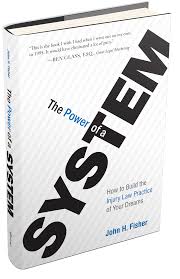
power of a systemReaders of this blog know it includes a random book report from time to time, and this is one of those times. I read John H. Fisher’s The Power of a System; How to Build the Injury Law Practice of Your Dreams last summer and I have bought it for more than one real estate practitioner. Today, I recommend it as excellent reading for the readers of this blog.

At the beginning of his medical malpractice firm, Fisher wished for a step-by-step manual for running a profitable practice because, like the rest of us, he was not taught strategic planning, goal setting, business metrics, managing employees, managing clients and marketing in law school.

The author has developed that manual for a personal injury law firm, not just technical systems for running a business, but also the managerial and entrepreneurial principles to keep a constant stream of new cases and clients coming down the pipe.

The three parts of the book, The Technician, The Manager and the Entrepreneur, are based on Michael E. Gerber’s classic book, The E-Myth Revisited, another favorite of mine for law firm management. Gerber’s message is that every lawyer should set aside time each day to work on the business through strategic thinking instead of only spending time working in the business through technical legal work. Fisher’s book provides systems for all three roles the law firm owner must play.

Mr. Fisher provides us with a glimpse into his daily work life through his office rules. Those rules are based on the theory that staff members should handle every aspect of a practice that don’t absolutely have to be handled by the attorney. In the residential real estate practice, the functions the attorney must handle would include the closing, the second review of title, and the resolution of legal issues that arise in connection with conflicts, title and closing. Rules in a residential practice would be in writing and would make it clear that staff members are responsible for keeping attorney time free to touch those matters that only the attorney can handle.

The author’s rules deal with dress code, internet use, cell phone use, personal errands and timeliness, how to avoid interruptions and completing assignments. He has “scripts” in place for handling telephone calls, and insists on answering the phone with a smile. My favorite is his “no-gossip rule”. His rules are robust and demanding. But putting those guidelines in practice and enforcing them would ease day-to-day conflicts and stresses that arise among staff members.

This law firm outsources manual tasks by using companies such as Elance.com (now Upwork.com), Your Man in India (YMII) and Brickwork. The author believes that outsourcing has allowed his business to become a 24 hour/day law firm.

Fisher’s emphasizes treating new clients with “shock and awe” to demonstrate that he “shows up like no one else”. His package includes his book The Seven Deadly Mistakes of Malpractice Victims. Each book is personalized and signed, for example, “Dear Mary”. The package also includes audio informational CDs and a binder of office policies including a “Client Bill of Rights”. Each client should understand communicating with his or her lawyer from the outset of the relationship.

Mr. Fisher believes in setting goals and measuring everything. Measuring law suit time frames reduces costs and increases profitability. Real estate lawyers should set goals and measure time frames for closings. By measuring time frames for title work, surveys, termite letters, receipt of closing numbers, receipt of lender closing packages, commitment preparation, closing document preparation, recording, disbursement, satisfactions and distributing final documents, a real estate practitioner would ascertain where systems are routinely bogged down and would be able to work toward fixing those pressure points.

The author believes in marketing to the “ideal client”. While I usually have to translate books like this for real estate practices, Mr. Fisher did the translation for me in this regard. This is his paraphrased message to us:

If you are a real estate lawyer, are your ideal clients the homeowners buying a new house? No! The homeowners will use your services one time for a fee of $750, and you will likely never hear from them again until they buy another home. You will be broke by the time the homeowners need you again. The ideal client for a real estate lawyer is the real estate agent who refers a steady stream of new homeowners. The goal is not to make money on a single transaction. Rather, the goal is to develop relationships with your ideal client that will generate new clients and a steady stream of income for the rest of your career. The lifetime value of your ideal client is far greater than the value of a single transaction.

The book outlines three simple marketing rules that the author says will place a lawyer ahead of 98 percent of the competition:

  1. An informational-powerhouse website that provides killer content on a daily basis;
  2. A monthly newsletter targeted to the ideal client; and
  3. Regular seminars and workshops that provide valuable content to the ideal client.

He gives details on producing the monthly newsletter and establishing regular event marketing in the form of seminars and workshops.

We could all use an entire school-year class in law office management including each aspect of the work Mr. Fisher emphasizes. Since that class doesn’t seem to exist, I will do my best to obtain and communicate the information dirt lawyers need in this regard. As a favorite political pundit routinely says, “watch this space.”

Nat Hardwick sentenced to 15 years

Standard

Nat HardwickThis blog discussed Nat Hardwick, a name familiar to many South Carolina real estate lawyers, last fall when he was convicted of embezzling more than $25 million from his former companies, including his former law firm, Morris Hardwick Schneider. Last week, he was sentenced to 15 years in prison. His co-conspirator and controller, Asha Maurya, was sentenced to seven years after she cooperated with the government.

Nathan E. Hardwick IV, 53, described himself as the face of Morris Hardwick Schneider, an Atlanta residential real estate and foreclosure firm that grew into sixteen states, including South Carolina. The firm once had more than 800 employees and boasted of offices in Charleston, Hilton Head, Columbia and Greenville.

On October 12, Hardwick was convicted in federal court in Atlanta of 21 counts of wire fraud, one count of conspiracy to commit wire fraud, and one count of making false statements to a federally insured financial institution. In federal court, sentencing is typically delayed, and the convicted person is released and allowed to get his affairs in order. In this case, however, Hardwick had been released pending trial on bond. After his conviction, he was described by the U.S. Attorney who prosecuted him as a flight risk and was handcuffed and taken to jail immediately.

This story hits close to home. My company was one of the victims of the crimes.

The prosecutor described an extravagant lifestyle that Hardwick enjoyed at the expense of others. The case was said to be particularly troubling because the illegal activity was orchestrated by a lawyer who swore an oath to uphold the law and represent his clients with integrity. The U.S. Attorney said he hoped the case sent the message that the FBI and the U.S. Attorney’s office will not tolerate this type of white-collar crime.

According to the evidence, from January 2011 through August 2014, Hardwick stole more than $26 million from his law firm’s accounts, including its trust accounts, to pay his personal debts and expenses. The firm’s audited financial statements showed that the firm’s net income from 2011 through 2013 was approximately $10 million. During that time, according to the evidence, Hardwick took more than $20 million from firm accounts.

Asha Maurya, who managed the firm’s accounting operations, reached an agreement last May with the U.S. Attorney’s office and pled guilty. She was expected to testify at the trial, but was unexpectedly not called as a witness.

Hardwick did take the stand in his defense and attempted to blame Maurya with the theft. He said that he trusted her to his detriment, that he was entitled to the funds, and that he was unaware that the funds were wired from trust accounts. Hardwick testified for more than a day and explained that he believed Maurya followed proper law firm procedures.

On the stand, Hardwick, described as the consummate salesman, said that he gave his cellphone number to almost everyone. He said he returned calls and messages within a few hours and instructed his employees to do the same. He apparently believed himself to be a master in marketing and customer service and prided himself in focusing on the firm’s expansion strategy. He hoped to expand to all fifty states and make money through a public stock offering.

With his ill-gotten gains, Hardwick bought expensive property, made a $186,000 deposit for a party on a private island, spent $635,000 to take his golfing friends to attend the British Open in 2014, paid off bookies, alimony obligations, and sent more than $5.9 million to various casinos, all according to trial evidence. Hardwick’s activities lead to the loss of his law license and the bankruptcy of his firm.

Forgive me for repeating myself

Standard

But practitioners really need to read The Lean Law Firm

In October, this blog discussed a book I had just read,  the 2018 ABA Law Practice Division book, The Lean Law Firm, How to run your firm like the world’s most efficient and profitable businesses.  Now that I have attended a South Carolina Bar seminar by the authors, I am even more convinced that the methodology this book embraces is exactly what residential real estate practitioners need to adopt to assist them in reducing stress and growing value in their practices.

lean law firm4

One of the authors is Columbia consumer lawyer Dave Maxfield, who happens to be the brother-in-law of my co-worker, Dorothy Boudreaux. The other lawyer, Larry Port, is CEO of Rocket Matter, the cloud based legal practice management software company. The January 31 seminar made an impactful initial point: most law firms are in survival mode. They won’t progress unless the lawyers step back and take a look at the business to gain perspective.

What is a lean law firm?  In the words of Larry Port, being lean is not about cost cutting. “It’s more about creating systems and then finding the constraints and inefficiencies that impede them. Lean lawyers believe in measurement, reducing waste, and producing as much value as they can for their clients. And more than anything else, Lean is about experimentation and continuous improvement.” The processes set out in this book are intended to teach lawyers how to increase their income while they are reducing their stress.

Unfortunately, most lawyers have little or no awareness of the value of creating systems. We are not taught to run businesses in law school. The lawyers I know and love are so busy practicing law that they don’t take the time to modernize, to focus on processes, and to create the systems that will allow them to run their firms like efficient and profitable businesses.

Wouldn’t your closing process be improved if you were able to figure out and reduce or eliminate those matters that cause delay? I was in an office recently and noticed a great deal of foot traffic by staff members. I asked where everyone was heading and was told they were all probably looking for files. Wouldn’t that office’s process be improved by using closing software that makes every file constantly available to every person involved in the closing? I was in another firm with multiple branches and learned one branch had templates for the title work for each subdivision, but the other branches didn’t have access to the templates. Sometimes, just stepping back to take a look will reveal small tweaks that can vastly improve systems.

One of my favorite suggestions from the book is the use of Kanban boards, a project management tool used to visually depict work at various stages. The simplest Kanban boards would have three columns: “to-do”, “doing” and “done”. A Kanban board for a residential closing office might have these columns:  “file opening”, “pre-closing”, “title”, “document preparation”, “closing”, “recording”, “disbursement” and “post-closing”. Each closing would be depicted in the appropriate column. By paying attention to this workflow tool, a closing attorney would learn quickly where work bottlenecks, and improvements could be made efficiently.

I believe the advice I once heard:  every time you touch a closing file after the closing, you lose money. A Kanban board might reveal whether reducing the numbers of post-closing touches in your office would increase the income from each closing.

Does the book sound like dry reading to you? It is not that at all. In fact, it is the first book published by the ABA to employ the graphic novel approach. It is written in the form of a story about Gray Law Firm, a small struggling firm, it’s newly-hired, former big law lawyer, Carson Wright, who wants to help  “fix” the law firm, and Carson’s friend, Guy Chaplin, who runs an extremely successful racing bicycle manufacturing and distribution company.  Guy slowly teaches Carson the business principles that make his company successful. And Guy helps Carson figure out how to apply those principles to his law firm.

I have to warn you that the book contains a lot of math. I am not a math scholar by any stretch of the imagination, and I was able to follow the formulas and to see how they would work well in a law firm that handles real estate, especially residential real estate. In fact, my only complaint about this book is that it is not geared specifically to real estate practitioners.

The book gives very specific advice about the basics of management, standardization, written procedures, checklists, marketing, goal setting and technology. A South Carolina real estate lawyer might find that some of the advice doesn’t apply, but I’m betting that most of it does apply, and I am encouraging everyone to order a copy of this book at www.ShopABA.org and to take its advice to heart.

I am now in the process of twisting Dave’s arm to translate “Lean” to residential real estate. If I am successful, I will certainly share his wisdom with my friends who practice residential real estate in South Carolina who are probably battling survival mode as they read this.

Here’s a new word to add to your vocabulary: “surban”

Standard
downtown-reston-virginia-

Reston Town Center, Virginia

A new term has been coined and trademarked by John Burns Real Estate Consulting, a company that provides research and consulting services relating to the housing market. The term is “surban”, and it is defined as “a suburban area that has the feel of urban, with walkability to great retail from a house or apartment.”

Even though the company trademarked the term, its website indicates everyone has permission to use the word without the trademark. The company just wanted credit for coining the phrase. I don’t see any examples in South Carolina from a list compiled by the company, not any in the South, for that matter.

Millennials are apparently the impetus for the new term as they look for a compromise between city living and suburban space. They typically enjoy the choices of the city: restaurants, bars, shops music, ball games and movies. But when they start pairing up and having children, they, like their predecessors, began seeking more room and lower housing costs. Not only are millennials raising families, they are often saddled with student loan debt and unable to afford the costs of city living. But they don’t want the strip malls and chain restaurants of the suburbs.

The compromise? A blended type of neighborhood that combines the energy and walkability of the city with the space and affordability of the suburbs. Millennials want pubs, microbreweries and nice restaurants. They want retail shopping, but not the big box variety. They prefer boutiques with unique choices.

Examples of surban areas, according to John Burns Real Estate Consulting, include:

  • Reston Town Center in Washington, DC, suburb of Reston, Virginia
  • Downtown Naperville, Illinois, in the suburbs of Chicago
  • Old Town Pasadena, California, in the suburbs of Los Angeles
  • A-Town in Anaheim, California, in a neighborhood around the Angels Major League Baseball park
  • Legacy Town Center in Plano, Texas, in the suburbs of Dallas
  • Santana Row in San Jose, California
  • City Centre in Houston, Texas
  • Downtown Tempe, Arizona, in the suburbs of Phoenix
  • Larkspur, California, north of San Francisco
  • Geneva, Illinois, in the suburbs of Chicago

Maybe there are examples in Atlanta, Charlotte, or even Charleston, Greenville or Columbia. Let me know if you know of any!

Have you heard about “Zillow Offers”?

Standard

It’s not available in South Carolina yet, but it may be a matter of time

zillow-logo

In early 2017, Zillow tipped its toe into the process of selling homes by launching a product it called “Instant Offers”. The product was initially tested in Las Vegas and Orlando and was described as a method for homeowners to sell their homes for a discounted price without the traditional complications of repairing, listing, staging and allowing for open houses.

The process started with a homeowner providing basic information via Internet about the home (square footage, number of bedrooms and bathrooms, and remodeling information) and uploading photos. The Zillow product then connected the homeowner with investors who buy homes in the area, and, typically, an all-cash offer was made by one or more of the investors. The homeowner paid no fee for the service and was not obligated to accept any offers. Zillow touted the product as a method to alleviate the seller’s stress and to allow the seller to close in a shorter timeframe.

Other companies, OpenDoor and OfferPad were already operating in this space at the time of the Zillow launch. The launch was called another example of technology disrupting the process of closing real estate transactions.

Real estate agents, of course, met the news with alarm. They said sellers would be suckered into making mistakes that might cost them the education of their kids, vacations or just the ability to sleep better at night because they have more money in their bank accounts. An online petition was initiated, asking the National Association of Realtors to threaten Zillow with being removed from access to listings. The NAR responded that it could not sponsor or encourage such a boycott.

Zillow has always stated publicly that it is not in the business of getting rid of real estate agents. Its executives called Zillow a media company, not a real estate company, and said it sold ads, not real estate. Even the Instant Offers program encouraged sellers to use a realtor even while avoiding the traditional listing and sales process. The question then became the amount of commission the real estate agent would earn for reduced services. When real estate agents initially complained about Instant Offers, Zillow responded that 70% of its revenue came from working with real estate agents.

In early 2018, however, Zillow announced that it would begin buying homes directly from sellers and then turning around and selling them. With this announcement, Zillow began selling ads and houses. Two test markets were announced, Las Vegas and Phoenix. Zillow said that when it buys homes, it will make the necessary repairs and updates and list the homes as quickly as possible. Zillow said local real estate agents would represent Zillow in the transactions. Zillow also announced in a press release that the vast majority of sellers who requested an Instant Offer ended up selling their homes with agents.

The program was later launched in several other markets, Phoenix, Atlanta, Denver and Charlotte. And last week, Zillow announced that it would be expanding to Miami, Minneapolis-St. Paul, Nashville, Orlando and Portland in 2019. So far, nothing is in the works for South Carolina as far as we know, but I did get a kick out of one article that referred to one of the markets as “Charlotte, South Carolina”.

Stay tuned for more news on this topic. Real estate lawyers will need to figure out how to remain in the game whether properties are sold through the Internet or not!

We have a new attorney preference case

Standard

…and dirt lawyers are not going to like it

The South Carolina Court of Appeals ruled recently in favor of Quicken Loans, Inc. in a foreclosure case where the defendants argued the lender was not entitled to foreclose because it had violated the attorney preference statute during the application process.* My friend and classmate, Special Referee James Martin Harvey, Jr., had granted partial summary judgment in favor of the defendants, and Quicken appealed.

quickenloans-logo-stack

Quicken telephonically takes information for loan applications from borrowers, according to the recited facts. Quicken’s system prompts Quicken’s banker to ask the borrower: “Will the borrower select legal counsel to represent them in this transaction.” If the borrower responds “no”, the attorney preference form is populated to read, “I/We will not use the services of legal counsel.”  No list of acceptable closing attorneys is provided to borrowers who answer “no” to this question, and the file is sent to Quicken’s affiliate company, Title Source, Inc., which acts as settlement agent in the transaction and subcontracts with attorneys to perform the settlement services.

If the borrower answers “yes”, Quicken’s system populates the attorney preference form to read, “Please contact lender with preference.” The system does not allow an attorney’s name to be entered at this stage of the application process.

The borrowers in this case declined legal representation during the initial telephonic application process.

The Court of Appeals indicated the form used by Quicken is identical to the form promulgated by the South Carolina Department of Consumer Affairs (DOCA) except that Quicken’s form is prepopulated with responses. Like the DOCA form, Quicken’s form states, “I/We have been informed by the lender that I (we) have a right to select legal counsel to represent me (us) in all matters in this transaction relating to the closing of the loan.” Unlike the DOCA form, however, Part 1(a) of the Quicken form is prepopulated to read, “I/We will not use the services of legal counsel.”

Under Part 1(b) the Quicken form, like the DOCA form, initially states, “Having been informed of this right, and having no preference, I asked for assistance from the lender and was referred to a list of acceptable attorneys. From that list I select…” Unlike the DOCA form, which provides blank lines to fill in an attorney’s name and the borrower’s signature, the Quicken form is prepopulated with the response, “Not Applicable.”

Quicken produced the affidavit of closing attorney Carlton D. Robinson, who said it was his practice to explain the legal effect of the attorney preference to borrowers and that he would not have closed if the borrowers had expressed any dissatisfaction with having him act as closing attorney.

The Attorney Preference Statute (S.C. Code §37-10-102(a) provides that when the primary purpose of a loan secured by real estate is for personal, family or household purpose, the creditor must ascertain prior to closing the preference of the borrower as to the legal counsel employed to represent the borrower in the closing. The purpose of this statute is to protect consumers.

DOCA filed an Amicus Brief arguing that Quicken had violated the statute. The Court of Appeals held that Quicken complied with the statute because an agent of Quicken asked the borrowers if they would be using preferred legal counsel and only populated the form after the borrowers responded that they did not have counsel of preference. Quicken sent the form to the borrowers, who signed and returned it without asking further questions.

Will the Supreme Court agree with the Court of Appeals given the opportunity? My guess that the current Justices will agree. My guess would have been different before the retirement of Chief Justice Jean Toal. Will the legislature tighten the language of the statute? That is always a possibility, but we have heard nothing on that front to date. I hate to be the bearer of such bad news for South Carolina real estate practitioners.

*Quicken Loans, Inc. v. Wilson, South Carolina Court of Appeals Opinion No. 5613, January 9, 2019.

Happy New Year!

Standard

Let’s make 2019 a great year!

2019 Happy New Year small

2018 has been a difficult year for our work family here in Columbia. Almost every person in our office suffered a personal loss or a difficult illness of a family member during the year. We have supported each other to the extent a work family can provide support, and we have collectively decided to turn the corner and to make 2019 our year. We invite you to join us in that resolution.

Abraham Lincoln said, “Most folks are as happy as they make up their minds to be.” My guess is that he used the qualifier “most” because he recognized that outside forces might lead to unhappiness for some people, but I couldn’t agree more with our 16th president that happiness is usually a matter of choice.

Here in the Bible Belt South, some may believe that faith leads to happiness, but experience suggests that people of faith don’t always choose happiness. Experience also suggests that affluence does not create happiness. In fact, it seems that the opposite may be true in many instances.

I write this blog* for South Carolina real estate lawyers and their staff members, and my goal is to keep us all up to date on real estate issues that may affect our practices.

Abe Lincoln Happiness

Early in my career, I decided to focus on real estate law because I chose happiness. I found real estate law to be a happier choice than litigation, especially the domestic litigation I tried for about five minutes. If the economy is good, then everyone should be satisfied at the end of the closing process. The seller should walk away with funds. The buyer should have a new piece of real estate to inhabit, rent or develop. The lender should have a nice income stream. And the players in the marketplace should be paid fairly for their services in connection with the closing.

Those of us who weathered the economic downturn that began in 2007 are well aware that practicing real estate law does not lead to similar happiness when the economy is terrible. Kudos to all of us who survived and came out the other side of that particularly unhappy season. And here’s to hoping we don’t experience a similar downturn any time soon.

Another realization I made early in my career is that to make money, lawyers have to work very hard, often at a speed and pressure that do not benefit their health and happiness. And if lawyers have to work under those circumstances, then their staff members do as well.

So how do we choose happiness in a pressure-filled real estate practice that is dependent on the economy?

I offer Jon Gordon’s “20 Tips for a Positive New Year” as a suggestion. Jon Gordon is a motivational business speaker I enjoy following. Many of his tips for a positive 2019 focus on choosing to be happy. (But I particularly like his tip #8, “Get More Sleep” as I type this piece at 5:30 a.m.) You can download this excellent advice in poster format to keep at your desk or post in your workroom.

I am going to try to follow Abraham Lincoln’s and Jon Gordon’s advice in 2019. And I invite you to join me!

*Thanks to the readers of this blog! I began writing weekly very late in 2014. Readership has increased from just under 2,000 in 2014 to just over 31,000 in 2018. I’d like to take the opportunity of a new year to thank Martha McConnell and Jennifer Rubin, excellent lawyers in our office, who help me with ideas, redirect my thinking, keep me out of trouble and proofread my work. And I’d like to thank Cris Hudson, IT guru extraordinaire in our office, who handles technical issues. It is definitely a team effort, and I am blessed with a great team! My friend and fellow lawyer, Bill Booth, has also supplied me with a steady stream of ideas. Thanks Bill! If you have ideas for me, please contact me through this blog or at claire.manning@ctt.com.

We hope you have a wonderful holiday season!

Standard

And if the holidays make you blue, please ask for help!

blue christmas

Our office pledges to give our agents all the CLE they need free of charge, that is, if they are South Carolina practitioners and only practice real estate law. Don’t ask us for litigation education…we don’t know anything about litigation! We have an impressive calendar of webinars and “brunch and learns”, and we have one grand “annual seminar” where all of our agents are invited to one place to network, to be wined and dined by us, and to learn the latest and greatest issues affecting the practice of real estate law.

We typically hold this seminar in October or November, well before year-end. For 2018, we planned our grand finale in Myrtle Beach in early October, the Monday after the horrible flood that affected our coast and Pee Dee area.

The hotel kept telling us that Myrtle Beach was fine!  Our speakers flying in from other states would have no problem with air or ground transportation. Our agents, however, coming from all over South Carolina, would have been hard pressed to get to Myrtle Beach from the South because Georgetown was flooded or from the West or North, where the Pee Dee was almost entirely unpassable.

So, we punted!  We convinced the hotel to let us reschedule and had a great cocktail party on Sunday, December 16 and an all-day seminar on Monday, December 17. We were thrilled when our agents responded and attended one week prior to Christmas vacation. And we thoroughly enjoyed celebrating with the lawyers and their staff members who work with us all year long.

We were able to hug our agents and wish for them the best during the holiday season in person, which was great fun for us!

Why am I going on and on about seminars and lawyers and holidays?  I have been impressed this year with the fact that some people, and especially some lawyers, don’t enjoy this time of year, and I wanted to encourage everyone, especially, every lawyer, who needs help to get help now.

You may have read a recent heartbreaking news story in American Lawyer where a lawyer’s widow blamed “biglaw” for her husband’s suicide. She admitted that her husband had a deep, hereditary mental health disorder and lacked essential coping mechanisms. But she said she believed his high-pressure job and culture where it is shameful to ask for help, shameful to be vulnerable, and shameful not to be perfect, created a perfect storm.

And our church held a “Blue Christmas” service in early December. This service brought home to me the sad point that many people are unusually sad during the holidays.

This story and this service encouraged me to read statistics on lawyer suicide, and I learned that there is apparently an epidemic. In a period of 18 months in South Carolina, six lawyers committed suicide. We, as lawyers, are supposed to be problem solvers. We are supposed to be strong. We are not supposed to have problems. But lawyers do have these problems. I read one statistic that indicated lawyers are 3.6 times more likely to suffer from depression than non-lawyers.

In order to pass our “character and fitness” check to become lawyers and in order to keep our licenses for the long haul, we tend to hide our mental health problems. Having problems and hiding the problems can create perfect storms in our own lives.

I encourage any lawyer who is particularly unhappy this time of year to call South Carolina Bar’s Lawyers Helping Lawyers toll free helpline at (866) 545-9590 or contact any Lawyers Helping Lawyers member directly.

And I refer everyone to Stuart Mauney’s excellent article, “The Lawyers’ Epidemic: Depression, Suicide and Substance Abuse”, which is located on the Bar’s website. This article outlines the problem and the symptoms and explains how important asking for help can be. This article is valuable to all of us because if we don’t suffer ourselves, we probably know someone who does. I am going to keep a copy of it at my desk for future reference.

I wish for all of you very happy holidays and a happy, healthy and prosperous 2019!

Lawyers: be careful with client documents

Standard

You and your staff can’t “fix” them

paperwork confusion

A recent disciplinary case from the South Carolina Supreme Court involved a document problem in a child custody case, but the case reminded me of an area that can create difficulties for real estate lawyers. The case, In re Robinson*, resulted in a definite suspension of nine months for a lawyer who submitted a sworn affidavit to a family court purportedly signed by the client and notarized by the lawyer. After the attorney-client relationship was dissolved, the client informed the court that the affidavit was forged. The client indicated that she had no knowledge of the affidavit when it was filed but contents of the affidavit were true.

It’s easy to imagine the scenario. A deadline approached. An affidavit was needed. The client was unavailable. The lawyer decided “no harm no foul” and “fixed” the document problem with an affidavit that spoke the truth but that was not signed by the client.

How does this case translate to real estate? Closing attorneys and their staff members are often tempted to correct errors in executed documents by replacing pages or typing or writing directly on them, both before and after recording. Some practitioners assume that if they can locate the original document after recording, they can simply “fix” it and re-record it. This assumption is incorrect. The documents belong to the parties to the transaction. Lawyers and their staff members cannot revise and re-record documents without party participation.

Changes in documents should be accompanied, at the very least, by the initials of the signatories. Perhaps more often, new documents should be signed, witnessed, notarized and re-recorded. Substantial changes may require more formal corrective measures, such as a deed back from the grantee and a corrective deed from the grantor.

Closing attorneys and their staff members sometimes attempt to correct documents with the participation of only the seller or borrower when actual correction of the problem may require the participation of the buyer or lender. For example, a developer’s deed mistakenly refers to Lot 1, when the closing involved Lot 2. It is not sufficient to correct this problem by having the seller sign a corrective deed using the legal description for Lot 2. The buyer should reconvey Lot 1 to the seller, and the seller should then convey Lot 2 to the buyer. Similarly, if Lot 1 was mortgaged in this closing, the lender should release Lot 1, and Lot 2 should be substituted by way of a corrective mortgage or mortgage modification.

Like the lawyer in the disciplinary case, real estate lawyers and their staff members may believe the adage “no harm no foul” comes into play when a mistake is found in a document. To stay out of the Advance Sheets, resist the impulse to “fix” client documents acting alone. And train your staff to resist similar impulses.


* South Carolina Supreme Court Opinion 27824 (July 11, 2018)