
IRS issues for tax season…for your reading pleasure

Standard

Just in time for tax season, the IRS announced on April 4 that it will begin using private debt collectors pursuant to federal law enacted late in 2015.

The IRS said that it will begin this month sending around 100 letters per week to taxpayers who have accumulated years-overdue tax debt. If the process goes smoothly, the number of letters will be increased to 1,000 per week.

Outsourcing debt collection will likely provide scammers with new opportunities, so the IRS has provided some advice for the safety of taxpayers.

The taxpayer will hear from the IRS first by letter. The letter will provide the name and contact information for the debt collection firm. After that initial contact, the debt collection firm will send its first letter confirming that it will handle the case. Neither initial contacts will be by telephone.

At this point, only four firms have been identified:  CBE Group of Cedar Falls, Iowa; Conserve of Fairport, New York; Performant of Livermore, California; and Pioneer of Horseheads, New York. Each taxpayer’s account will be assigned to only one of these firms.

None of the firms will ever ask for payments to be made to anyone other than the United States Treasury. If a taxpayer is asked to make payment to anyone else, this is a scam.

In the case of mistreatment under this new program, taxpayers are urged to file complaints with the Treasury Inspector General for Tax Administration and the Consumer Financial Protection Bureau.  The IRS and Congress have indicated they will be monitoring this situation carefully.

On a related topic, real estate lawyers should be reminded that the IRS may issue a levy, which is a legal seizure, of a taxpayer’s property to satisfy a tax debt. When a levy is issued, it applies to real property, money, credits and bank deposits. A levy can also reach property held by third parties, such as retirement accounts, dividends, bank accounts, licenses, rental income, accounts receivable, the cash loan value of life insurance policies and commissions.

The IRS issues a levy only after it has exhausted other means to collect a tax debt.

From time to time, a settlement agent will receive a levy for a party involved in a closing. The taxpayer should be sent a notice in writing of the receipt of the levy and should be directed to consult with his or her tax advisor. Remember that a real estate lawyer who is not also competent as a tax lawyer should never offer tax advice. Typically, after the taxpayer has time to seek tax advice, the settlement agent should comply with the levy.

(If I received a levy, however, I would also seek my own tax advice prior to disbursing any funds!)

The Carolinas are basketball states!

Standard

(And states dealing with a “clarified” boundary)

Congratulations to the University of North Carolina on last night’s win in the Men’s College Basketball National Championship!  North Carolina has always been a basketball state, and our hats are off to you!  Our Gamecocks made it to the Final Four for the first time ever, so both states are proud of their men’s basketball teams!  And congratulations to our Gamecock women who won their National Championship on Sunday!  We love seeing that flag fly over our statehouse! Both Carolinas are apparently now basketball states!

We are also states with a newly defined boundary line between us. The long awaited and much debated legislation “clarifying the original location the boundary” became effective on January 1, 2017, and both states are dealing with the ramifications of the legislation.

Some parcels previously believed to be in South Carolina are now confirmed to be in North Carolina and vice versa. Both legislatures insist that the boundary has not changed, but that since markers have been lost or destroyed by the elements, it was necessary to have the boundary researched and resurveyed. (If they had taken the position that the boundary line was being moved, they would have had to involve Congress.)

South Carolina real estate lawyers have been advised to consult with their title insurance companies for guidance as they deal with affected properties. In North Carolina, however, the Real Property Section of the Bar and the Land Title Association have issued a lengthy memorandum, dated March 20, 2017, to provide guidance to North Carolina lawyers. I thought this memorandum might be useful to point out the various issues to South Carolina lawyers and link it here.

The best advice I can give all of us dealing with issues surrounding this change is to proceed slowly and with due diligence, consulting your title insurance company underwriters every step of the way!

Wells Fargo distributes new settlement agent communication

Standard

Note: Settlement agents are scheduled to be re-evaluated

Wells Fargo delivered a memo entitled “News for Wells Fargo Settlement Agents” on March 23. The first paragraph cryptically announced that future communications will detail the Uniform Closing Dataset (UCD) that will become effective for lenders in 2018.

StageCoachLogo

For insight into the UCD, review Fannie Mae’s or Freddie Mac’s websites. Briefly, the UCD is going to be a common industry dataset to allow information on the Closing Disclosure to be communicated electronically. Fannie Mae and Freddie Mac have developed the UCD at the direction of the Federal Housing Finance Agency in an effort to enhance loan quality and consistency through uniform loan date standards. Stay tuned for more information on this topic and lenders gear up to comply.

The Wells Fargo memo also touted continued expansion of settlement agents who are using Closing Insight™.  Settlement agents who are just getting started were asked to take advantage of the support available at RealEC’s Closing Insight Resource Center at http://www.closinginsightresourcecenter.com or to contact the company at CISupport@realec.com or 800.893.3241. I encourage all South Carolina closing attorneys to get up to speed on this system as soon as possible.

The serious news from Wells Fargo, however, relates to a new effort to evaluate settlement agents.

The memo warned that Wells Fargo will evaluate the population of settlement agents who have closed loans within the past twelve months for problems such as missing documents, execution errors and other frequent problems that require curative work. As a result, settlement agents may receive letters indicating they are being removed from Wells’ list of approved settlement agents.

Processes are in place, however, to accommodate the customer’s choice for a settlement agent who is not on the approved list. Apparently, a new approval process will be instituted, but no detail on this process is provided.

house made of cashThe memo further indicates that attorneys’ ability to act as counsel for customers will not be impacted.  I don’t read this last directive to mean that attorneys who are not on the approved list will be in a position to close loans. They will only be in a position to dispense legal advice, if I am interpreting this correctly.


Settlement agents with questions are encouraged to communicate with Wells at WellsFargoSEttlementAgentCommunicatons@wellsfargo.com. I urge anyone who is interested in continuing to close Wells Fargo loans to hang onto this information.

Finally, the memo is requesting acknowledgement of Master Closing Instructions from all active and approved settlement agencies. Requests for this acknowledgement are coming from Wells Fargo in the form of e-mails to settlement agents. Please respond!

All lenders are beginning to hold settlement agents to higher standards. South Carolina closing attorneys are encouraged to stay abreast of changes and train, train, train staff members.

And, as always, contact your title insurance companies for insight into these matters.

Tax-related identity theft is on the rise

Standard

Some safety tips for you and your clients

The dreaded tax day is fast approaching! Please be aware of tax-related identity fraud, which we are being told is on the rise.

tax time

This fraud occurs in several forms. One scheme is to file more than one return using a single Social Security Number. The fraudster steals the SSN and other identifying information, files a return and receives the refund before the true taxpayer has a chance to file. (Or the true taxpayer is a lawyer who always files late.)

Another scheme involves calling the taxpayer to inform him that he owes additional taxes and will have collection actions taken against him. He can get off the hook by providing credit card information to resolve the problem.

A third scheme involves calling the taxpayer to inform her that she received wages or other income from an employer for whom she never worked. Again, she can resolve the problem by paying additional taxes via credit card.

In a similar situation not involving tax-identity fraud, my husband received a voicemail on his cell phone this week indicating a subpoena was about to be served on him either at home or at work and to avoid that subpoena, he could call a telephone number. He is a lawyer, so having a subpoena served wouldn’t be outside of the realm of possibility, but he was able to determine this was a scam based on very limited Internet research.

The IRS advises that anyone who receives a telephone call, letter or e-mail purporting to come from the IRS should call the agency directly at 800.908.4490 to validate the request. In other words, never contact the requester by the method indicated in the communication. Go directly to the source.

The IRS also gives some very common sense advice:  never give personal information without validating the source.

If you are a victim of tax-related identity theft, the IRS recommends the following steps:

  • Notify the IRS at 800.908.4490;
  • If instructed to do so by the IRS after the initial notification, go it its identity verification service website to report the incident.
  • If your return is rejected because of a duplicate filing, complete IRS Form 14039, Identity Theft Affidavit, available at IRS.gov.

The Federal Trade Commission recommends the following steps if you are a victim of identity theft:

  • File a complaint with the FTC at identitytheft.gov;
  • Contact one of the three major credit bureaus to place a “fraud alert” on your credit records:

Be safe out there, use common sense, advise your clients to use common sense, and get those returns filed on time, lawyers!

Dirt Lawyers: Make sure you conform(a) with your pro forma policies

Standard

businessman paper magnifying glass

Commercial real estate lawyers are routinely asked to issue pro forma title insurance policies. A friend who routinely acts as lenders’ counsel recently told me he sees lots of pro forma policies coming from borrowers’ counsel, and they are not being handled appropriately. For that reason, I thought I’d list a few reminders for all of us.

What is a pro forma policy? It is a sample policy provided to the customer and customer’s counsel in advance of closing. It outlines the actual language and format the final policy will contain, in the event the transaction actually closes and the policy is actually issued. A pro forma policy is not intended to serve as a promise to issue the final policy. And it is definitely not a substitute for a commitment.

One excellent process is to never send out a pro-forma policy independently. When I was in private practice, I issued a pro forma as an attachment to a letter which said, basically, “A policy in the form attached may be issued when the requirements in Commitment #_____, dated _____ have been satisfied.” My lenders’ counsel friend nails this matter down further by issuing the pro-forma policy as an attachment to the commitment with a note in the requirements section to the effect that upon satisfaction of all applicable requirements, a policy in the form set forth in Exhibit ___ will be issued.

A note to this effect be added to the policy:  “NOTE: This is a Pro Forma Policy. It does not reflect the present state of title and is not a commitment to insure the title or to issue any of the attached endorsements. Any such commitment must be an express written undertaking on appropriate forms.”

The pro-forma policy and all endorsements should be clearly marked “Pro-Forma Specimen” or “Sample” and should not be signed.  Many lawyers have a large “Specimen” stamp to use in these situations. My lenders’ counsel friend told me he actually stamps pro forma policies coming from borrowers’ counsel. Not all lenders’ counsel are that accommodating.

Where the policy date and policy number are requested on the form, supply the note “None”.

These rules are very simple and comply with common sense. A pro-forma policy is not a policy and should be clearly shown in every instance as a sample. Following these very straightforward rules will keep you and your title company out of trouble. And, as always, call you underwriter if you have questions or concerns!

IRS issues urgent warning about W-2 phishing scam

Standard

On February 2, the Internal Revenue Service issued an urgent alert to all employers about a W-2 email phishing scam. The scam was launched in 2016 but has been expanded this year, according to the bulletin, which can be read here.

The bulletin warned that cybercriminals employ a number of spoofing techniques to create an email that appears to originate from an organization’s executive. The email is sent to employees in human resources and payroll departments, requesting a list of employees and their W-2 forms. These forms, of course, contain identifying information including addresses and Social Security numbers.

w-2-image

Last year, the scam targeted the corporate sector, but this year, the scam appears to be spreading to school districts as well as nonprofit and tribal organizations. Another twist is that the cybercriminals may follow with emails requesting wire transfers. Some companies have lost funds in addition to sensitive information. Some organizations report having received these emails in 2016 and 2017.

The IRS memo urges employers to be vigilant and to share this information with their payroll, finance and human resources departments. Organizations should report incidents to phishing@irs.gov with a subject line of “W2 Scam” and should file a complaint with the Internet Crime Complaint Center (IC3).

Individuals whose W-2 forms have been stolen should take the actions set out in www.identitytheft.gov or www.irs.gov/idenditytheft.  They should also file a Form 14039, Identity Theft Affidavit, if a tax return is rejected because of a duplicated Social Security number.

IRS Commissioner John Koskinen said, “This is one of the most dangerous email phishing scams we’ve seen in a long time. It can result in the large-scale theft of sensitive data that criminals can use to commit various crimes, including filing fraudulent tax returns. We need everyone’s help to turn the tide against this scheme.”

A useful SCDOT website for South Carolina dirt lawyers

Standard

opposite-road-signs-sc-dot My colleague Tom Dunlop recently shared a South Carolina Department of Transportation website with me that is a nifty tool for determining whether the DOT maintains a road.  Check out the site here.
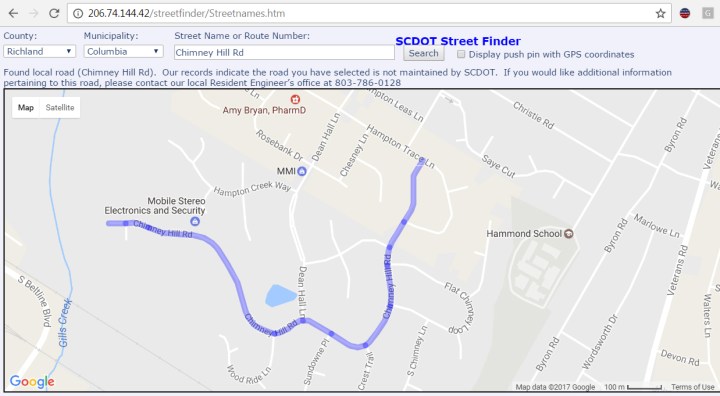
I entered my own street, Chimney Hill Road, and found out that the DOT does not maintain my street but that I could get more information from the Resident Engineer’s office at 803-786-0128. (I know Chimney Hill Road is marginally maintained by the City of Columbia from watching the repair of the pothole in front of my house at least annually.)  Here’s what the website shows:

blog-screenshot-1

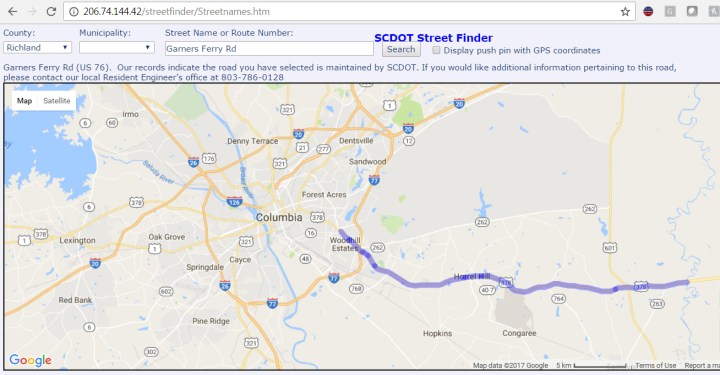
Then, I tried Garners Ferry Road (U.S. 76) and learned that the DOT does maintain this road.  Here’s the map:

blog-screenshot-2

Trying another County, I entered one of my favorite roads (the road to the beach!), Highway 17 (Ocean Highway S) in Georgetown County. This road is maintained by the DOT, and the phone number for the local office, for more information, is 843-546-2405.

blog-screenshot-3

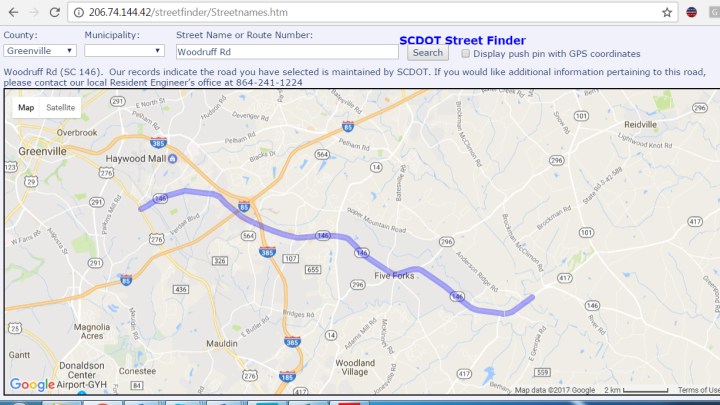
Turning to the upstate, I tried Woodruff Road (SC 146) in Greenville County and learned that this road is maintained by the DOT, and the phone number for the local office, for more information, is 864-241-1224.

blog-screenshot-4

I hope this website will provide real estate closing attorneys with some quick information when road maintenance becomes an issue.

One of President Trump’s first official actions affects housing

Standard

presidential-seal

The Federal Housing Administration (FHA) announced on January 9 that it planned to reduce mortgage insurance premiums effective January 27. Mortgage insurance protects lenders from borrower defaults and is common where the down payment is less than 20%.

The Democratic view of this issue is that sufficient reserves and four years of economic growth allowed the FHA to pass along some modest savings to consumers. Additionally, the move was viewed as an attempt to help first-time and lower income home buyers to access the market at a time when mortgage rates were rising.

The Republican view is that such reductions put taxpayers at risk by decreasing the funds the FHA has to deal with mortgage defaults. In other words, taxpayers might be at a greater risk for footing the bill for another bailout if FHA’s reserves were reduced.

President Trump’s advisors criticized the Obama administration for adopting new policies as it prepared to leave office. During Dr. Ben Carson’s confirmation hearing for Secretary of the Department of Housing and Urban Development (HUD), FHA’s parent agency, he expressed disappointment that the cut was announced so late in President Obama’s term.

On January 20, shortly after he was sworn in, as one of his first substantive actions, President Trump undid this new policy before it took effect by signing an executive order.

HUD then issued a letter stating that more analysis is needed before changes are made, and the rates will remain the same for the time being.

It appears industry groups may have differing opinions on whether President Trump’s executive order will affect home buying. Will this action reduce opportunities for first-time buyers? Or will it eventually allow FHA’s reserves to be increased to a point where it can offer more services to borrowers? Industry groups will continue to weigh in, and this blog will continue to keep South Carolina dirt lawyers posted on developments.

A little mundane, but useful, information for your New Year

Standard

paperwork-stacks

York County’s Register of Deeds office recently informed local dirt lawyers that it will begin using a new system on January 23. The new system will require labels containing recording information to be attached to recorded documents.

This County will require a three-inch margin at the top or bottom of the front page of each recorded document. Documents that do not meet the margin requirement may be rejected because the label may conceal a portion of the document.

I am confident York County lawyers are informed of this development but wanted to get the word out to the remainder of the state to benefit lawyers who may handle a transaction in that County from time to time.

SC residential tax breaks are “two ships in the night”

Standard
ships passing night.jpg

“Ships that pass in the night, and speak each other in passing, only a signal shown, and a distant voice in the darkness”  – Longfellow

Tax cases can be complicated, but this one seems relatively simple. The South Carolina Court of Appeals held in late December that the homestead exemption and the primary residence (4%) classification are two entirely separate matters*.

The taxpayer, Frank Mead, turned sixty-five in 2004 and received the homestead exemption from 2005 to 2010 on his home located in beautiful Hilton Head Island. In 2011, he had a brilliant idea and rented his home for 138 days during which he traveled part of the time and stayed in a rental apartment the remainder of the time.

The Beaufort County Tax Assessor didn’t approve of Mr. Mead’s brilliant idea. She revoked the homestead exemption for 2011 on the theory that he no longer qualified because he rented his home for more than fourteen days.  Mr. Mead believed the fourteen-day limitation applied only to the primary residence (4%) classification and appealed to the Beaufort County Tax Equalization Board.

He lost in that forum but then appealed to the Administrative Law Court. The ALC found for Mr. Mead and determined that the homestead exemption and the primary residence classification are “two ships in the night” with different requirements. The Tax Assessor appealed to the Court of Appeals.  The issue was whether the homestead exemption under §12-37-250 of the South Carolina Code is available only to property that also qualifies for the preferential residential assessment ration set out in §12-43-220(c).

Section 12-37-250 provides for a homestead exemption for a person sixty-five or older when that person has been a resident of South Carolina for at least one year. Section 12-43-220(c) provides for a special property tax assessment ratio of 4% (as opposed to the normal 6%) for owner occupied legal residences.

To make the matter a little more complicated, but more advantageous to the taxpayer, the assessment ratio statute further provides that the owner-occupant of a legal residence is not disqualified from receiving the 4% classification if the requirements of Internal Revenue Code §280A(f)[2] as defined in section 12-6-40 (A), meaning the property may be rented for less than fifteen days.

The Court of Appeals noted that nothing in the homestead exemption statute makes reference to the primary residence classification statute and that the 14-day rule applies only to the four percent assessment ratio. Simple, right? Not quite so simple: interestingly, the Department of Revenue had taken the same position in a 1997 memorandum that the Tax Assessor in this case took, but withdrew that memorandum two years later.

For now, the rules are separate and distinct, and the taxpayer wins!