Foreign ownership of real estate has become a political issue

Standard

Pending legislation in South Carolina may affect your transactions

Remember the Chinese surveillance balloon the United States shot down off the coast of the Palmetto State in February? That incident and other rising tensions between our government and China over several issues (the war in Ukraine, recognition of Taiwan, to name only two) have resulted in politicians proposing to broaden state law bans on foreign ownership of real estate.

According to a New York Times article dated February 7, entitled “How U.S-China Tensions Could Affect Who Buys the House Next Door”, legislation in Texas was proposed after a Chinese billionaire with plans to create a wind farm bought more than 130,000 acres of land near a U.S. Air Force base.

Proposed legislation is also pending in Florida, California and now South Carolina to restrict ownership of real estate by “hostile nations” or “foreign adversaries.” Some have suggested that such bills may run afoul of due process and equal protection issues.

Chicago Title published an Underwriting Memorandum on April 5 entitled “Foreign Ownership of Property in South Carolina” to advise agents of the pending legislation in our state.

You may recall that we have an existing statute (S.C. Code §27-13-30) prohibiting any “alien” or corporation controlled by an “alien” from owning or controlling more than 500,000 acres of land in South Carolina. Recently, the South Carolina Senate passed Senate Bill 576 that amends the existing statute by expressly prohibiting any citizen of a foreign adversary or corporation controlled by a foreign adversary from acquiring any interest in South Carolina property.  The proposed legislation will now be considered by the House.

The term “foreign adversary” is defined in the bill as “any foreign government or nongovernment person determined by the United States Secretary of Commerce to have engaged in a long-term pattern or serious instances of conduct significantly adverse to the national security of the United States or the security and safety of United States citizens.”

And there are other bills pending along the same lines.

Senate Bill 392 would amend our existing statute to reduce the amount of property allowed to be owned by an “alien” to 1,000 acres. House Bill 3566 would add a statute to reduce to 1,000 acres the amount of land that can be owned or controlled by China, the Chinese Communist Party, or an entity whose principal place of business is located within China.  House Bill 3118 would prohibit any company owned or controlled by China or the Chinese Communist Party or that has a principal place of business in China from owning, leasing, possessing, or exercising any control over real estate located within 50 miles of a state or federal military base for the purpose of installing or erecting any type of telecommunications or broadcasting tower.

All dirt lawyers will know immediately that all versions of the proposed legislation will create uncertainty in our market. I have only two pieces of advice at this point. First, let’s all monitor the proposed legislation. And, second, let’s pay attention to guidance provided by our excellent title insurance underwriters.

Who said real estate law is boring?

Standard

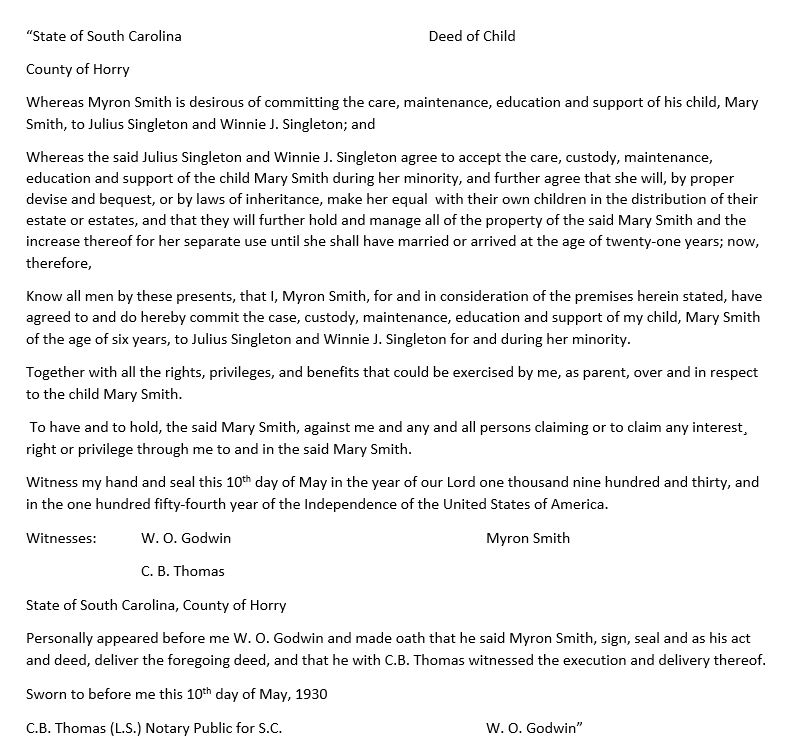
Take a look at this “Deed of Child”

My friend and self-professed “fellow title nerd”, Lacey Higginbotham, who practices in Myrtle Beach, sent to me a “Deed of Child” she found in the Horry County records. The document is dated May 10, 1930, recorded June 3. 1930, and purports to convey a child from a father to another family .

Because the document is difficult to read, I’ll squint for you and set it out here for your reading pleasure:

I can imagine Professor Spitz presenting this document to us as an exam in our first- year property law class. He might ask for us to spot all the issues concerning the enforceability of this document. Thanks, Lacey, for this diversion!

How do mail away closings work in light of In re Lester*?

Standard

A reader posed this question to me

A recent blog about a South Carolina Supreme Court amendment to a comment following our UPL rule contained the following paragraph:

“Remember that our Supreme Court adamantly told us in In re Lester* that a lawyer must be physically present for a closing. Prior to Lester, a closing attorney might be on vacation and available by telephone to answer closing questions. Lester called a halt to that practice.”

A reader responded, “Claire, can you clarify the effects of In Re Lester on ‘mail away’ closings?” This is such a great question, and I responded that I would answer with a new blog. This is that blog!

In the South Carolina Bar’s publication, Handbook for South Carolina Dirt Lawyers, I included the following discussion of mail-away closings.

“Attorneys in resort areas have done “mail away” closings routinely for years. Titles are examined, closing packages are prepared and mailed to a remote location for signatures. Recent South Carolina Supreme Court disciplinary cases requiring attorneys to be present at closings have caused some attorneys to question whether mail away closings can be done ethically by South Carolina attorneys.

The Supreme Court has not addressed this issue specifically, so no one knows the answer to this question. However, in a seminar in 2005, a lawyer from the Office of Disciplinary Counsel was asked whether an attorney can ethically handle a closing by mail.

He responded that it was his opinion that the attorney should:

           •     Schedule a closing date, time and place;

           •     Advise the clients that they should attend the closing;

           •     Advise the clients that the attorney will be able to provide better representation if the clients attend the closing; and

           •     Require the clients to sign a document indicating they received the foregoing advice but chose not to attend the closing.

Another speaker at the seminar suggested that he would only handle mail away closings if the clients agreed to meet with a lawyer in the clients’ location to execute the documents.

On September 16, 2005, we received a more formal opinion in the form of Ethics Advisory Opinion 05-16. This opinion states that an attorney may ethically conduct a real estate closing by mail as long as it is done in a way that:  (1) ensures that the attorney is providing competent representation to the client; (2) all aspects of the closing remain under the supervision of an attorney;  and (3) the attorney complies with the duty to communicate with the client, so as to maintain the attorney-client relationship and be in a position to explain and answer any questions about the documents sent to the client for signature. To meet this test, according to the opinion, clients must have reasonable means to be in contact with the attorney, by telephone, facsimile, or electronic transmission.

The Opinion states that there is no legal requirement that a client attend the closing, but it must be the client’s decision not to attend the closing. The Opinion acknowledges today’s climate by this statement: “Given today’s technological advances in communications and funds transfer, to require a client living in one part of the country to attend a closing against the client’s own wishes is both unnecessary and punitive.” The Opinion makes the point that the duties of the attorney do not change when the closing is accomplished by mail in this statement: “The prudent attorney will conduct closings by mail in such a fashion that the client is fully informed and properly advised, that the client has a reasonable means to consult with the attorney, and that all personnel assisting the attorney are properly supervised.”

South Carolina closing attorneys are relieved to have this authority and appreciative of the efforts of the South Carolina Bar Ethics Advisory Committee.”

Of course, technology has drastically changed since these words were written, but the legal issues have not. A dirt lawyer can certainly handle mail away closings ethically. But dirt lawyers must still practice law in connection with those closings.

Please feel free to make comments and ask questions about these blogs!

*353 S.C. 246, 578 S.E. 2d 7 (2003).

Does real estate “wholesaling” work in our market?

Standard

Maybe, but real estate practitioners should be careful!

A recent discussion on South Carolina Bar’s real estate section listserv surrounded whether and how to close “double closings” vs. “assignments of contracts”.  This is not a novel topic in our market. In the very hot market that preceded the crash beginning in 2007, one of the biggest traps for real estate attorneys was closing flip transactions. Title insurance lawyers fielded questions involving flips on an hourly basis!

Flips have never been illegal per se. Buying low and selling high or buying low and making substantial improvements before selling high are great ways to make substantial profits in real estate.  

Back in the day, we suggested that in situations where there were two contracts, the ultimate buyer and lender had to know the property was closing twice and the first closing had to stand on its own as to funding. In other words, the money from the second closing could not be used to fund the first closing. (Think: informed consent confirmed in writing!)

Where assignments of contracts were used, we suggested that the closing statements clearly reflect the cost and payee of the assignment.

The term real estate investors are using these days to define buying low and selling high is “wholesaling”.  A quick Google search reveals many sites defining and educating (for a price, of course) the process of wholesaling. This is a paraphrase of a telling quote I found from one site:

If you’re looking for a simple way to get started in real estate without a lot of money, real estate wholesaling could be a viable option. Real estate wholesaling involves finding discounted properties and putting the properties under contract for a third-party buyer. Before closing, the wholesaler sells their interest in the property to a real estate investor or cash buyer.

One of the smart lawyers on our listserv, Ladson H. Beach, Jr., suggested that there does not appear to be a consensus among practitioners about how to close these transactions. He suggested reviewing several ethics cases* that set out fact-specific scenarios that may result in ethical issues for closing attorneys.

In addition to the ethics issues, Mr. Beach suggested there may be a licensing issue where an assignor is not a licensed broker or agent. A newsletter from South Carolina Real Estate Commission dated May 2022 which you can read in its entirety here addresses this issue. The article, entitled “License Law Spotlight: Wholesaling and License Law” begins:

“The practice of individuals or companies entering into assignable contracts to purchase a home from an owner, then marketing the contract for the purchase of the home to the public has become a hot topic, nationwide in the real estate industry in recent years. This is usually referred to as ‘wholesaling’. The question is often, “is wholesaling legal?’ The answer depends upon the specific laws of the state in which the marketing is occurring. In South Carolina, the practice may require licensure and compliance with South Carolina’s real estate licensing law.”

The article suggests that the Real Estate Commission has interpreted that the advertising of real property belonging to another with the expectation of compensation falls under the statutory definition of “broker” in S.C. Code §40-57-30(3) and requires licensure. Further, the newsletter suggests S.C. Code §40-57-240(1) sets up an exception; licensing is not required if an unlicensed owner is selling that owner’s property. The Commission has interpreted, according to this article, that having an equitable interest is not equivalent to a legal interest for the purpose of licensing. In other words, a person having an equitable interest acquired by a contract is not the property’s owner and has no legal interest in the property for the purposes of this licensing exemption.

So real estate practitioners have several concerns about closing transactions of this type. Be very careful out there and consult your friendly title insurance underwriter and perhaps your friendly ethics lawyer if you have concerns as these situations arise in your practice.

*In re Barbare (2004), In re Fayssoux (2009), In re Brown (2004) and In re Newton (2007)

South Carolina has another builder arbitration case

Standard

Real estate law never bores me, but our cases may seem particularly mundane considering the Murdaugh prosecution that has gripped our state for more than a month. You may want to put this blog aside until the jury returns its verdict. I’ve seen so many photos on social media of groups of lawyers watching the case together that I am confident real estate is not top of mind!

Huskins v. Mungo Homes, LLC* is a South Carolina Court of Appeals case which was originally issued June 1, 2022, then withdrawn, substituted and refiled February 15, 2023.

The Huskins signed a Purchase Agreement with Mungo in June 2015 for a home in Westcott Ridge subdivision in Irmo. The document consisted of three pages. The first page contained a statutory notice of arbitration, the second page included a paragraph entitled “LIMITED WARRANTY”, and the third page included a paragraph entitled “ARBITRATION AND CLAIMS.”

In 2017, the Huskins filed an action against Mungo alleging the Purchase Agreement violated South Carolina law by disclaiming implied warranties without providing for a price reduction or other benefit to the purchaser for relinquishing those rights. The causes of action included: (1) breach of contract and the implied covenant of good faith and fair dealing; (2) unjust enrichment; (3) violation of the South Carolina Unfair Trade Practices Act, and (4) declaratory relief regarding the validity of the waiver and release of warranty rights and the validity of Mungo’s purported transfer of all remaining warranty obligations to a third party.

Mungo filed a motion to dismiss and compel arbitration. The Huskins’ responsive memorandum argued that the arbitration clause was unconscionable and unenforceable. They asserted that the limitation of warranties provision should be considered as a part of the agreement to arbitrate. The Circuit Court issued an order granting the motion to dismiss and compelling arbitration. In ruling the arbitration clause was not one-sided and unconscionable, the Circuit Court found that (1) the limited warranty provision must be read in isolation from the arbitration clause; and (2) terms in the arbitration clause pertaining to a 90-day time limit were not one-sided and oppressive because they did not waive any rights or remedies otherwise available by law.

The Court of Appeals initially held that the Circuit Court’s order was immediately appealable, stating that our state procedural rules, rather than the Federal Arbitration Act, govern appealability of arbitration orders. While arbitration orders are not typically immediately appealable under South Carolina law, this order had granted Mungo’s Rule 12(b)(6) motion to dismiss, which is an appealable order.

The Court next held that the arbitration clause must be considered separately from the limited warranty provision, citing cases to the effect that arbitration provisions are separable from the contracts in which they are imbedded. A prior D.R. Horton South Carolina Supreme Court case** considered the arbitration and warranty provisions together, in part because the title of the paragraph, “Warranties and Dispute Resolution” signaled that the provisions should be read as a whole. Since the Mungo paragraphs were separated, the Court of Appeals said they should be read separately. In addition, the two provisions did not contain cross references.

The Court next addressed the Huskins’ argument that the limitation of claims provision restricted the statutory limitations period from three years to 90 days and was therefore not severable from the arbitration clause. The Court agreed that the provision that limited the statute of limitations is one-sided and oppressive, but held that the arbitration clause is enforceable because the unconscionable provision is severable.

After concluding that the Huskins lacked a meaningful choice in entering the arbitration clause, the Court of Appeals held that the arbitration clause’s shortening of the statute of limitations violates South Carolina law and is therefore unconscionable and unenforceable.

The Circuit Court’s order was affirmed as modified.

Now …. back to the Murdaugh trial!

*South Carolina Court of Appeals Opinion 5916 (June 1, 2022, Withdrawn, Substituted and Refiled February 15, 2023.

**Smith v. D.R. Horton, Inc., 417 S.C. 42, 790 S.E.2d 1 (2016).

Facts of HOA-Developer dispute called “not for the weary”

Standard

On February 8, the South Carolina Supreme Court issued an opinion* in a real estate case involving the I’On development in Charleston County. Justice Hearn’s opening sentence is revealing: “This case involves promises made and broken to homeowners by a developer and its affiliated entities.” The first sentence describing the facts is equally telling: “The facts of this case are complicated, and, (in the words of a prior Supreme Court opinion, citation omitted) are “not for the weary.”

I’On is described as a high-density residential development that comprises public squares, restaurants, shops, and homes designed to imitate historic urban housing, including a replica of downtown Charleston’s Rainbow Row. The opinion recites that after the Court rejected a referendum effort to restrict multi-use zoning, construction of I’On Phase II began around 2000.

In 2010 two individual homeowners sued the developer entities and individuals for various causes of action related to the nonconveyance of certain real property and community amenities within the neighborhood. A mistrial was ordered to realign the homeowner’s association as a plaintiff. A subsequent trial resulted in a jury verdict in favor of the HOA in the amount of $1.75 million for breach of fiduciary duty and in favor of an individual owner in the amount of $20,000 for negligent misrepresentation.

The history of the development includes a 1998 Property Report filed with the U.S. Department of Housing and Urban Development to comply with the Interstate Land Sales Full Disclosure Act. The report contained a paragraph in all caps promising that “recreational facilities” would be conveyed to the HOA upon completion of construction. But the report warned that certain recreational facilities may be owned and operated by persons other than the HOA.

The Court recited that shortly after the Report was issues, the developers began a pattern of conduct altering their initial promise to convey ownership of the disputed properties to the HOA. Later, an easement agreement was executed and signed by the same person in three different roles, as manager of the I’On Club, as president of the HOA, and as general manager of the I’On Company. A property owner expressed the concern that this agreement was “sort of shaking hands with yourself.”

The Court of Appeals waffled, first upholding the lower’s court’s verdicts, then, on rehearing, practically nullifying the verdicts.

I am not going to get down into the weeds on the complex facts, but I do want to make a couple of points for your information.

First, the statute of limitations issues were thorny, and the Supreme Court upheld the Circuit Court’s submission of these issues to the jury and stated that the facts supported the jury’s determination of the question of when the statute of limitations began to run.

Second, please pay attention to footnote 7. It states that the developer conceded on appeal that one individual owner’s contract to purchase his lot was a sealed instrument and thus has a twenty-year statute of limitations under S.C. Code §15-3-520. Please pay particular attention to whether your clients signed “sealed instruments” because liability under those instruments may be much longer than anticipated.

Otherwise, the Court was adamant that the verdicts were appropriate because of the “plethora of evidence presented of the Developers’ bad faith, broken promises, and self-dealing.”

Represent your developer clients well, dirt lawyers, to avoid losing cases like this one.  Read this case carefully and share it with your developer clients as an excellent lesson of what not to do!

*Walbeck v. The I’On Company, LLC, South Carolina Supreme Court Opinion 28134 (February 8, 2023)

MV Realty sued by Florida Attorney General

Standard

This blog has previously discussed MV Realty PBC, LLC. South Carolina title examiners report they are discovering “Homeowner Benefit Agreements” or “Exclusive Listing Agreements” filed in the public records as mortgages or memoranda of agreement. The duration of the agreements purport to be forty years, and quick search revealed hundreds of these unusual documents filed in several South Carolina counties. The documents indicate that they create liens against the real estate in question.

The company behind these documents is MV Realty PBC, LLC which appears to be doing business in the Palmetto State as MV Realty of South Carolina, LLC. The company’s website indicates the company will pay a homeowner between $300 and $5,000 in connection with its Homeowner Benefit Program. In return for the payment, the homeowner agrees to use the company’s services as listing agent if the decision is made to sell the property during the term of the agreement. The agreements typically provide that the homeowner may elect to pay an early termination fee to avoid listing the property in question with MV Realty.

In response to numerous underwriting questions on the topic, Chicago Title sent an underwriting memorandum to its agents entitled “Exclusive Listing Agreements”. Chicago Title’s position on the topic was set out in its memorandum as follows: “Pending further guidance, Chicago Title requires that you treat recordings of this kind like any other lien or mortgage. You should obtain a release or satisfaction of the recording as part of the closing or take an exception to the recorded document in your commitments and final policies.”

Googling MV Realty results in a great deal of information. Real estate lawyers should familiarize themselves with this company and its program to advise clients who may question whether the program makes sense from a financial and legal perspective.

In December, Florida’s Attorney General sued the company calling the venture a “deceptive scheme”. The lawsuit seeks an injunction, preventing enforcement of the contracts with consumers, preventing future deceptive and unfair trade practices, and returning funds to consumers.

News sources report that the company is active in 23 states, including South Carolina, and that Attorneys General in several other states are investigating the activities of this company. News sources also report numerous lawsuits against consumers seeking to enforce these contracts. U.S. Senator Sharrod Brown (D-Ohio) has indicated the company could face scrutiny from the Senate Committee on Banking, Housing and Urban Development.

Dirt lawyers, pay attention to this situation. We will certainly see updates.

Second real estate case of the year rejects replacement mortgage doctrine

Standard

SC Supreme Court discards arguments of ALTA and PLTA

Real estate cases can be absent from our Advance Sheets for months, but we have seen two cases already in 2023. In ArrowPoint Federal Credit Union v. Bailey* our Supreme Court was asked to adopt a novel replacement mortgage doctrine, but the Court deflected the question, deferring to the legislature, even though American Land Title Association and Palmetto Land Title Association filed amicus briefs in favor of the doctrine.

This is a real estate mortgage priority dispute between two institutional lenders concerning a residential property in Winnsboro.  Jimmy and Laura Bailey mortgaged their residence at 247 Morninglow Drive to Quicken Loans in the amount of $256,500. The mortgage was recorded on October 20, 2009. One week later, the Baileys closed an equity line of credit with ArrowPoint Federal Credit Union in the amount of $99,500. The second mortgage was recorded on November 4. ArrowPoint had record notice of the Quicken mortgage. On November 23, the Baileys refinanced the Quicken mortgage with Quicken, this time in the amount of $296,000.

In connection with the refinance, the Baileys executed an interesting document entitled “Title Company Client Acknowledgment”, which stated the only outstanding lien on the property was the prior Quicken mortgage. This statement was false. The Court stated that there was no clear explanation as to whether Quicken had the title searched at this point.

The Baileys used $257,459 from the refinance to pay off the first mortgage. On December 15, Quicken released the first mortgage and recorded the refinance mortgage. Quicken assigned the mortgage to U.S. Bank, the petitioner in this case.

(If these facts make you break out into a cold sweat, then you were around doing real estate closings at the break-neck speed we suffered during this time frame.)

The Baileys defaulted on the line of credit, and ArrowPoint filed this action seeking a declaration that its line of credit had priority over the Quicken refinance mortgage. Both lenders moved for summary judgment. U.S. Bank claimed it had priority under the replacement mortgage doctrine. The special referee and Court of Appeals agreed with ArrowPoint, and the Supreme Court affirmed. Both appeals courts concluded that adopting the replacement mortgage doctrine is a question for the General Assembly.

Dirt lawyers are intimately familiar with South Carolina’s race-notice statute (S.C. Code §30-7-10) which prioritizes liens based on notice and the recording date.

The Supreme Court recited that it had recognized the equitable subordination doctrine as an exception to the race-notice statute. The Court noted the right of subrogation is essentially a creation of the court of equity, which allows a person who is secondarily liable for a debt, upon paying the debt, to assume by law the place of the creditor whose debt is paid.  Decades later, the Court declined to recognize the doctrine for a lender that refinanced its own mortgage but failed to discover an intervening mortgage. The Court said in the case at hand that it had previously warned lenders of their duty to search titles!**

The Court noted that the replacement mortgage doctrine is another exception to the race-notice statute, and many jurisdictions either recognize the doctrine or follow its logic. Cases from other jurisdictions were cited, and the Restatement (Third) of Property was quoted. According to the Restatement, the replacement mortgage doctrine provides:

  • If a senior mortgage is released of record and, as a part of the same transaction, is replaced with a new mortgage, the latter mortgage retains the same priority as its predecessor, except
  • To the extent that any change in the terms of the mortgage or the obligation it secures is materially prejudicial to the holder of a junior interest in the real estate, or
  • To the extent that one who is protected by the recording act acquires an interest in the real estate at a time that the senior mortgage is not of record.

The Court said that it was required to respect the authority of the legislature on public policy matters and declined to sit as a “superlegislature” to second-guess the General Assembly’s decisions. The Court differentiated the equitable subrogation doctrine from the replacement mortgage doctrine by saying that the “race” begins with the original mortgage in the equitable subrogation situation, and the intervening lender suffers no loss. Under the replacement mortgage doctrine, on the other hand, the original first mortgage is satisfied of record and replaced with a new mortgage that is recorded after the intervening mortgage.

The Court also criticized the replacement mortgage doctrine because it dilutes the importance of title examinations. Lenders who seek to refinance their own mortgages, as Quicken did in this case, can easily search the title to discover the intervening lien. The last words of the case state, “Finally, we emphasize parties must conduct diligent title searches to protect their interests under the race-notice statute.”

I, for one, will not argue with that final statement. It now appears that if ALTA and PLTA want a replacement mortgage doctrine in South Carolina, they need to approach the legislature.

*South Carolina Supreme Court Opinion 28129, January 11, 2023.

**All the citations are omitted but are set out in detail in the subject case.  

Happy New Year dirt lawyers

Standard

2023’s first real estate case is both humorous and sexy!

If real estate lawyers weren’t easily amused, our profession might live up to the common misconception that it’s boring. But the first South Carolina real estate case of 2023 is both funny and sexy. I’ll explain the funny part shortly. Sadly, the only thing sexy about this case* is that the property is occupied by two strip clubs. But let’s agree to be entertained where we can.

This is a specific performance case involving property in Charleston County. Clarke owned a strip club located at 2015 Pittsburgh Avenue in Charleston. The defendant’s predecessor in title owned a strip club across the street at 2028 Pittsburgh Avenue. The Supreme Court called the property at 2028 Pittsburgh Avenue the subject property, so we will, too. The subject property includes buildings and a parking lot.

In 1999, Clarke entered into a lease which permitted him to share the parking spaces on the subject property with the property owner. The lease contained the following language: “Right of First Refusal: Lessor grants the Lessee the right of first refusal should it wish to sell.”

Before we discuss what the Supreme Court had to say about this language, let me throw in my two cents. Don’t use the terms “lessor” and “lessee” when you draft leases. Use the terms everyone can understand, “landlord” and “tenant”. And please pay attention to prepositions. In this language, which party is “it”?  A drafter of real estate documents cannot be too precise!

Back to the case. I often read cases by starting with the dissent or concurrence. With complicated cases, the minority opinion often explains the holding quickly. This case isn’t complicated, but Justice Few really cut to the chase in his concurrence. And this is the funny part. Justice Few quips, “This instrument says nothing, does nothing, restrains nothing.” (Remember I admit to being easily amused.)

Justice James’ majority opinion goes into more detail.

When Clarke learned that his landlord had conveyed to subject property to Fine Housing for $150,000, he initiated this action for specific performance. Interestingly, the closing attorney failed to raise the lease and the right of first refusal with the purchaser, but Fine Housing admitted it had record notice of both.

The trial court ruled the right of first refusal is enforceable as to the entire property and ordered Fine Housing to convey title to Clarke upon his payment of $350,000. There is no explanation for this figure. Appraisals must have been involved. The Court of Appeals reversed, holding the right of first refusal is an unreasonable restraint on alienation and is therefore unenforceable.

The Supreme Court affirmed, stating that whether a right of first refusal is enforceable turns on whether the right unreasonably restrains alienation. The Court agreed with The Restatement (Third) of Property: Servitudes §3.4 and held that the factors to be considered include: (1) the legitimacy of the purpose of the right; (2) the price at which the right may be exercised; and (3) the procedures for exercising the right. The Court further held that these factors are not exclusive, and in this case, agreed to address another point raised by Fine Housing—the lack of clarity as to what real property the right encumbers.

Clarke argued that the lease provides the right applies to all the property, the price should be determined by the seller, and South Carolina law requires that the right should be exercised within a reasonable time.

Fine Housing argued that the lease merely identifies the location of the leased parking spaces, and the remaining language does not provide the clarity needed to identify the property intended to be encumbered by the right. The Supreme Court agreed, holding that the uncertainty as to what property is encumbered supports the conclusion that the right is an unreasonable restraint on alienation.

The Court also agreed with Fine Housing that the failure of the right to determine a price and the procedures for its exercise also created an unreasonable restraint on alienation.

The bottom line is that the Court held the language to be so imprecise as to be unenforceable. While real estate lawyers are always interested in obtaining the best deal for clients, the second most important aim of drafting real estate documents should be clarity.

Always keep in mind how Justice Few dismissed the language that says nothing, does nothing and restrains nothing! You never want language you draft to be dismissed so easily!

*Clarke v. Fine Housing, Inc., South Carolina Supreme Court Opinion 28126 (January 4, 2023)

Fifth Circuit addresses short-term rental challenge

Standard

This blog has previously discussed challenges by various cities, including cities in South Carolina, to short-term rentals in residential areas.

Vrbo and Airbnb are two go-to websites to find interesting short-term rentals in vacation locations. Sometimes a cabin or house seems much more appropriate and fun than a hotel room for a family get-away. Having a kitchen and room for dining is often a plus.

Arguments against such rentals often focus on noise and parking problems in otherwise quiet residential subdivisions.

Rules vary greatly in the cabins and houses we’ve rented, but a common theme seems to be that parties are not allowed. I’ve also seen limits on the number of cars that can be accommodated and, of course, the number of people permitted. Pets may or may not be allowed.

The Fifth Circuit Court of Appeals recently addressed such a challenge in Hignell-Stark v. City of New Orleans, 46 F. 4th 317 (August 22, 2022). Thanks to Professor Dale Whitman of the University of Missouri at Kansas City Law School via the Dirt Listserv for information on this case.

An ordinance in the City of New Orleans required an owner to be a resident of the city to obtain a license to become a landlord allowing short-term rentals. When the plaintiffs challenged this ordinance using a “takings” theory, the Fifth Circuit held that theory to be inapplicable because permission to make short-term rentals of a residential unit is not a property interest. It is instead, according to the Court, a privilege.

The plaintiffs also argued that the ordinance was an undue burden on interstate commerce, and the Court agreed, stating that an ordinance that discriminates against interstate commerce is per se invalid unless there are no available alternative methods for enforcing the city’s legitimate policy goals. The ordinance in question was a blanket prohibition against out-of-state property owners’ participation in the short-term rental market. The Court pointed out that the ordinance doesn’t just make it more difficult for non-residents to compete in the market for short-term rentals in residential neighborhoods; it forbids them from participating altogether.

The Court pointed to alternative methods for achieving the city’s legitimate goals of preventing nuisances, promoting affordable housing, and protecting neighborhoods’ residential character. More aggressive enforcement of nuisance laws, increased penalties for nuisance violations, increased taxes on short-term rentals, requiring an operator remain on the property during night hours, and capping the number of short-term rentals licenses in particular zoning district might be alternatives.

The ordinance was held unconstitutional and void because the city’s objectives could be addressed in other ways that did not burden interstate commerce.

What do you think? Would you be comfortable with short-term rentals in your neighborhood?