Did Columbia destroy an archeological structure?

Standard

Court of Appeals holds the City is not responsible

On November 10, the South Carolina Court of Appeals affirmed a summary judgment order in favor of the City of Columbia concerning the alleged destruction of an archeological and historical bridge abutment during a sewer rehabilitation project*.

The Brinkmans, Colemans, Fosters and Collins (property owners) own real estate on Castle Road on the banks of the Broad River in Richland County. The City of Columbia owns and operates sewer lines that run beneath portions of the property and has a permanent, 15-foot easement across the property for the purpose of maintaining the sewer lines. In 2014, the City began a sewer rehabilitation project which required access to the sewer lines.

According to the property owners, two bridge abutments stood on their property located outside the easement. The owners claim these abutments, which were made of carved rock, were built in the 1700s and were the “oldest existing structures in the Midlands.”

One of the owners testified that he shouted to the City’s contractors and said there was a valued monument on the property. Unfortunately, while the City and the contractors were clearing the land, they destroyed the stones that allegedly comprised the bridge abutments. The City acquiesced to the owner’s request that all work cease, and the property owners brought the subject lawsuit alleging various causes of action, including the destruction of archaeological resources in violation of §16-11-780 of the South Carolina Code.

This statute states that it is unlawful for a person to willfully, knowingly, or maliciously enter upon the lands of another and disturb or excavate a prehistoric or historic site for the purpose of discovering, uncovering, moving, removing or attempting to remove an archaeological resource.

The property owner’s expert testified that he believed the structures were historic abutments from the 1700s or early 1800s and likely to be the “Compty bridge abutment.” He explained that additional excavation and review of other properties across the river would have been the appropriate “next step”.

The property owners submitted an application in 2008 to the National Register of Historic Places, but the Department responded that a great deal more research and archeological investigation was needed before a determination of eligibility could be made.

The record contains a screenshot from the website “ArchSite. The property owner’s expert testified that ArchSite is a multi-agency website that allows access to the archaeological resources database. He explained that when ArchSite receives information about historic sites, it verifies the information and posts it to the website. The image in the record shows a rendering of part of the Broad River and Castle Road, and it includes the notation “Historic Areas: Broad River Ferry and Bridge Site.”

The trial court found no governing preservation or conservation authority had recognized the structures as either archaeological resources or historical structures. In granting the City’s motion for summary judgment, the court found that the City was not liable under the statute.

The Court of Appeals agreed, holding that no evidence exists that the City cleared the land “for the purpose of” discovering, uncovering, moving, removing or attempting to remove an archaeological resource. Clearly, the City was attempting to clear the easement area to access the sewer lines. In addition, the owners provided no evidence that the City had any knowledge of the historic nature of the site.

The owner who shouted at the contractors could not testify that the contractors heard him and did not know whether this incident took place before or after the destruction of the stones. In addition, the Court held that the owners failed to show the City was obligated to consult ArchSite. The Court also questioned whether the entry on ArchSite contained sufficient information to conclude the property is historic because the entry indicates the site is “not eligible or requires evaluation.”

Finally, the Court held that regardless of whether any preservation or conservation authorities designed the structures as archaeological resources, the property owners failed to demonstrate the City had either actual or constructive knowledge of the existence of such resources.

*Brinkman v. Weston & Sampson Engineers, Inc., South Carolina Court of Appeals Opinion No. 5870, November 10, 2021

Borrower sues mortgage lender for violation of attorney preference statute

Standard

Court of Appeals holds lender’s foreclosure action is not a compulsory counterclaim

South Carolina’s Court of Appeals ruled on a noteworthy foreclosure case* in August.

The facts are interesting. In 1998, the borrowers signed a fixed-rate note in the amount of $60,400 at a 9.99% interest rate secured by a mortgage on property in Gaston. The note contained a balloon provision requiring payment in full on July 1, 2013.

On June 27, 2013, days before the note matured, the borrowers brought an action against the lender alleging a violation of South Carolina Code §37-10-102, the Attorney Preference Statute. The complaint alleged that no attorney supervised the closing, that the loan was unconscionable, and that the borrowers were entitled to damages, attorney’s fees and penalties as provided in the Consumer Protection Code. In addition, the complaint asserted a claim under the Unfair Trade Practices Act. All the allegations were premised on the same alleged violation of the Attorney Preference Statute.

The borrowers immediately defaulted on the note, and the lender filed an answer asserting no counterclaims. At trial, the jury found for the lender. About a year later, the borrowers sent a letter by certified mail to the lender requesting that it satisfy the mortgage. The letter included a $40 check to pay the recording fee for the mortgage satisfaction. The lender refused to satisfy the mortgage and returned the check.

The lender brought the present action for foreclosure in October of 2016. The borrowers asserted defenses of res judicata, laches, unclean hands, waiver, and setoff, but admitted no payments had been made on the loan after July 1, 2013. The borrowers then sought a declaratory judgment that the lender held no mortgage on the property, or, alternatively, that the mortgage was unenforceable. They alleged that the lender was liable for failing to satisfy the mortgage and for noncompliance with the Attorney Preference Statute. The lender denied the allegations and argued that the claims under the Attorney Preference Statute were time-barred.

Both parties sought partial summary judgments before the master-in-equity. The master granter the borrower’s motion and denied the lender’s motion. He ruled that the mortgage was satisfied and instructed the lender to file a satisfaction.

On appeal, the lender argued the master erred by finding its foreclosure action was a compulsory counterclaim in the 2013 action. The Court of Appeals agreed, holding that the two claims arose out of separate transactions. The Attorney Preference claim arose from the closing, while the foreclosure arose from the borrower’s default, according to the Court. The Court reversed the master’s award of partial summary judgment to the borrower and remanded the case for further proceedings. Because of its decision on this issue, the Court determined that it did not need to address the remaining issues.

*Deutsche Bank National Trust Company v. Estate of Houck, South Carolina Court of Appeals Opinion 5844, August 11, 2021.

EAO 21-01 says it’s ethical to pay $249 to be on lender’s closing attorney list

Standard

The first Ethics Advisory Opinion of the year is noteworthy for South Carolina real estate practitioners.

Here is a brief summary of the facts:  In a residential refinance, the lender’s loan estimate package provided the name of a specific South Carolina licensed attorney that the bank “identified” as one who could close the loan. The package expressly said the borrower could “shop for (the borrower’s) own providers” for legal and other services.

The borrower informed the bank that a different lawyer had been selected, but the bank’s second set of loan estimate documents again identified a different lawyer and again said the borrower could chose its own provider.

When the borrower asked why another lawyer’s name was identified, the bank responded that the borrower’s chosen lawyer could sign with a third-party company that the bank had contracted with to produce loan forms for an annual fee of $249 to be included on the list.

The borrower’s lawyer did not enroll in the program but did close the loan.

The question to the Ethics Advisory Committee was whether a lawyer may participate in a service provider network for an annual fee of $249 to be listed as an “identified” service provider without violating S.C. Rule of Professional Conduct 7.2(c)?

Rule 7.2 (c) generally provides that a lawyer shall not give anything of value to a person for recommending the lawyer’s services. One exception to the rule is that a lawyer may pay the reasonable costs of advertisements or communications permitted by the Rule.

The Committee pointed to Comment 7 which states that a communication contains a recommendation if it endorses or vouches for a lawyer’s credentials, abilities, competence, character, or other professional qualities. The bank’s form in this case only provides contact information for participating lawyers and indicates the lawyers on the list have been identified. And the borrower is told in each instance that he or she can choose a different lawyer.

The Committee said these limited statements hardly match up the verbs and nouns used to describe a “recommendation” in the comment because the language in the forms says nothing substantive about the credentials, abilities, competence, character, or professional quality of the listed lawyers.

The Opinion further stated that participation in the network appears to be open to any real estate attorney and that the fee appears to be reasonable considering the enrollment, onboarding, and maintenance charges for including attorneys in the network.

The short answer to the question was “yes”, a lawyer may pay the fee and participate in the network of legal service providers and be “identified” as a possible service provider.

It is interesting that the facts included this statement: “The package and disclosures are assumed to be compliant with federal and state requirements for loan applications and attorney-preference notices.” The Committee answered the very specific question put to it and clearly has no authority to address federal law.

Lawyer publicly reprimanded for closing irregularity

Standard

Most South Carolina dirt lawyers were disappointed with the result of the 2017 Quicken Loan case which did not hold, as many had hoped, that a South Carolina licensed lawyer must be at the center of each residential real estate closing, overseeing each step, and ensuring that the consumer client’s interests are protected in each step. That case blessed a scenario where an out-of-state entity oversaw the closing process and divvied up the required lawyer functions among various functions.

A disciplinary case* from August of 2021 demonstrates just one way the scenario approved by Quicken can go awry.

The lawyer was hired by Superior Closing and Title Services, LLC to serve as closing attorney for a home purchase for an attorney’s fee of $200. That fee is our first clue about the type of closing that is the subject of this case.  The Court refers to the purchaser as “C.W.” The lender was 1st Choice Mortgage, and the loan was assigned to Wells Fargo.

Almost two years after the closing, Wells Fargo demanded 1st Choice repurchase the loan because of a discrepancy with the title. The Court states “it was discovered” that C.W. was a straw purchaser who never made a payment on the loan.  The lawyer argued, and the Office of Disciplinary Counsel did not dispute, that the lawyer was unaware of the straw purchase. The closing statement showed a payment by C.W. of $11,598.16. At the closing, a copy of a $12,000 cashier’s check made payable to Superior Closing was shown to the lawyer and to 1st Choice Mortgage as the source of the down payment.

The lawyer signed the normal certification at closing representing that the settlement statement was a true and accurate account of the transaction.

The $12,000 check was never negotiated, and 1st Choice never received the funds. 1st Choice paid over $39,000 to settle the claim with Wells Fargo.

1st Choice sued Superior Closing and the lawyer. The lawyer represented that Superior Closing prepared the closing statement and acknowledged that he failed to properly supervise the preparation of the settlement statement and the disbursement of funds. As a result of the lawsuit, a $39,739 judgment was filed against the lawyer and Superior Closing. The judgment has been satisfied.

We all know how challenging it is to supervise the disbursement of a residential closing where the funds do not flow through the closing attorney’s trust account. This disciplinary case demonstrates the danger of skipping that problematic but necessary step.

*In the Matter of Ebener, South Carolina Supreme Court Opinion No. 28047 (August 11, 2021)

This tax sale case has an interesting twist

Standard

The alleged successful purchaser seeks to void the sale!

I’ve always believed our courts will happily void any tax sale on the flimsiest of technicalities, but apparently not when the purported tax sale buyer is the party seeking to get out of the purchase.

Alterna Tax Asset Group, LLC v. York County* is a Court of Appeals case from July dealing with a 2014 tax sale. Alterna claims it was the successful bidder at the sale and sought to void the sale and cancel its ownership relying on §12-61-20 of the South Carolina Code, which reads, in part:

“Any…person…(that) has purchased at or acquired through a tax sale and obtained title to any real or personal property, may bring an action in the court of common pleas of such county for the purpose of barring all other claims thereto.”

The complaint alleged that the title to the property was clouded because of York County’s failure to provide proper notice. The complaint set up four causes of action: (1) declaratory judgment; (2) injunctive relief, (3) quiet title, and (4) unjust enrichment.

The Master consulted the County’s records and took judicial notice that Alterna was neither the purchaser of the property at the tax sale, nor the owner currently listed on the deed. The Master ruled Alterna was not a real party in interest and lacked standing. The Master also ruled that the quoted code section does not create a valid cause of action to void a tax sale.

Alterna appealed claiming the Master erred in taking judicial notice of the public records. The Court of Appeals termed this use of judicial notice “problematic” but decided the appeal on what it called a more fundamental issue:  whether, as the alleged tax sale purchaser, Alterna may seek to rescind its successful purchase based on the facts in this case.

Since the purpose of the code section is to clear tax titles, the Court held that Alterna states to viable cause of action when it seeks to defeat rather than defend its title.

The Court accepted for the purposes of this appeal from a 12(b)(6) motion Alterna’s allegation that it purchased the property at the tax sale and concluded that no valid causes of action for declaratory judgment or injunctive relief existed.

The Court then stated that the remaining questions whether a winning bidder at a tax sale may use the quiet title doctrine or claim of unjust enrichment to defeat rather affirm the bidder’s title, are novel questions in South Carolina. The Court held that the complaint does not allege a proper cause of action for quiet title because there is no existing adverse claim. Neither the County nor anyone else was challenging Alterna’s tax title, so the claim is “imaginary or speculative”.

The unjust enrichment cause of action, which claimed the county was enriched by picketing the tax sale proceeds yet delivering a clouded title, collides, according to the Court, with South Carolina Code §12-51-160, which establishes as a matter of law the presumption that a tax deed is prima facie evidence of good title.

The Court further noted that Alterna’s alleged cloud on the title, that York County’s notification was defective, was a matter of public record visible to Alterna before the sale.

Finally, the Court held that Alterna’s claim was not a justiciable controversy. Alterna claimed its title was hopelessly clouded and would someday be snatched away by someone with a superior claim. The court resisted the request to “tame paper tigers or pass upon issues not subject to a genuine, concrete dispute.”

This is a very interesting case! I’ll keep you posed of future developments.

*South Carolina Court of Appeals Opinion 5836, July 14, 2021

South Carolina Supreme Court protects Captain Sam’s Spit again

Standard
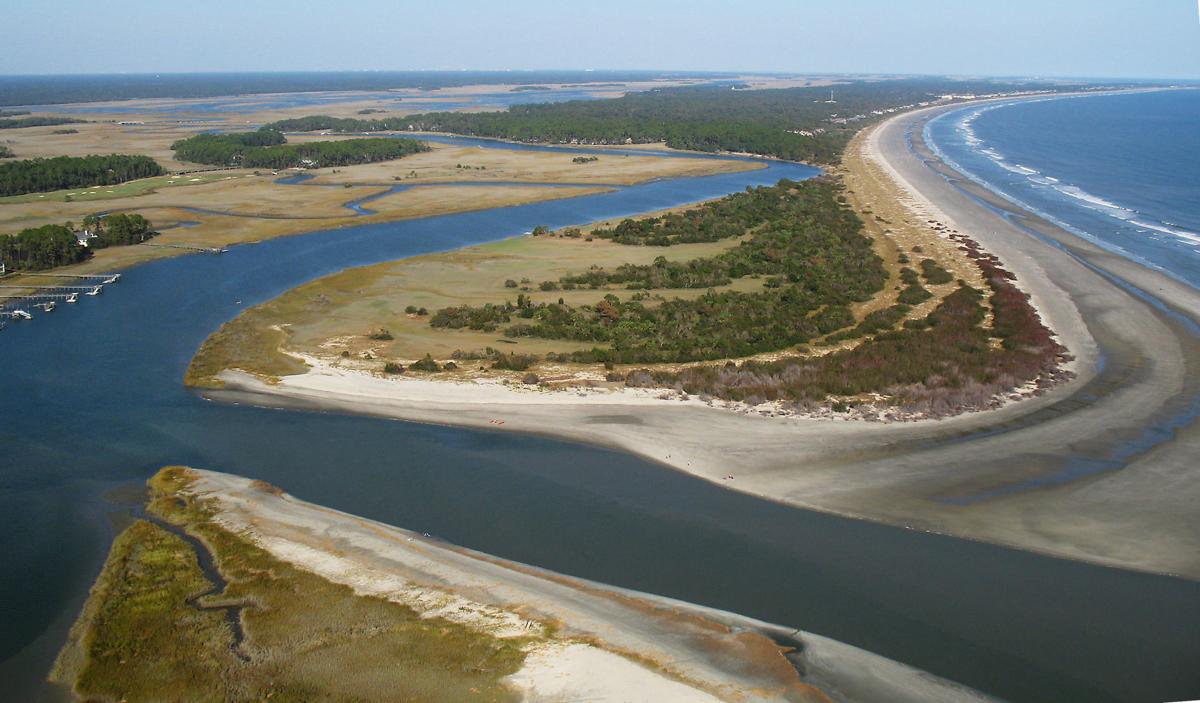
Photo courtesy of the Post and Courier

This blog has discussed “Captain Sam’s Spit” in Kiawah Island three times before. Googling that picturesque name will reveal a treasure trove of news, opinion and case law involving the proposed development of a beautiful and extremely precarious tract of pristine beach property on South Carolina’s coast.

In the latest case*, South Carolina’s Supreme Court refers to the property as one of our state’s only three remaining pristine sandy beaches readily accessible to the general public. The other two are Hunting Island State Park and Huntington Beach State Park. I enjoy the blessing of walking the pristine beach of Huntington Beach State Park on a regular basis, so despite having a career on the periphery of real estate development, I am in favor of maintaining these three state treasures.

The South Carolina Bar’s Real Estate Intensive seminar in 2016 and 2018 included field trips to Captain Sam’s Spit, from a distance at least. Professor Josh Eagle of the University of South Carolina School of Law was an excellent tour guide, and how many opportunities do we, as dirt lawyers, have for field trips? The South Carolina Environmental Law Project, located in Pawleys Island, fights these cases. Amy Armstrong, an attorney with that entity, joined our group to explain the environmental and legal issues.

Here are greatly simplified facts. Captain Sam’s Spit encompasses approximately 170 acres of land above the mean high-water mark along the southwestern tip of Kiawah Island and is surrounded by water on three sides. The Spit is over a mile long and 1,600 feet at its widest point, but the focal point of the latest appeal is the land along the narrowest point (the “neck”), which is the isthmus of land connecting it to the remainder of Kiawah Island. The neck occurs at a deep bend in the Kiawah River where it changes direction before eventually emptying into the Atlantic Ocean via Captain Sam’s Inlet.

The neck has been migrating eastward because of the erosive forces of the Kiawah River. The “access corridor”—the buildable land between the critical area and the ocean-side setback line—has narrowed significantly in the past decade to less than thirty feet. Googling this issue will lead to active maps which show the change over time. The width of the neck is significant because the developer needs enough space to build a road. At the base of the neck is Beachwalker Park, operated by the Charleston County Parks and Recreation Commission. Our fieldtrips were conducted on that Park.

Previously, the administrative law court (ALC), over the initial objection of DHEC, has granted permits for the construction of an extremely large erosion control device in the critical area. In the prior cases (citations omitted), the Supreme Court found the ALC erred. The current appeal stems from the ALC’s third approval of another structure termed “gargantuan” by the Supreme Court—a 2,380-foot steel sheet pile wall designed to combat the erosive forces carving into the sandy river shoreline in order to allow the developer to construct the road to support the development of fifty houses. The Court again reversed and, in effect, shut down the proposed development, at least temporarily. The economic interests of an increased tax base and employment opportunities do not justify eliminating the public’s use of protected tidelands, according to the Court.

After a motion for a re-hearing, the result is the same. The Court reaffirmed its earlier decision without further arguments. We’ve pondered whether each case is the end of the litigation. At this point, we don’t know. Creative developers and lawyers may make further attempts to proceed. Stay tuned.

*South Carolina Coastal Conservative League v. South Carolina Department of Health and Environmental Control, South Carolina Supreme Court Opinion 28031 (June 2, 2021); Re-Filed September 1, 2021.

Court decides an interesting, but unpublished, case on the effect of a plat notation

Standard

Unpublished opinions don’t typically get my attention, but my friend, Bill Booth, sent this one* to me because he found it interesting, and I do, too. As a reminder, unpublished opinions have no precedential value, but they sometimes provide insight on how the Court might react in a similar situation, at least under the current makeup of the court.

The issue in this case was whether a notation on a subdivision plat that certain lots were “for agricultural use only” created a valid restriction of the use of the lots. Mikell Scarborough, Master-in-Equity for Charleston County, granted summary judgment, relying on extrinsic evidence to conclude that there was no intent to create a restriction despite the plain language on the face of the plat. That decision was affirmed.

The Court cited familiar cases holding that restrictive covenants are contractual in nature and must be strictly construed in favor of the free use of property. The Court also referred to cases holding that when a deed describes land as shown on a plat, the plat becomes a part of the deed. The interesting twist became whether the plat notation created an ambiguity that would allow the introduction of extrinsic evidence.

The Court found that the language in the plat was not ambiguous, but that the origin of the note created the ambiguity. The surveyor provided an affidavit to the effect that the Charleston County Planning Commission placed the agricultural use restriction on the plat “for the purpose of indicating that Charleston County would not, at that time, approve building permits for the lots because (the lots in question) did not meet current minimum standards for a modified conventional sub-service disposal system.”

When the plat was submitted for approval, the property owners included a letter explaining they were aware that the land possessed poor soil conditions for septic systems. The letter requested that the subdivision be approved with the stipulation that any lot that did not support a septic system would be restricted from becoming a building lot until public sewer service became available.

The case doesn’t make this point clear, but I am assuming the Appellant sued other lot owners who had built on their lots despite the plat notation. In other words, the Appellant wanted the restriction enforced as to other lots, not the lot the Appellant purchased. Interestingly, one house had been built before the Appellant purchased its lot.

A representative of the Appellant claimed he relied on the plat notation and that his title insurance company told him the lots were restricted. The Court found it significant, however, that the property owners who recorded the plat did not intend to restrict the property.

The Appellant argued that the deeds for all the lots specifically state that the property is subject to all restrictions, reservations, easements and other limitations that appear of record, including on the Plat. The Court held, citing 20 Am. Jur. 2d Covenants, Conditions, and Restrictions §151 (2015) that common “subject to” language does not create a restriction where none exists.

The Appellant also argued that an agricultural use exception in the title insurance policy was evidence that the restriction ran with the land, but the Court held that the title insurance company was merely noting the provision was on the plat so that it would not be liable if the Appellant could not build on its lot.  

The Court concluded that the record does not contain a scintilla of evidence to support the imposition of a building restriction on the Respondents’ lots.

Carpenter Braselton, LLC v. Roberts, South Carolina Court of Appeals Unpublished Opinion No. 2021-UP-280.

SC Supreme Court deals with Rock Hill stormwater issue

Standard

Justice Few declares piping storm water under a house is “wrong”

I love a case where a separate opinion (usually a dissent) cuts to the chase and explains in a few words a multiple-page quagmire.  That’s what we have in Ray v. City of Rock Hill*, a case decided on August 4 by the South Carolina Supreme Court.

Lucille Ray sued the City of Rock Hill for inverse condemnation, claiming her property was taken as a result of stormwater flowing through pipes under City streets into a terra cotta pipe that runs behind her property. The circuit court granted summary judgment to the City, and the Court of Appeals reversed, holding a genuine issue of material fact exists as to whether the City engaged in an affirmative, positive, aggressive act sufficient to support the inverse condemnation claim. The Supreme Court modified and affirmed that decision, remanding the case for a determination on that issue.

The facts are particularly interesting for dirt lawyers. Ray purchased her house on College Avenue in 1985. Before the house was built in the 1920s, someone—there is no record as to who—installed a 24-inch underground terra cotta pipe under the property. The property and the pipe are located at the topographical low point of a 29-acre watershed. Three stormwater pipes installed and owned by the City collect stormwater and transport it under various streets in the neighborhood. Stormwater runs through the pipe to a catch basin directly in front of Ray’s house. When the water reaches the catch basin, it is channeled under Ray’s house to the back of her property. The pipe has been channeling stormwater in this fashion for roughly 100 years although the record reflects no evidence of an easement.

You won’t be shocked that Ray’s property had a history of sinking and settling. In 1992, Ray saw her gardener fall waist-deep into a sinkhole. The house’s roof was subject to bending and movement. The steps on the front porch sank. In 2008, Ray contacted the City and was told about the pipe running under those steps. (This exchange supported the City’s claim that the statute of limitations had run on a damages claim.)

In 2012, Ray brought this action seeking inverse condemnation and trespass. Other relief was sought and the South Carolina Department of Transportation was added as a defendant, but those issues are not relevant to this appeal. Shortly after Ray brought the suit, the City began maintenance work on a sewer line beneath College avenue.

To get to the sewer line, the City had to dig up part of College Avenue in front of the property and to sever three stormwater pipes from the catch basin. The basis of the inverse condemnation claim is that the City’s reconnection of the pipes to the catch basin was an affirmative, positive, aggressive act. That issue was returned to the circuit court for determination.

Justice Few’s separate opinion (not categorized as a concurrence or a dissent) is cogent. He wrote to make two points. First, the City should not be piping stormwater under Ray’s house! It is wrong, he said, and he doesn’t care who built the pipe or whose fault it is that the house is sinking because of the water. “The City should do the right thing and fix the problem.”

Justice Few’s second point is that all wrongs are not subject to redress in our civil courts. To the extent Ray’s inverse condemnation theory is valid, he said, the taking occurred many years ago, either when the pipes were installed or when the deterioration of the pipes began to harm the property. He said it makes no difference that the pipes were reconnected in 2012. The effect of that act was to continue to run storm water under property Ray alleges had already been taken.

Justice Few concluded that there is simply no right of action available under an inverse condemnation theory and that the circuit court correctly dismissed that claim

I look forward to what happens next!

* South Carolina Supreme Court Opinion 28045, August 4, 2021

Three strikes, you’re out?

Standard

South Carolina Supreme Court protects Captain Sam’s Spit for the third time

This blog has discussed “Captain Sam’s Spit” in Kiawah Island twice before. Googling that picturesque name will reveal a treasure trove of news, opinion and case law involving the proposed development of a beautiful and extremely precarious tract of pristine beach property on South Carolina’s coast.

In the latest case*, South Carolina’s Supreme Court refers to the property as one of our state’s only three remaining pristine sandy beaches readily accessible to the general public. The other two are Hunting Island State Park and Huntington Beach State Park. I enjoy the blessing of walking the pristine beach of Huntington Beach State Park on a regular basis, so despite having a career on the periphery of real estate development, I am in favor of maintaining these three state treasures.

The South Carolina Bar’s Real Estate Intensive seminar in 2016 and 2018 included field trips to Captain Sam’s Spit, from a distance at least. Professor Josh Eagle of the University of South Carolina School of Law was an excellent tour guide, and how many opportunities do we, as dirt lawyers, have for field trips? The South Carolina Environmental Law Project, located in Pawleys Island, fights these cases. Amy Armstrong, an attorney with that entity, joined our group to explain the environmental and legal issues.

Here are greatly simplified facts. Captain Sam’s Spit encompasses approximately 170 acres of land above the mean high-water mark along the southwestern tip of Kiawah Island and is surrounded by water on three sides. The Spit is over a mile long and 1,600 feet at its widest point, but the focal point of the latest appeal is the land along the narrowest point (the “neck”), which is the isthmus of land connecting it to the remainder of Kiawah Island. The neck occurs at a deep bend in the Kiawah River where it changes direction before eventually emptying into the Atlantic Ocean via Captain Sam’s Inlet.

The neck has been migrating eastward because of the erosive forces of the Kiawah River. The “access corridor”—the buildable land between the critical area and the ocean-side setback line—has narrowed significantly in the past decade to less than thirty feet. Googling this issue will lead to active maps which show the change over time. The width of the neck is significant because the developer needs enough space to build a road. At the base of the neck is Beachwalker Park, operated by the Charleston County Parks and Recreation Commission. Our fieldtrips were conducted on that Park.

Twice before, the administrative law court (ALC), over the initial objection of DHEC, has granted permits for the construction of an extremely large erosion control device in the critical area. In both cases (citations omitted), the Supreme Court found the ALC erred. The current appeal stems from the ALC’s third approval of another structure termed “gargantuan” by the Supreme Court—a 2,380-foot steel sheet pile wall designed to combat the erosive forces carving into the sandy river shoreline in order to allow the developer to construct the road to support the development of fifty houses. The Court again reversed and, in effect, shut down the proposed development, at least temporarily. The economic interests of an increased tax base and employment opportunities do not justify eliminating the public’s use of protected tidelands, according to the Court.

The Charleston Post and Courier has reported that a lawyer for the developer will ask for a rehearing of the latest case. I wouldn’t be surprised to see the litigation continue for another decade, despite rising sea levels and increasing hurricane threats affecting the precarious property. Stay tuned for future news.

*South Carolina Coastal Conservative League v. South Carolina Department of Health and Environmental Control, South Carolina Supreme Court Opinion 28031 (June 2, 2021)

SC Supreme Court warns Clerks of Court to avoid rejecting filings

Standard

ROD offices should pay attention!

This post may be the first and last time this blog deals with a criminal case*, but the warning from South Carolina’s Supreme Court to Clerks of Court presents a worthy discussion for dirt lawyers.

The case involved a post conviction relief (PCR) application following a murder and attempted armed robbery conviction. The application was fraught with problems including a prison lockdown and incorrect forms. The Court said that the Clerk of Court’s ministerial duties required to Clerk to simply accept the application for filing, give it the appropriate docket number, and distribute it as required by law. Instead, the Clerk returned the application based on the statute of limitations. After chastising the Clerk, the Court granted the petition and instructed the petitioner to file his successive application within thirty days of the decision.

Omitting the citations and a significant footnote to be discussed later, here is the warning:

“We take this opportunity to remind the clerks of courts of their ministerial duty to docket filings irrespective of potential procedural flaws that may exist. It is not within the Clerk of Court’s authority to refuse to perform her duty based on her opinion that a filing lacks legal merit or is untimely. This duty is not discretionary. Unless specifically authorized by statute or a court rule, a clerk of court may not exercise any judicial power reserved for a judge. The clerk cannot, without express constitutional or statutory authority, exercise any judicial functions. This includes the prohibition of performing any action contingent on deciding a question of law. It follows that a clerk of court cannot ordinarily determine questions of law. Accordingly, a clerk of court does not have the authority to reject a filing based on ostensible or perceived failures, including whether the document is contained on the proper form. Because the clerk’s role is ministerial in this respect, the clerk shall not be concerned with the merit of the papers or with their effect and interpretation. Stated differently, a clerk of court may not reject a pleading for lack of conformity with requirements of form; only a judge may do that. In the absence of an order from a judge, clerks may not refuse to accept a notice of appeal, even if they believe that no appeal is untimely or otherwise defective. Instead, the clerk shall accept the filing, thereby permitting the court to decide any issues the parties may have with it.”

If you ever have an ROD office reject your deed, mortgage or other real estate documents, you may need to cite this case!

I had a situation early in my practice where properties had been accumulated across county lines for the development of a mall. To comply with seller and lender requirements, I had to record all the documents in a single day. Prior to cutting the recording checks, I had to apportion the documentary stamps between the two counties, which I did carefully and with much tax advice. The first county readily accepted all the documents. I was halfway home. The other county, however, rejected all the documents by jumping to a legal and tax decision about the sufficiency of the doc stamps for that county. I was in a proverbial pickle! I couldn’t un-record documents in the first county to take the time to sort out the situation. I had to convince the second county to accept the documents. Luckily, I had a good friend who was on the legal staff of the Department of Revenue. After several hours of running that friend down and explaining the situation to him in great detail, he agreed on my behalf to convince the second ROD to record the documents to allow the DOR to sort out the tax issue later. Whew! (And, by the way, my calculations turned out to be correct because I got great advice in advance.)

My position about this topic has always been that the ROD did not have the authority to decide a legal question about my documents! After this case, I believe the Supreme Court would agree.

Dirt lawyers love to tell stories about the treatment of documents in different counties. The stories go something like this…. County A will record a leaf that floats in from an open window, but County B will refuse to record a document on the flimsiest of legal technicalities.

I hope this case will help even the playing field.

One significant footnote in the case relates to real estate transactions. Referring to the rule that indicates a clerk cannot exercise judicial power unless authorized by statute, footnote 2 reads: “For example, in the context of real or personal property, section 30-9-30 authorizes a clerk of court to remove a sham document from the public records upon proper notice if the clerk reasonably believes the document to be fraudulent.”

This statute and this power could be important in cases of forged signatures and other fraud, but I still believe the ministerial official would at least need sound legal advice.

Pull this case out the next time one of your documents is rejected!

*Barnes v. The State of South Carolina, South Carolina Appellate Case No. 2020-001360 (June 3, 2021).