
Thank you, Claire

Standard

For more than three decades, Claire Manning has been a trusted voice in South Carolina’s real estate law community. Ten years ago, Claire decided to start writing a real estate law blog she titled “Let’s Talk Dirt” to educate and engage lawyers, paralegals, and title agents on the ever-evolving landscape of real estate law and title insurance. With an impressive 518 posts and 284,000 views, her dedication to keeping the industry informed is nothing short of remarkable. In fact, Claire has continued to blog regularly even after she retired in 2021!

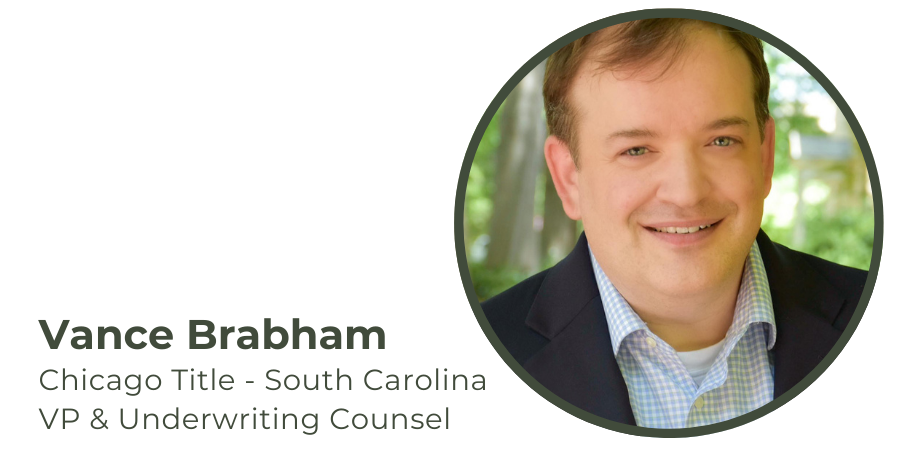
Now, as she steps away from her role as blog editor and hands the reins over to the Chicago Title South Carolina underwriters, we want to take a moment to say: Thank you, Claire.

A Legacy of Knowledge and Service

Claire’s ability to break down complex legal topics into clear, digestible insights has been invaluable. Whether it was legislative updates, case law interpretations, or practical guidance on day-to-day title issues, her posts provided a reliable resource for professionals across the state.

Her writing was more than just informative—it was engaging and relatable. She had a way of making even the driest legal topics feel approachable, sprinkling in humor and real-world applications that made learning enjoyable. It’s no surprise that Let’s Talk Dirt became a go-to source for so many in the industry.

More Than a Blog—A Community

One of Claire’s greatest accomplishments was fostering a sense of community. Through her blog, she created a space where real estate professionals could stay connected, share insights, and navigate challenges together. She never shied away from tackling tough topics, and she always welcomed discussion and questions.

Her impact goes beyond the blog itself. Claire has been a mentor, a leader, and a resource to so many in the industry. She has always been generous with her knowledge and time, ensuring that South Carolina’s real estate professionals had the tools and information they needed to serve their clients with confidence.

The Future of Let’s Talk Dirt

Though Claire is stepping away as editor, her legacy continues. Chicago Title’s South Carolina underwriters and attorneys will carry on the blog’s mission, ensuring that the industry remains informed and engaged. And while Claire may no longer be writing the posts, her influence will still be felt in every update and insight shared.

To Claire—thank you for your years of dedication, your expertise, and your passion for educating the real estate law community. Your contributions have made a lasting impact, and your work will continue to benefit professionals across the state for years to come.

We wish you all the best in your next chapter and hope you take great pride in the incredible resource you’ve built. Let’s Talk Dirt wouldn’t be what it is today without you!

For your holiday reading pleasure … here’s another drafting nightmare case, dirt lawyers

Standard

South Carolina’s Supreme Court has invalidated an arbitration agreement in a residential home purchase contract because of a sentence found to run afoul of public policy*. The homebuyers are free to pursue their lawsuit against the home builder.

Amanda and Jay Huskins bought a house from Mungo Homes. The arbitration section in the purchase contract included this sentence:

“Each and every demand for arbitration shall be made within ninety (90) days after the claim, dispute or other matter in question has arisen, except that any claim, dispute or matter in question not asserted within said time periods shall be deem waived and forever barred.”

The Court held that it is undisputed that this clause shortened the statute of limitations for any claim to the ninety-day period. Mungo conceded that this provision ran afoul of South Carolina Code §15-3-140 (2005), which forbids and renders void contract clauses attempting to shorten the legal statute of limitations.

The Huskins brought this lawsuit against Mungo, raising various claims related to the sale. Mungo asked the Circuit Court to dismiss the complaint and compel arbitration. The Huskins countered that the arbitration clause was unconscionable and unenforceable and the lower court granted the motion to compel arbitration. The Court of Appeals held the clause was unconscionable and unenforceable but ruled the clause could be severed from the rest of the arbitration agreement and affirmed the order compelling arbitration.

The Supreme Court stated that the better view is that the clause is unenforceable because it is void and illegal as a matter of public policy. The Court further noted that the contract contained no severability provision and that Mungo’s “manipulative skirting of South Carolina public policy goes to the core of the arbitration agreement and weighs heavily against severance.”

The Court mused that it has been steadfast in protecting home buyers from unscrupulous and overreaching terms, and stated that applying severance here would erode laudable public policy. The Court, therefore, declined to sever the unconscionable provision for public policy reasons. The entire arbitration provision was held to be unenforceable. The case was remanded to the Circuit Court for further action.

Drafting contracts for corporate clients can be tricky, dirt lawyers. Read this case and similar cases carefully!

*Huskins v. Mungo Homes, LLC, South Carolina Supreme Court Opinion 28245 (December 11, 2024).

Charleston County finally agrees to implement an e-filing system

Standard

For many years, Charleston County’s Register of Deeds Office has refused to join the growing list of South Carolina counties that offer electronic filing for land records. Dirt lawyers have scratched their heads wondering when this large county will implement a system that has proved in other counties to be efficient and economically advantageous.

Finally, Charleston ROD has announced that it has entered into a contract with a vendor to implement an electronic filing system. Initial projections are that the new system will be in place in late 2025.

Charleston has also announced that it will provide property owners the opportunity to sign up for fraud prevention services that will notify owner of any filings that may affect their properties. Similar services have been offered by national companies at a price. Other counties in South Carolina have offered similar services free of charge.

Register of Deeds Karen Hollings said in a press release that the electronic filing system will make the Register of Deeds office better organized and more efficient for the people of Charleston County.

Merry Christmas to all!

Following injunction, FinCEN announces compliance with CTA is voluntary

Standard

On December 3, the United District Court for the Eastern Division of Texas granted a nationwide preliminary injunction that prohibits the federal government from enforcing The Corporate Transparency Act.

In response, the United States Treasury Financial Crimes Enforcement Network (FinCEN) announced on December 9 that while the injunction is in place, compliance with the CTA is only voluntary.

The Corporate Transparency Act, which went into effect January 1, 2024, requires many companies to report beneficial ownership information to FinCEN. Beneficial ownership information is defined as identifying information about the individuals who directly or indirectly own or control a company. The deadline for entities created before January 1, 2024 was January 1, 2025

Lawyers have been scrambling to grasp the intricacies of the new law and to assist their corporate clients, including homeowners’ associations, in compliance.

Six plaintiffs filed the lawsuit in May challenging the constitutionality of the law. The decision is based on the Commerce Clause, and the statute is based on national security and aimed at enforcing laws against money laundering.

This case will surely go to the Supreme Court, and we will have to wait to see how that Court reacts. It is possible that the rationale for the legislation holds for some but not all entities. Homeowners’ associations seem to be likely candidates to dodge this particular bullet.

In the meantime, your clients are not required to comply with the new law.

Court grants nationwide injunction against enforcement of CTA

Standard

The Corporate Transparency Act, which went into effect January 1, 2024, requires many companies to report beneficial ownership information to the United States Treasury Financial Crimes Enforcement Network (FinCEN). Beneficial ownership information is defined as identifying information about the individuals who directly or indirectly own or control a company. The deadline for entities created before January 1, 2024 is January 1, 2025.

Lawyers have been scrambling to grasp the intricacies of the new law and to assist their corporate clients, including homeowners’ associations, in compliance.

But we have a huge development.

On December 3, the United District Court for the Eastern District of Texas granted a nationwide preliminary injunction that prohibits the federal government from enforcing the new law.

Six plaintiffs filed the lawsuit in May challenging the constitutionality of the law. The decision is based on the Commerce Clause, and the statute is based on national security and aimed at enforcing laws against money laundering. This case will surely go to the Supreme Court, and we will have to wait to see how that Court reacts. It is possible that the rationale for the legislation holds for some but not all entities. Homeowners’ associations seem to be likely candidates to dodge this particular bullet.

Department of Justice takes last-minute action against NAR Settlement

Standard

On November 24, just 48 hours before the National Association of Realtors’ settlement agreement headed to final approval, the Department of Justice filed a statement of interest in the lawsuit.

The filing indicated that the DOJ did not participate in the underlying litigation, but it challenged the settlement’s provision that requires buyers and buyers’ agents to enter into a written agreement before touring a home. This provision raises concerns under antitrust laws that could be addressed in multiple ways, according to the DOJ’s statement.

The DOJ suggested rectifying the issue by eliminating the buyer broker agreement requirement or to disclaim that the settlement creates any immunity or defense under the antitrust laws. Otherwise, the court could clarify that the settlement approval affords no immunity or defense for the buyer-agreement provision. The DOJ believes the settlement could limit the ways buyer brokers compete for clients.

The final hearing is scheduled for November 26 in Missouri. The NAR said in a statement that it will advocate for a final settlement that day. The statement suggested that the settlement is not what the NAR wants, but that it is preferable to continued litigation and the uncertainty of a jury verdict.

We’ll see lots of news on this topic this week and next week!

In the meantime, Happy Thanksgiving wishes for you and your family!

Court of Appeals holds right of first refusal unenforceable

Standard

Heads up, dirt lawyers, this is another case dealing with drafting issues. Please read it carefully and apply its concepts the next time you are asked to draft a right of first refusal.

Crescent Homes SC, LLC v. CJN, LLC* involved a contract for CJN to develop 32 lots in a subdivision for sale to Crescent Homes. Crescent Homes would build single-family homes on these lots for sale to homebuyers. The contract referenced a “Future Phase on adjacent property owned by CJN and contained the following paragraph:

“Right of First Refusal: At the Initial Closing, (CJN) will grant to (Crescent) a right of first refusal with respect to the lots cross-hatched and shown on Exhibit ‘A-2’ as “Future Phase” and any additional lots that may from time to time be annexed or otherwise included in the Subdivision. A memorandum of such right of first refusal in a form reasonabl(y) acceptable to the Parties will be recorded in the public records of Greenville County at the Initial Closing.”

CJN did not start development of the future phase because of cost concerns. Crescent brought a lawsuit for breach of contract asserting CJN delayed the initial closing by, most significantly, failing to maintain the lots free from trash and debris. Crescent sought specific performance and other remedies.

CJN entered into a contract with Douglas Clark making termination of the right of first refusal in the Crescent contract a contingency. When CJN provided a copy of the Clark offer to Crescent, Crescent responded by offering $700,000 to purchase the property and by filing a lis pendens. Crescent notified CJN that even though the right of first refusal was binding, Crescent was not required to exercise or waive it at that time because the initial closing had not yet occurred.

Crescent asserted that the right of first refusal had not been delivered and was not capable of being validly exercised at that time. Clark withdrew his offer for reasons unrelated to this controversy.

The initial closing took place and the parties began the process of developing the lots in the first phase of the subdivision.

CJN filed a lawsuit against Crescent seeking a declaratory judgment and alleging abuse of legal process. The suit alleged that that the right of first refusal was invalid and Crescent had filed four lis pendens for the ulterior purpose of preventing the sale of the future phase property to third parties. CJN also answered Crescent’s complaint asserting counterclaims of breach of contract and quantum meruit/unjust enrichment and seeking remedies of specific performance and monetary damages.

CJN filed a motion for partial summary judgment alleging the right of first refusal was void because it constituted a restraint on the alienation of the property.  The Master denied the motion, finding factual disputes and novel issues required further inquiry.

CJN continued to market the property and obtained at least one additional offer. Crescent filed a motion to consolidate the cases. CJN amended its complaint, adding causes of action for tortious interference with a contractual relationship and unfair and deceptive trade practices.

The Master bifurcated the proceeding and tried CJN’s cause of action for a declaration that the right of first refusal was unenforceable. Crescent moved to dismiss, arguing no justiciable controversy as the matter was not ripe because the previous offers had been withdrawn.

The Master denied that motion and found the right of first refusal to be unenforceable because it was an unreasonable restraint on the alienation of an interest in land, stating “based on the language used in (the paragraph), the court is unable to interpret and/or give meaning to the parties’ agreement without substantially and significantly creating terms and conditions that the parties themselves could have and should have included.”  This appeal followed.

The Court of Appeals held that the matter was justiciable once a bona fide offer had been made. Neither party provided cases regarding ripeness in which offers were made and subsequently withdrawn.

As to the enforceability of the right of first refusal, the Court stated that such a right does restrain an owner’s power of alienation, but the question becomes whether the right unreasonably restrains alienation.

The Court cited a prior case holding that a right of first refusal was unenforceable because it failed to identify the property it encumbered, failed to contain price provisions and failed to contain procedures governing the exercise of the right. The Court found those factors present in this case and affirmed the Master’s finding of unenforceability.

Dirt lawyers, a rule against perpetuities issues was also raised against the right of first refusal, but the Court held it did not have to reach that issue. That is drafting challenge that we will save for another day. The bottom line in this case is that drafting real estate documents requires a great deal of skill and continuing legal research. Be careful out there!

*South Carolina Court of Appeals Opinion 6093 (November 20, 2024)

We have a new real-estate related arbitration case

Standard

Court of Appeals holds arbitration clause unconscionable

Photo from PalmettoBluff.com

315 Corley CW LLC v. Palmetto Bluff Development* involves an appeal from Beaufort County arising from the sale of real estate in the Palmetto Bluff Development to homeowners who ultimately became plaintiffs in this case.

Palmetto Bluff is a planned residential community. Purchasers, by accepting deeds, automatically become members in the Palmetto Bluff Club. Club membership is further memorialized by a Club Membership Agreement. The governing terms of the Club are set out in the Club Membership Plan. The Club is a for-profit entity which retains the power, according to the parties, to unilaterally change its fees and policies with no input from Club members.

In 2017, a clause was added to the Membership Agreement stating that disputes surrounding the Membership Agreement will be resolved by mandatory arbitration in accordance with the rules of the American Arbitration Association (AAA), applying the substantive law of South Carolina.

In 2020, several homeowners complained that the Club was planning to make changes that they understood would limit the ability of their short-term tenants to use the Club’s facilities. After failed mediation attempts, this lawsuit was brought in 2022. The plaintiff homeowners then demanded arbitration.

Later in 2022, the homeowners asked the circuit court to stay arbitration and sought summary judgment on the alleged invalidity of the arbitration clause. The defendants moved to compel arbitration. The lower court held that the arbitration clause was invalid because the agreement was unconscionable.

The Court of Appeals agreed that the agreement was unconscionable because the homeowners lacked a meaningful choice in entering the agreement and because the agreement can be unilaterally modified. 

The Court cited cases to the effect that whether one party lacks a meaningful choice in entering the arbitration agreement typically speaks to the fundamental fairness in the bargaining process. Courts consider the relative disparity in the parties’ bargaining power, the parties’ relative sophistication, whether the parties were represented by independent counsel, and whether the plaintiff is a substantial business concern. Contracts of adhesion, according to these cases, are standard form contracts offered on a take-it-or-leave-it basis with terms that are not negotiable. However, contracts of adhesion are not per se unconscionable. Instead, adhesion contracts are not unconscionable in and of themselves so long as the terms are even-handed.

The Court of Appeals held that the contract at issue is unconscionable because there is no conceivable potential for bargaining power on the part of those whom the provisions purport to bind. There was an absence of meaningful choice. The Court also held that the agreement was oppressive and one-sided because it limited the award of treble damages, regardless of whether they are construed as compensatory or punitive.

I recommend that South Carolina dirt lawyers read this case in detail and apply its guidelines in drafting documents for developer and builder clients.

*South Carolina Court of Appeals Opinion 6074 (Filed July 24, 2024, Refiled November 13, 2024)

SC Supreme Court disbars real estate lawyer for “robbing Peter to pay Paul”

Standard

…and using title insurance as his tool

In the Matter of Bush* resulted in a disbarment of a dirt lawyer who used a common “robbing Peter to pay Paul” scheme to steal from clients. The case involved three disciplinary complaints.

The first complaint revolved around the failure to wire $334,000 to a lender to pay off a mortgage in a real estate closing. The lawyer eventually admitted he used the money to replace funds he misappropriated from another closing.

The second complaint arose when the lawyer issued a closing protection letter and a title insurance commitment despite the fact that his title insurance company had suspended him as an agent and his title insurance agency license had expired. The lawyer received funds for this closing but, again, failed to satisfy the prior mortgage. The lawyer eventually admitted he used the funds to pay off the underlying mortgage for the closing described in the first complaint.

After the lawyer was placed in interim suspension by the Supreme Court, he responded to a third client whose mortgage had not been satisfied that, “I am going to plow back in to this and let me talk with some colleagues about a way to get a better resolution quickly.”  The lawyer did not tell the third client that he had failed to satisfy her mortgage. Instead, he provided false information to the client regarding the status of the debt. The lawyer finally admitted that he had stolen the funds.

It’s amazing that a few bad apples continue to employ these deceptive techniques that eventually come to light. It is impossible to hide this type of scheme forever because the economy always ebbs and flows. Even a small economic downturn can result in the failure of the next closing to materialize. Without the funds from the next closing, the mortgage from the prior closing is never paid, and the house of cards falls quickly. In this case, the lawyer’s former title insurance company received a claim from one of the lenders who was not paid. A title insurance complaint will also cause the house of cards to fall quickly.

Lawyers, please read this case carefully as a model of what not to do! Be careful out there!

*South Carolina Supreme Court Opinion 28241 (November 6, 2024).

Judge approves real estate commissions settlement

Standard

Late in 2023, this blog discussed multiple class action lawsuits across the United States attempting to hold brokerage companies responsible for conspiring to keep residential real estate commissions artificially high. We have a development.

A Federal judge in Missouri said on October 31 that he will approve a $110 million settlement with nine brokerage companies. In May, a similar $208 million settlement was approved. And two more orders are expected in November, when the same judge weighs a pair of settlements against the National Association of Realtors and HomeService of America.

This blog also discussed last November that a similar class action was brought in South Carolina. Dirt lawyers, I would love to know what you are seeing in your markets. Are commissions now being negotiated to avoid the potential liability? I’d love to hear what’s going on out there.