
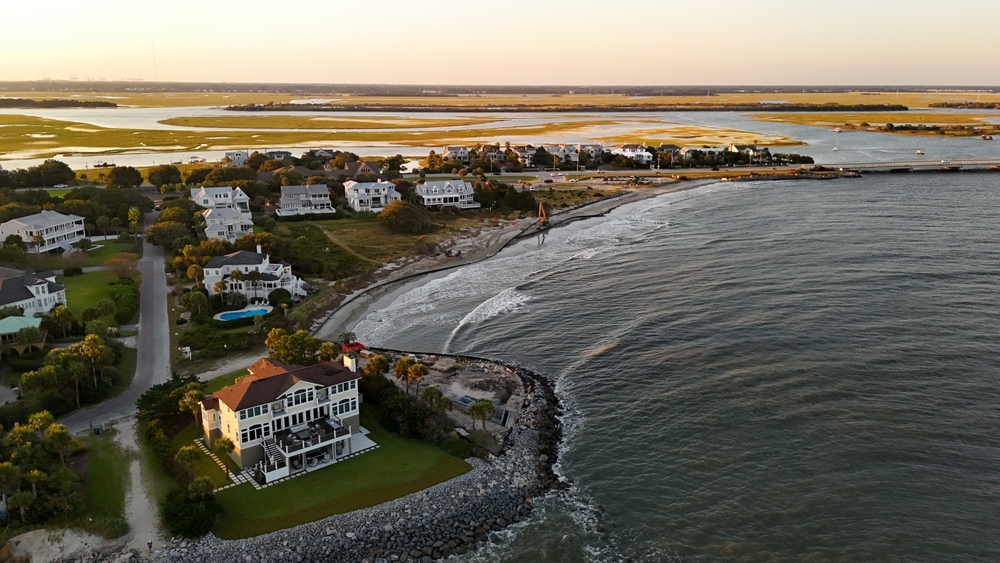
We all know that South Carolina has some of the most beautiful natural scenery in the nation. As the weather gradually improves, and with Spring Break underway for many and the summer rental season right around the corner, tourists begin flocking to our beautiful beaches.
In February 2026, a legal dispute[1] on Sullivan’s Island quietly reshaped the conversation around property rights, zoning enforcement, and the future of residential ownership models in South Carolina’s coastal communities. At the center of the case was 2 SC Lighthouse, LLC, a property owner, and Pacaso, Inc., a company that facilitates fractional homeownership. On the other side stood the Town of Sullivan’s Island, determined to enforce its long‑standing restrictions on short‑term rentals. While the case involved a single property, its implications reach far beyond one address.
Sullivan’s Island has long maintained strict zoning rules designed to preserve its residential character. Among those rules are limits on short‑term vacation rentals, which town officials argue can disrupt neighborhoods and strain local infrastructure. As new real estate models have emerged, the town has taken a close look at how these arrangements fit within existing ordinances.
That scrutiny intensified when a home owned by 2 SC Lighthouse, LLC was used in partnership with Pacaso. Pacaso’s model allows multiple buyers to purchase fractional ownership interests (in this instance, one‑eighth shares) in a single property. Each owner receives scheduled access throughout the year, and Pacaso manages maintenance and logistics. However, unlike a true rental property, occupants do not pay nightly or weekly fees to stay in the home; they are staying in a property they legally own.
Town officials concluded that the arrangement functioned like a vacation rental in practice, even if it was structured differently on paper. The Town’s Zoning Administrator issued a violation, asserting that the property was being used as a prohibited short‑term rental under Sullivan’s Island zoning laws. That decision was upheld by the Town’s Board of Zoning Appeals (BZA).
2 SC Lighthouse and Pacaso appealed to the Charleston County Circuit Court. The court sided with the Town, effectively agreeing that the zoning authorities’ interpretation of the ordinance should stand.
The property owner and Pacaso appealed, arguing that a fractional ownership is not a rental, and that the Town was stretching the definition of “short‑term rental” beyond what its ordinance actually said.
On February 18, 2026, the South Carolina Court of Appeals reversed the circuit court’s decision, siding with 2 SC Lighthouse and Pacaso. The ruling turned on the critical distinction between ownership and renting. The court emphasized that the individuals staying in the home were owners, not tenants. Without a rental transaction (no landlord‑tenant relationship and no payment for temporary lodging), the court found that the town’s definition of a short‑term rental did not apply.
In making its ruling, the court clarified that interpreting a zoning ordinance is a question of law rather than a factual determination entitled to broad deference. While zoning boards are given leeway in applying ordinances, they cannot rewrite or expand those ordinances. If a municipality wants to regulate fractional ownership, it must do so explicitly.
Although the ruling is an unpublished opinion and is not binding precedent, its practical impact is significant. For Sullivan’s Island, the decision places limits on enforcement under current zoning language. The town may still regulate short‑term rentals aggressively, but it cannot treat fractional ownership arrangements as rentals unless its ordinances are amended to say so.
For other South Carolina coastal communities, the case serves as a warning and a roadmap. Many towns face similar tensions between preserving neighborhood character and responding to evolving real estate practices. The decision signals that courts will closely scrutinize attempts to regulate new ownership models using old definitions.
For property owners, the ruling reinforces a core principle of land‑use law: property rights cannot be curtailed by implication. Restrictions must be clearly stated, not inferred based on policy concerns alone.
The decision does not end the debate over fractional ownership on Sullivan’s Island or elsewhere. Municipalities may respond by revising zoning ordinances to directly address co‑ownership models. Developers and property owners, meanwhile, will likely continue testing the boundaries of traditional zoning frameworks.
This case highlights the broader reality that zoning laws written decades ago are being asked to govern a rapidly changing housing market. As ownership models evolve, so too must the rules that regulate them—through legislation, not interpretation.
For now, 2 SC Lighthouse, LLC’s victory stands as a reminder that in land‑use law, words matter, and towns must play by the rules they have written.
[1] Pacaso, Inc. & 2 SC Lighthouse, LLC v. Town of Sullivan’s Island, South Carolina, Appellate Case No. 2024‑000134, 2026‑UP‑078 (S.C. Ct. App. Feb. 18, 2026) (unpublished).


 Let's Talk Dirt