Recent HOA foreclosure case leads to new rule in Beaufort County

Standard

Master imposes rule based on Chief Justice Beatty’s concurring opinion

foreclosure notice

This blog recently discussed the remarkable homeowners’ association foreclosure case, Winrose Homeowners’ Association, Inc. v. Hale, South Carolina Supreme Court Opinion 27934 (December 18, 2019.) You can read the earlier blog here.

The case focused on the inadequacy of the foreclosure sales price and the business model of a third party to leverage a nominal debt to secure an exorbitant return from homeowners who fear eviction. I believe the case will require HOA foreclosure attorneys to rethink their approach going forward.

In his concurring opinion, Chief Justice Beatty said he would go a step further than the majority opinion and adopt the equity method of determining an adequate sales price for residential property in a foreclosure. The equity method compares the winning bid price to the equity in the property. The alternative debt method compares the total debt on the property to its fair market value.

The majority opinion stated that our courts have not established a bright-line rule for what percentage “shocks the conscience”, but a search of our South Carolina’s jurisprudence reveals that our courts have consistently held a price below ten percent definitely does. In this case, the debt method would have resulted in a ratio of 53.9 percent, while the equity method would have resulted in a ratio of 4.9%.

The new rule of the Beaufort County Master-in-Equity Marvin Dukes focuses on a totally separate issue in the case. The homeowners, who were in default, did not receive a notice of the date and time of the foreclosure sale. Judge Dukes’ office disseminated a message to foreclosure attorneys requiring new wording in foreclosure orders.

The new required wording entitled “Special Default Foreclosure Order and Sale Notice Service Instructions” reads as follows:

That, in addition to all notices to the property owner(s) which are required by the  SCRCP or other law, in a case involving property owner’s SCRPC 55 default, or any other case or circumstances where property owner(s) would not ordinarily receive a copy of the Order of Foreclosure and/or Notice of Sale, the party seeking foreclosure (Foreclosing Party) shall, within 5 (five) days of the execution of this Order cause this Order and Notice of Sale (if available) to be served by US Mail upon said property owner(s).

An affidavit of such service shall be filed with the Clerk of Court expeditiously.

In cases where the Notice of Sale is executed later in time than the Order, service shall be accomplished separately, and shall be sent no later than 5 (five) days from receipt by the Foreclosing Party.”

I suspect additional guidance will be coming from our courts about whether the Winrose case will have broad application in foreclosure cases or be limited to its facts. I’m confident foreclosure attorneys feel they need more information.

Supreme Court to hear CFPB Constitutionality Challenge

Standard

Seila Law, LLC v. Consumer Financial Protection Bureau likely to be heard by mid-2020

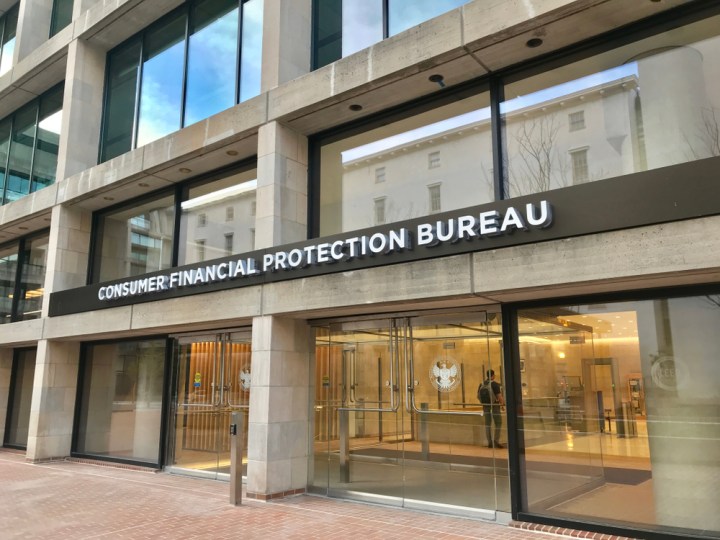
CFPB building

The United States Supreme Court has chosen a case to decide the constitutionality of the CFPB. The case is Seila Law LLC v. Consumer Financial Protection Bureau (U.S. Supreme Court 19-7). The announcement was made on Friday, December 27. The allegation in question is that the structure of the agency grants too much power to its director, in violation of the Constitution’s separation of powers doctrine.

Under the current structure, the director of the CFPB cannot be fired by the president absent “inefficiency, neglect of duty, or malfeasance in office.” The heads of other federal agencies may be removed at the pleasure of the president.

The order posted by the Court requested that both sides address the following question: “If the Consumer Financial Protection Bureau is found unconstitutional on the basis of separation of powers, can 12 U.S.C §5491(c)(3) be severed from the Dodd-Frank Act?”

The United States House of Representatives’ motion to file an amicus curiae brief because the Department of Justice has chosen not to defend the constitutionality of the agency.

Concern about the structure of the agency has been voiced since its inception based on the fact that such huge power has been placed in the hands of one individual director. The argument continues that the CFPB has more power than any agency ever created by Congress. While most federal agencies are controlled by commissions or by a director who serves at the pleasure of the President, the CFPB’s sole director is removable only for cause. Also, since all of the funding of the agency is not controlled by Congress, there is little legislative oversight.

In previous hearings, when the CFPB has been asked what the appropriate remedy should be if the structure of the agency is held to be unconstitutional, the CFPB has maintained that formative statute would have to be amended to allow the President to remove the director with or without cause.  Some have suggested that all of the actions of the CFPB might be suspect if its structure is held unconstitutional. Others have suggested that agency should be headed by a multi-person, bi-partisan commission rather than a single director for greater transparency and accountability.

If a decision in the case is announced in mid-2020, the presidential election could be affected since Sen. Elizabeth Warren’s role in creating the agency is a central pillar of her presidential bid.

Justice Brett Kavanaugh has made clear in a previous dissent that he believes the structure of the agency is unconstitutional.

SC Supreme Court may have eradicated HOA foreclosures

Standard

Third party bid was held grossly inadequate

gavel house

On December 18, the South Carolina Supreme Court decided a case that will force homeowners’ association attorneys to carefully consider whether they will initiate foreclosure actions in the future*. This blog discussed the Court of Appeals case last April. You can read that blog here but the very short version is that the Court of Appeals did not upset any apple carts and left the foreclosure process status quo.

The facts are simple. Mr. and Mrs. Hale bought their home in Richland County in 1998 for $104,250. In the next 20+ years, they built up $60,000 in equity, and the property now has a fair market value of $128,000.

In 2011, the Hales fell behind on their homeowners’ association payments. The HOA initiated a foreclosure complaint seeking a sale of the property in exchange for $566.41 in principal and interest. The Hales defaulted.

Interestingly, after the affidavit of default was filed, the HOA sent the Hales a bill for $250, which they paid. Also interestingly, the law firm representing the HOA sent the Hales a notice that the lien had been satisfied.

Three months after the HOA filed the affidavit of default, the Master entered a default judgment, calculating the amount due to the HOA as $2,898.67, comprised of $250 in principal, $80.87 in interest, $542.80 in litigation costs and $2,025 in attorneys’ fees. The property was sold at auction two weeks later to a third party, Regime Solutions, LLC.

This is the Hale’s explanation of the facts in their motion to vacate the sale:

“When we were served with the lawsuit to take away our home, I put the papers in a drawer and forgot about them. Some time after that, we received a bill from the HOA asking for the $250.00. I paid that without a problem. In November, we received a letter from the law firm of (the HOA) telling us that the Lien had been Satisfied…I thought that everything was OK after that. The next thing I know, someone is knocking on my door telling me that they bought my home and that me and my family were being evicted.”

The Master denied the Hales’ motion and adopted the position that the “effective sales price” was $69,040, consisting of the successful bid plus the balance of the mortgage. In his order, Richland County’s Master-in-Equity, Joseph Strickland, stated that “the practice of homeowners’ association foreclosures would effectively be eradicated if (the Hale’s) position came to bear.”

The appeal was handled by the law office of my friend, Brian Boger, a Columbia lawyer and well-known champion of consumers’ rights. The appeal argued that the $3,036 bid “shocked the conscience” and violated equitable principles.

The Court of Appeals affirmed.  Chief Justice Lockemy dissented, saying:

“A buyer at a judicial sale in which a senior lienholder is not a party takes the property subject to that lien, but the buyer is not responsible for its payment. The evidence in this cases shows (the Hales) have continued to pay the mortgage for a home for which they have no title because they will suffer the severe consequences of default if they do not. The buyer (Regime) has paid nothing. I do not believe it proper to give a judicial sale buyer credit for assuming a debt which is not legally required to pay.”

The Supreme Court seemed truly troubled by Regime’s business model. In a footnote, the Court stated that Regime either allows the senior mortgagee to (re)foreclose on the property or quitclaims the property to the original homeowners for a hefty fee. The Court seemed to be disturbed by Regime’s failure to assume mortgages in the ordinary course of its business.

The Court discussed two methods to calculate whether a bid price is so grossly inadequate as to shock the conscience. The debt method is a ratio comparing the total debt on the property to the fair market value. Under the debt method, Regime would have paid 53.9% of the value of the property. The equity method is a ratio comparing the winning bid price to the equity in the property. Under the equity method, Regime would have paid 4.9% of the value of the property.

The Court stated that our courts have not established a bright-line rule for what percentage “shocks the conscience”, but that a search of our jurisprudence reveals our courts have consistently held a price below ten percent definitely does.

The Court stated that when the foreclosure purchaser assumes the mortgage, the debt method should be used. But the court rejected the blind application of the debt method because of the facts in this case. Under these facts, the Court stated, applying the equity method is the only logical option.

The Court expressed concern about the foreclosure proceeding itself, stating that it morphed in to “a proxy to capitalize on a small debt”. The Court said it was especially troubled by Regime’s participation in a foreclosure proceeding to accommodate its business model of leveraging a nominal debt to secure an exorbitant return from homeowners who fear the prospect of an eviction. The Court said, “We do not countenance the improper use of foreclosure proceedings by the HOA, its attorney or Regime.”

The decision should not be read as a shift toward providing relief to homeowners despite their own poor choices, according to the Court. The Court said the case would have turned out very differently if the HOA and Regime had pursued “foreclosure in the normal course and made affirmative efforts to assume the Hales’ mortgage”. And that under the “unique facts of this case”, the Hales have demonstrated Regime’s bid was grossly inadequate.

I am quite sure my foreclosure lawyer friends are deciding how to change their practices in light of this case. I’m not sure the Court is correct about the normal course of foreclosures. I also doubt that the facts in this case are unique.

Justice Beatty concurred in a separate opinion, stating that he would adopt the equity method generally. That approach would certainly provide more clarity. Justice Beatty also said, “homeownership is the quintessential American dream. Purchasing a home is the largest investment that most South Carolinians will make. To allow the hard-earned equity to be confiscated by a bidder’s minimal investment is unconscionable. This is especially troubling when the foreclosure sale is the result of an HOA lien.”

For many reasons, I am glad today that I am not a foreclosure lawyer!

*Winrose Homeowners’ Association, Inc. v. Hale, South Carolina Supreme Court Opinion 27934 (December 18, , 2019).

Connecticut codifies attorney closing requirement

Standard

connecticut map

South Carolina licensed attorneys must close real estate transactions because our Constitution gives our Supreme Court the power to define the practice of law, and that Court, beginning with the 1987 seminal case, State v. Buyers Service, has defined the practice of law to include closing real estate transactions.

No explicit authority has required a similar result in Connecticut, but by custom, lawyers in Connecticut have routinely been involved in real estate closings. Beginning October 1, 2019, however, this long-standing practice will be required by statute as a result of the passage of Connecticut Senate Bill 320 (Public Act 99-88).

The new law defines “real estate closing” as follows:

  • a mortgage loan transaction, other than a home equity line of credit transaction or any other loan transaction that does not involve the issuance of a lender’s or mortgagee’s policy of title insurance in connection with such transaction, to be secured by real property, or
  • any transaction wherein consideration is paid by a party to such transaction to effectuate a change in the ownership of real property in Connecticut.

A violation of the new law will constitute a felony punishable by a $5,000 penalty or five years in jail.

It is interesting to me that a loan not involving title insurance does not require the involvement of an attorney. Why would a lender’s requirement of title insurance be determinative?  I can envision the argument that foregoing title insurance and thereby foregoing the requirement of the involvement of a licensed attorney would greatly decrease closing costs. Both are protective of the interest of the lender. It seems to me that either title insurance OR a closing attorney would be more desirable than neither.

It is also interesting that there is no differentiation between residential and commercial transactions in the new Connecticut statute. All the South Carolina cases in this area have involved residential facts, and at least one well-respected commercial lawyer in Columbia believes the Court may not have intended to include commercial transactions, where sophisticated parties are almost always involved. Most commercial transactional lawyers believe commercial transactions must follow the residential line of cases.  In Connecticut, it seems clear by the statutory definitions that lawyers are required for commercial closings.

Equity lines not being included under the purview of the new law seems counterintuitive. A consumer can get into as much or more trouble with an equity line as with any first or second mortgage.

And my final thought is that the statute doesn’t seem to define who the attorney must represent in the closing. The law states “no person shall conduct a real estate closing unless such person has been admitted as an attorney in this state.” South Carolina cases are clear that the protections are established for the consumer borrower.

In any event, I believe most South Carolina dirt lawyers would agree with me that we like the fact that Connecticut agrees with South Carolina and wish other states would follow suit!

Dave Whitener’s “Palmetto Logs”

Standard

SC palmetto state

Two weeks ago, this blog paid tribute to the late, great Dave Whitener, a giant among real estate legal professionals in South Carolina. As suggested in that blog about Dave’s “Top Ten You Betters”, I also wanted to share with you Dave’s “Palmetto Logs”.

Several years before his death, Dave was asked to address the American Bar Association. The issue was whether a successful defense might be mounted if a federal agency attacked the rights now existing in South Carolina for lawyers, and only lawyers, to close real estate transactions. In that talk, Dave cited ten areas of defense that he called the Palmetto Logs. For non-South Carolinians, the palmetto log has traditionally been a symbol of protection for South Carolinians in time of war. South Carolina is nicknamed “The Palmetto State”.

Here are Dave’s suggested protections against an attack from outside our state for closings performed by licensed South Carolina attorneys:

Caselaw

  1. State v. Buyers Service, 292 S.C. 426, 357 S.E.2d 15 (1987). In this case, the South Carolina Supreme Court defined the practice of law in a residential real estate closing to include: certification of the title; preparation of the deed and loan closing documents, closing the transaction and overseeing recording.
  2. Doe v. Condon, 351 S.C. 158, 568 S.E.2d 356 (2002). In this case, the South Carolina Supreme Court reiterated and confirmed that the four protected areas set out in Buyer’s Service would also apply to residential refinances.
  3. Doe v. McMaster, 355 S.C. 306, 585 S.E.2d 773 (2003). In 2003, the South Carolina Supreme Court again reiterated its holding in Buyer’s Service.

Statutes and South Carolina Constitution

  1. C. Code §40-5-310 makes it a felony for an individual to participate in the unauthorized practice of law.
  2. C. Code §40-5-320 makes it a misdemeanor for a corporation or other entity to participate in the unauthorized practice of law.
  3. C. Code §37-10-102 gives a borrower the absolute right to choose the closing attorney in a residential loan closing. The statute provides for a $7,500 penalty if the disclosure is not given.
  4. South Carolina’s Constitution gives the S.C. Supreme Court the exclusive right to define the practice of law within South Carolina

Practical Considerations

  1. The low cost attributable to attorneys’ fees for residential closings in South Carolina. Dave believed the low cost would present a major difficulty if a federal agency argues that South Carolina’s practice is anti-competitive or increased prices.
  2. Major job losses would possibly result from the outsourcing of jobs to closing centers outside of South Carolina
  3. Major risks would be raised in turning over the duties now performed by experienced lawyers to unregulated and inexperienced lay persons.

I’m not sure whether Dave would say differently if he were here to analyze this topic for us today. I fear that the retirement of Chief Justice Jean Toal may have resulted in the loss of the South Carolina lawyer’s strongest advocate in the South Carolina Supreme Court. So far, the Palmetto Logs are holding strong, but some more recent cases from our Supreme Court give me some concern on this topic.

In any event, I am continually thankful for Dave Whitener and his influence, mentorship and friendship to South Carolina dirt lawyers!

Paying tribute to a giant of the SC Real Estate Bar

Standard

Dave Whitener was a friend and mentor to us all

Have you ever tried to organize your old forms, seminar materials and documents only to start waxing nostalgic and ultimately getting absolutely nothing accomplished? That happened to me today.

I am sorely behind schedule writing an update to the Handbook for South Carolina Dirt Lawyers. I’m sure my name is “Mud” with Terry Burnett and Alicia Hutto, my good friends at the South Carolina Bar who are not very patiently waiting for results. I had a plan to get the update done in 2017 and again in 2018, but that never happened. I’ve been so busy with new initiatives at work that I didn’t even attempt to develop a plan to write an update in 2019. Now, I’m shooting for the date of my death or retirement, whichever comes earlier. Wish me luck!

Hugh Dave WhitenerBut today, I began to organize ancient materials in an attempt to breathe new life into this aged project. And I kept coming across the same name, my late, great friend, Dave Whitener. Why? Because Dave wrote and taught much of the subject matter I now need to address.

Dave was 70 years old when he died in 2014 after practicing commercial real estate and teaching law school in Columbia for many years. He was married to my friend, Tricia Wharton Whitener, who continues his good work today. Dave was not only an excellent practitioner and teacher, but he was also, as his obituary quips, “renowned as a raconteur whose stories made others happy”. He loved people and he loved the law. He loved talking to law students and lawyers and telling them memorable stories in an effort to keep them out of trouble.

Since keeping my fellow South Carolina dirt lawyers out of trouble is the mission of this blog, I’m finding that many of the lessons Dave taught are appropriate on my day of waxing nostalgic.

If a law student or lawyer called Dave with a disturbing current event that the caller said “rang a bell” from one of Dave’s ethics lectures, Dave would reply, “You’re hearing the dinner bell at the federal prison.” That would get the caller’s attention!  I thought of that quote when I came across a lecture from Dave entitled “Top Ten ‘You Betters’”.  I thought I’d share that list with this audience today because this particular top ten list will never go out of style for real estate practitioners.

Dave Whitener’s Top Ten “You Betters”

    1. You better not facilitate the unauthorized practice of law.
    2. You better do what you should be doing.
    3. You better know what you should be doing.
    4. You better be on time.
    5. Everything better be shown on the closing statement.
    6. Everything on the closing statement better be correct.
    7. You better communicate with your clients.
    8. You better understand the rules on conflicts of interest.
    9. You better remember that your trust account is sacred.
    10. You better train your staff properly.


I could editorialize about each item on the list, but I believe the simplicity of this list speaks volumes for today’s purposes. But if I were to write a chapter on each item on the list, my handbook would be complete.

stay tuned

Thank you, Dave, for your example. My next blog may be about Dave’s ten-point plan for defending the rights of South Carolina licensed practitioners to handle real estate closings. Watch this space! 

Here’s a gift, SC dirt lawyers: Your official recording fee list!

Standard

calculator house

This blog reported on May 29 that South Carolina Governor McMaster signed House Bill 3243 into law on May 16. This legislation, called the Predictable Recording Fee Act (S.C. Code §8-21-310), will streamline document filing in ROD offices by creating predictable fees for many commonly recorded documents such as deeds and mortgages. The new law will take effect on August 1, 2019. You and your staff will no longer have to count pages for documents to be recorded!

You can read the short but effective statute here.

My friend and colleague, Jennifer Rubin, was instrumental in the creation and passage of this legislation. Jennifer drafted the legislation and spearheaded Palmetto Land Title Association’s efforts to get the bill passed. Since the legislation was enacted, Jennifer has worked with members of South Carolina Court Administration, as well as leaders in ROD offices throughout the state, to draft a uniform recording fee schedule.  Attached is the newly created official recording fee list.

This law should simplify and streamline your practice and result in significant time and money savings for you and your clients.

SC Court of Appeals provides lis pendens primer

Standard

Termination on the merits is required for malicious prosecution claim

gavel house

A lis pendens is a handy tool for real estate lawyers. When litigation is brought affecting title to real estate, a lis pendens gives notice to third parties that sales, loans and construction draws should, most likely, come to a screeching halt until the issues affecting title are resolved.

Back in the days when I was in private practice, malicious prosecution claims arose relatively routinely when lis pendens were filed in cases where the title to real estate was not in question. That situation is the subject of a Court of Appeals case from early this year.*

The case involved Somerset Point at Lady’s Island, a subdivision in beautiful Beaufort County. The developer, Coosaw, and River City, one of the construction companies building homes in the subdivision, became involved in a dispute about design and construction standards. River City accused Coosaw of failing to enforce the standards with other builders, and Coosaw, in turn, accused River City of failing to comply with the standards.

River City brought suit in 2011 alleging causes of action for breach of fiduciary duty, breach of contract, and unfair trade practices. Coosaw counterclaimed and crossclaimed against River City for violating the design standards and sought a temporary injunction against continued construction. Coosaw also filed a lis pendens describing one property, Lot 16, in Somerset Point.

River City moved to strike the lis pendens on the ground that title to Lot 16 was not at issue. The master-in-equity agreed and struck the notice of lis pendens. On reconsideration, the master stated, in part, that striking the lis pendens would allow River City’s construction lender to resume providing construction draws and would allow River’s City’s project to be completed. Coosaw appealed but ultimately withdrew the appeal after River City’s sale of Lot 16 rendered the issue moot.

In late 2014, River City filed the lawsuit at issue, alleging causes of action for malicious prosecution and abuse of process based on Coosaw’s filing the lis pendens in the 2011 action. River City argued the cause of action for malicious prosecution was proper because the lis pendens had been terminated in its favor.

The Court of Appeals listed the elements of malicious prosecution to include termination of the proceedings in the plaintiff’s favor. River City argued that a lis pendens is an ancillary proceeding, and termination of an ancillary proceeding will support a malicious prosecution claim. The Court of Appeals held, however, that a lis pendens is not an ancillary proceeding but is simply a notice of the proceeding.

Citing earlier cases, the Court reviewed the law of lis pendens:

  • A lis pendens is a statutory doctrine designed to inform prospective purchasers or encumbrancers that a particular piece of property is subject to litigation.
  • A properly filed lis pendens binds subsequent purchasers or encumbrancers to all proceedings evolving from the litigation.
  • Generally, the filing of a lis pendens places a cloud on title which prevents the owner from freely disposing of the property before the litigation is resolved.
  • The lis pendens mechanism is not designed to aid either side in a dispute between private parties. Rather, the lis pendens is designed to protect third parties by alerting them of pending litigation that may affect title.
  • When no real property is implicated, no lis pendens should be filed.
  • A lis pendens is merely a form of pleading that does not provide any substantive right. It is simply a notice.

The Court held that the termination of a lis pendens to support a malicious prosecution cause of action must be a victory on the merits of the litigation, not a termination based solely on technical or procedural considerations. In the case at hand, the underlying merits remained pending after the termination of the lis pendens. The Court held that the subject action is, therefore, premature.

In short, the Court held that a maliciously filed lis pendens can act as the primary basis for a malicious prosecution claim, provided the plaintiff can establish a favorable termination of the lis pendens reflective of the merits of the underlying action.

*Gecy v. Somerset Point at Lady’s Island Homeowners Association, Inc., South Carolina Court of Appeals Opinion 5622 (January 30, 2019).

Flat recording legislation passes!

Standard

August 1, 2019 is the effective date for this time-saving law

businessman thought bubble scales

On May 16, 2019, Governor Henry McMaster signed House Bill 3243 into law. You can read the short but effective statute here. House Bill 3243, better known as the Predictable Recording Fee Act (S.C. Code §8-21-310), will streamline the filing of documents in the register of deeds offices across the state by creating predictable fees for many commonly recorded documents such as deeds and mortgages. The new law will take effect on August 1, 2019. You and your staff will no longer have to count pages for documents to be recorded!

My friend and colleague, Jennifer Rubin, began work on this predictable recording Bill in the fall of 2016 when she was the President of the Palmetto Land Title Association. Our Agent and friend, Cynthia Blair, who is currently the American Land Title Association President, asked for Jennifer’s help in crafting, drafting and helping to turn the idea of predictable filing fees into law. Accepting that challenge and with the help and support of Chicago Title and PLTA, Jennifer began work on the Bill and began coordinating with the various stakeholders who were: The American Land Title Association, The South Carolina Association of Clerks of Court and Register of Deeds, The Association of Counties, The South Carolina Association of Realtors, The South Carolina Bankers Association, The Mortgage Bankers of the Carolinas, The South Carolina Bar Association, and the American Resort Developers Association on various versions of the Bill.

Jennifer said she was particularly thankful for the efforts of PLTA’s Legislative Committee led by attorney John Langford and the major contributions of her friend Julie Stutts, the deputy RMC for Aiken County.  She also appreciated the advocacy, guidance and support of lobbyists James Knox, Sharon Wilkerson, Neil Rashley, and Kali Turner and their respective groups.  Without everyone pushing this bill forward along and along, the creation of this law would not have been possible.

This new law will finally allow South Carolina real estate attorneys to fully comply with TRID regulations, provide clients and other parties with accurate final closing costs, and keep our bank accounts orderly. Please note that while the new law does not go into effect until August 1st, there is no grace period. So if you have closings on or near the first of August, please be sure to review the new statute to ensure that you’ve collected the correct amount for recording fees.

Nat Hardwick ordered to pay $40M in restitution

Standard
Nat Hardwick

Nathan E. Hardwick IV

This blog discussed Nat Hardwick, a name familiar to many South Carolina real estate lawyers, last fall when he was convicted of embezzling more than $25 million from his former companies, including his former law firm, Morris Hardwick Schneider. He was discussed again in February when he was sentenced to 15 years in prison. His co-conspirator and controller, Asha Maurya, was sentenced to seven years after she cooperated with the government. On May 9, Hardwick and Maurya were ordered to pay $40 million in restitution.

Nathan E. Hardwick IV, 53, described himself as the face of Morris Hardwick Schneider, an Atlanta residential real estate and foreclosure firm that grew into sixteen states, including South Carolina. The firm once had more than 800 employees and boasted of offices in Charleston, Hilton Head, Columbia and Greenville.

On October 12, Hardwick was convicted in federal court in Atlanta of 21 counts of wire fraud, one count of conspiracy to commit wire fraud, and one count of making false statements to a federally insured financial institution. In federal court, sentencing is typically delayed, and the convicted person is released and allowed to get his affairs in order. In this case, however, Hardwick had been released pending trial on bond. After his conviction, he was described by the U.S. Attorney who prosecuted him as a flight risk and was handcuffed and taken to jail immediately.

This story hits close to home. My company was one of the victims of the crimes and one of the parties awarded restitution because it funded the firm’s escrow accounts when the losses were discovered.

The prosecutor described an extravagant lifestyle that Hardwick enjoyed at the expense of others. The case was said to be particularly troubling because the illegal activity was orchestrated by a lawyer who swore an oath to uphold the law and represent his clients with integrity. The U.S. Attorney said he hoped the case sent the message that the FBI and the U.S. Attorney’s office will not tolerate this type of white-collar crime.

According to the evidence, from January 2011 through August 2014, Hardwick stole more than $26 million from his law firm’s accounts, including its trust accounts, to pay his personal debts and expenses. The firm’s audited financial statements showed that the firm’s net income from 2011 through 2013 was approximately $10 million. During that time, according to the evidence, Hardwick took more than $20 million from firm accounts.

Asha Maurya, who managed the firm’s accounting operations, reached an agreement last May with the U.S. Attorney’s office and pled guilty. She was expected to testify at the trial, but was unexpectedly not called as a witness. Her lawyer argued at the restitution hearing that she should be liable for only $900,000, the amount she admitted taking from the firm for her own benefit. She had agreed to pay restitution in that amount as a part of her plea bargain.

During the trial, Hardwick did take the stand in his defense and attempted to blame Maurya with the theft. He said that he trusted her to his detriment, that he was entitled to the funds, and that he was unaware that the funds were wired from trust accounts. Hardwick testified for more than a day and explained that he believed Maurya followed proper law firm procedures.

On the stand, Hardwick, described as the consummate salesman, said that he gave his cellphone number to almost everyone. He said he returned calls and messages within a few hours and instructed his employees to do the same. He apparently believed himself to be a master in marketing and customer service and prided himself in focusing on the firm’s expansion strategy. He hoped to expand to all fifty states and make money through a public stock offering.

With his ill-gotten gains, Hardwick bought expensive property, made a $186,000 deposit for a party on a private island, spent $635,000 to take his golfing friends to attend the British Open in 2014, paid off bookies, alimony obligations, and sent more than $5.9 million to various casinos, all according to trial evidence. Hardwick’s activities lead to the loss of his law license and the bankruptcy of his firm.

Hardwick’s former partners, Mark Wittstadt and his brother, Gerald Wittstadt, were each awarded $6 million in restitution, and Art Morris, a retired member of the firm, was awarded $5 million.  All claim damage to their reputations in addition to substantial monetary losses.