Borrower sues mortgage lender for violation of attorney preference statute

Standard

Court of Appeals holds lender’s foreclosure action is not a compulsory counterclaim

South Carolina’s Court of Appeals ruled on a noteworthy foreclosure case* in August.

The facts are interesting. In 1998, the borrowers signed a fixed-rate note in the amount of $60,400 at a 9.99% interest rate secured by a mortgage on property in Gaston. The note contained a balloon provision requiring payment in full on July 1, 2013.

On June 27, 2013, days before the note matured, the borrowers brought an action against the lender alleging a violation of South Carolina Code §37-10-102, the Attorney Preference Statute. The complaint alleged that no attorney supervised the closing, that the loan was unconscionable, and that the borrowers were entitled to damages, attorney’s fees and penalties as provided in the Consumer Protection Code. In addition, the complaint asserted a claim under the Unfair Trade Practices Act. All the allegations were premised on the same alleged violation of the Attorney Preference Statute.

The borrowers immediately defaulted on the note, and the lender filed an answer asserting no counterclaims. At trial, the jury found for the lender. About a year later, the borrowers sent a letter by certified mail to the lender requesting that it satisfy the mortgage. The letter included a $40 check to pay the recording fee for the mortgage satisfaction. The lender refused to satisfy the mortgage and returned the check.

The lender brought the present action for foreclosure in October of 2016. The borrowers asserted defenses of res judicata, laches, unclean hands, waiver, and setoff, but admitted no payments had been made on the loan after July 1, 2013. The borrowers then sought a declaratory judgment that the lender held no mortgage on the property, or, alternatively, that the mortgage was unenforceable. They alleged that the lender was liable for failing to satisfy the mortgage and for noncompliance with the Attorney Preference Statute. The lender denied the allegations and argued that the claims under the Attorney Preference Statute were time-barred.

Both parties sought partial summary judgments before the master-in-equity. The master granter the borrower’s motion and denied the lender’s motion. He ruled that the mortgage was satisfied and instructed the lender to file a satisfaction.

On appeal, the lender argued the master erred by finding its foreclosure action was a compulsory counterclaim in the 2013 action. The Court of Appeals agreed, holding that the two claims arose out of separate transactions. The Attorney Preference claim arose from the closing, while the foreclosure arose from the borrower’s default, according to the Court. The Court reversed the master’s award of partial summary judgment to the borrower and remanded the case for further proceedings. Because of its decision on this issue, the Court determined that it did not need to address the remaining issues.

*Deutsche Bank National Trust Company v. Estate of Houck, South Carolina Court of Appeals Opinion 5844, August 11, 2021.

Thoughts of a traveling dirt lawyer in the days of COVID

Standard

I am a planner. In November of 2019 I told my boss I planned to retire in February of 2021, giving us plenty of time to name and train my replacement. Thank goodness, Jennifer Rubin stepped up to learn more than I ever knew about my job. My husband, Frank, had already retired, and we had plans to travel.

But none of us planned for COVID!

Jennifer, the rest of our office and I all worked from home beginning March of 2020. We did manage to put everything in place for my retirement, and Jennifer has taken over like a champ…seamlessly.

After two COVID vaccines, Frank and I decided to put our toes timidly into the travel waters. Six adults flew with masks to Denver and toured Colorado for ten days. We drove over 1,700 miles and saw six National Parks, the Air Force Academy, and many other beautiful sites. (We crossed over to Utah on a whim to visit beautiful Arches National Park.)

 Except for the challenges of breathing at heights up to 14,000 feet above sea level, Colorado is a delightful state! Having grown up in Georgetown, South Carolina, and Panama City, Florida, my lungs are accustomed to breathing at sea level. And compared to Columbia, the temperatures in September were wonderfully cool!

A dirt lawyer can’t travel without having lots of real estate thoughts and raising lots of real estate questions.

Here are just a few from Colorado:  How was all that land accumulated for those National Parks? Were condemnations required? Who was displaced? What kinds of contracts are in place for care and maintenance of the parks?  How does the Federal Government share and manage the Academy’s real estate with the City of Colorado Springs and the State of Colorado? Is the Academy’s real estate treated like the real estate of our Fort Jackson? (I once handled the legal work for the creation of a subdivision from surplus Fort Jackson land, so I learned a good bit about the technicalities.) Where do those people who live in the middle of nowhere buy groceries and deliver babies?  How is that mountainous property surveyed?

I can do the research, but maybe some lawyers who are much smarter than I am will point me in a direction.

Of the six vaccinated, mask wearing adults, three came home and tested positive for COVID! Thankfully, the cases were minor, and everyone is fine by now.

After booster shots, Frank and I decided to travel again. This time, we struck out on our own and drove about 1,400 miles from Columbia to Asheville, Nashville, Memphis, Selma and back to Columbia. What a great trip!

We spent one night at an upscale, relatively new hotel in Asheville, and I was struck with how cramped it seemed, surrounded by busy Asheville streets. I, of course, thought about the developer’s thought process in accumulating the real estate and placing the hotel in that location.

Don’t judge, but it was Halloween week, so we took the “Spooky Asheville Walking Tour”. We didn’t see any ghosts, but I was struck with the stories of covering up cemeteries to create streets. I’m not sure I bought that story from a real estate standpoint. I’ve been involved in many claims involving missed cemeteries!

In fact, I couldn’t decide whether the tour guide was completely making up the stories or whether some of them were based in historical fact. Apparently, a lieutenant of Al Capone was pushed out of Asheville’s Flat Iron Building, and a United Methodist Church is haunted by a nun who predicts futures. I may need to check some of this out. Call me skeptical.

At Graceland, we saw Elvis’ Trust Deed with the notation, “A Title Policy is a Vital Policy.” I couldn’t agree more, and I’m attaching a picture for your enjoyment.

At the Peabody Hotel in Memphis, we watched the ducks leave their fountain in the hotel lobby to return to their “penthouse apartment” for the evening. We watched this show twice and dubbed it the best show in town. (The “rubber ducky” drinks I was imbibing may have added to the attraction.)

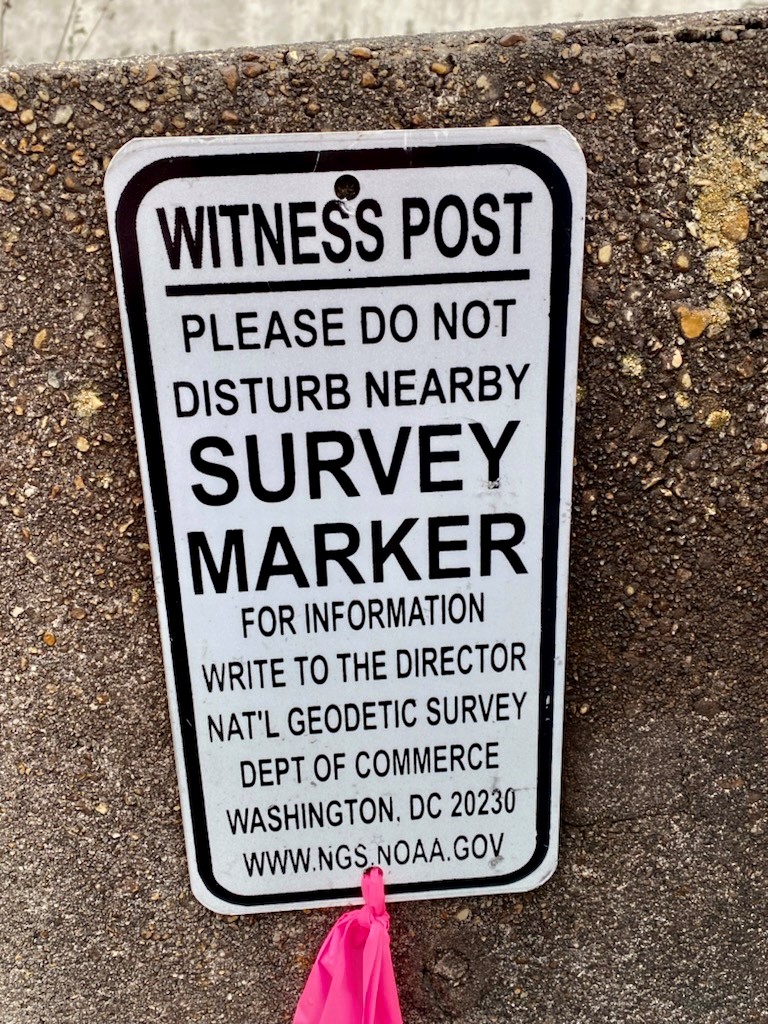
At the historic Edmund Pettus Bridge in Selma, we saw a “Witness Post” advising that we shouldn’t remove a survey market. What dirt lawyer could resist taking a picture of that? It is also attached for your enjoyment.

Thanks for indulging my real estate meandering thoughts and questions. Our next trip will be with children and grandchildren to Disney World for Thanksgiving week. Be prepared!

EAO 21-01 says it’s ethical to pay $249 to be on lender’s closing attorney list

Standard

The first Ethics Advisory Opinion of the year is noteworthy for South Carolina real estate practitioners.

Here is a brief summary of the facts:  In a residential refinance, the lender’s loan estimate package provided the name of a specific South Carolina licensed attorney that the bank “identified” as one who could close the loan. The package expressly said the borrower could “shop for (the borrower’s) own providers” for legal and other services.

The borrower informed the bank that a different lawyer had been selected, but the bank’s second set of loan estimate documents again identified a different lawyer and again said the borrower could chose its own provider.

When the borrower asked why another lawyer’s name was identified, the bank responded that the borrower’s chosen lawyer could sign with a third-party company that the bank had contracted with to produce loan forms for an annual fee of $249 to be included on the list.

The borrower’s lawyer did not enroll in the program but did close the loan.

The question to the Ethics Advisory Committee was whether a lawyer may participate in a service provider network for an annual fee of $249 to be listed as an “identified” service provider without violating S.C. Rule of Professional Conduct 7.2(c)?

Rule 7.2 (c) generally provides that a lawyer shall not give anything of value to a person for recommending the lawyer’s services. One exception to the rule is that a lawyer may pay the reasonable costs of advertisements or communications permitted by the Rule.

The Committee pointed to Comment 7 which states that a communication contains a recommendation if it endorses or vouches for a lawyer’s credentials, abilities, competence, character, or other professional qualities. The bank’s form in this case only provides contact information for participating lawyers and indicates the lawyers on the list have been identified. And the borrower is told in each instance that he or she can choose a different lawyer.

The Committee said these limited statements hardly match up the verbs and nouns used to describe a “recommendation” in the comment because the language in the forms says nothing substantive about the credentials, abilities, competence, character, or professional quality of the listed lawyers.

The Opinion further stated that participation in the network appears to be open to any real estate attorney and that the fee appears to be reasonable considering the enrollment, onboarding, and maintenance charges for including attorneys in the network.

The short answer to the question was “yes”, a lawyer may pay the fee and participate in the network of legal service providers and be “identified” as a possible service provider.

It is interesting that the facts included this statement: “The package and disclosures are assumed to be compliant with federal and state requirements for loan applications and attorney-preference notices.” The Committee answered the very specific question put to it and clearly has no authority to address federal law.

Lawyer publicly reprimanded for closing irregularity

Standard

Most South Carolina dirt lawyers were disappointed with the result of the 2017 Quicken Loan case which did not hold, as many had hoped, that a South Carolina licensed lawyer must be at the center of each residential real estate closing, overseeing each step, and ensuring that the consumer client’s interests are protected in each step. That case blessed a scenario where an out-of-state entity oversaw the closing process and divvied up the required lawyer functions among various functions.

A disciplinary case* from August of 2021 demonstrates just one way the scenario approved by Quicken can go awry.

The lawyer was hired by Superior Closing and Title Services, LLC to serve as closing attorney for a home purchase for an attorney’s fee of $200. That fee is our first clue about the type of closing that is the subject of this case.  The Court refers to the purchaser as “C.W.” The lender was 1st Choice Mortgage, and the loan was assigned to Wells Fargo.

Almost two years after the closing, Wells Fargo demanded 1st Choice repurchase the loan because of a discrepancy with the title. The Court states “it was discovered” that C.W. was a straw purchaser who never made a payment on the loan.  The lawyer argued, and the Office of Disciplinary Counsel did not dispute, that the lawyer was unaware of the straw purchase. The closing statement showed a payment by C.W. of $11,598.16. At the closing, a copy of a $12,000 cashier’s check made payable to Superior Closing was shown to the lawyer and to 1st Choice Mortgage as the source of the down payment.

The lawyer signed the normal certification at closing representing that the settlement statement was a true and accurate account of the transaction.

The $12,000 check was never negotiated, and 1st Choice never received the funds. 1st Choice paid over $39,000 to settle the claim with Wells Fargo.

1st Choice sued Superior Closing and the lawyer. The lawyer represented that Superior Closing prepared the closing statement and acknowledged that he failed to properly supervise the preparation of the settlement statement and the disbursement of funds. As a result of the lawsuit, a $39,739 judgment was filed against the lawyer and Superior Closing. The judgment has been satisfied.

We all know how challenging it is to supervise the disbursement of a residential closing where the funds do not flow through the closing attorney’s trust account. This disciplinary case demonstrates the danger of skipping that problematic but necessary step.

*In the Matter of Ebener, South Carolina Supreme Court Opinion No. 28047 (August 11, 2021)

This tax sale case has an interesting twist

Standard

The alleged successful purchaser seeks to void the sale!

I’ve always believed our courts will happily void any tax sale on the flimsiest of technicalities, but apparently not when the purported tax sale buyer is the party seeking to get out of the purchase.

Alterna Tax Asset Group, LLC v. York County* is a Court of Appeals case from July dealing with a 2014 tax sale. Alterna claims it was the successful bidder at the sale and sought to void the sale and cancel its ownership relying on §12-61-20 of the South Carolina Code, which reads, in part:

“Any…person…(that) has purchased at or acquired through a tax sale and obtained title to any real or personal property, may bring an action in the court of common pleas of such county for the purpose of barring all other claims thereto.”

The complaint alleged that the title to the property was clouded because of York County’s failure to provide proper notice. The complaint set up four causes of action: (1) declaratory judgment; (2) injunctive relief, (3) quiet title, and (4) unjust enrichment.

The Master consulted the County’s records and took judicial notice that Alterna was neither the purchaser of the property at the tax sale, nor the owner currently listed on the deed. The Master ruled Alterna was not a real party in interest and lacked standing. The Master also ruled that the quoted code section does not create a valid cause of action to void a tax sale.

Alterna appealed claiming the Master erred in taking judicial notice of the public records. The Court of Appeals termed this use of judicial notice “problematic” but decided the appeal on what it called a more fundamental issue:  whether, as the alleged tax sale purchaser, Alterna may seek to rescind its successful purchase based on the facts in this case.

Since the purpose of the code section is to clear tax titles, the Court held that Alterna states to viable cause of action when it seeks to defeat rather than defend its title.

The Court accepted for the purposes of this appeal from a 12(b)(6) motion Alterna’s allegation that it purchased the property at the tax sale and concluded that no valid causes of action for declaratory judgment or injunctive relief existed.

The Court then stated that the remaining questions whether a winning bidder at a tax sale may use the quiet title doctrine or claim of unjust enrichment to defeat rather affirm the bidder’s title, are novel questions in South Carolina. The Court held that the complaint does not allege a proper cause of action for quiet title because there is no existing adverse claim. Neither the County nor anyone else was challenging Alterna’s tax title, so the claim is “imaginary or speculative”.

The unjust enrichment cause of action, which claimed the county was enriched by picketing the tax sale proceeds yet delivering a clouded title, collides, according to the Court, with South Carolina Code §12-51-160, which establishes as a matter of law the presumption that a tax deed is prima facie evidence of good title.

The Court further noted that Alterna’s alleged cloud on the title, that York County’s notification was defective, was a matter of public record visible to Alterna before the sale.

Finally, the Court held that Alterna’s claim was not a justiciable controversy. Alterna claimed its title was hopelessly clouded and would someday be snatched away by someone with a superior claim. The court resisted the request to “tame paper tigers or pass upon issues not subject to a genuine, concrete dispute.”

This is a very interesting case! I’ll keep you posed of future developments.

*South Carolina Court of Appeals Opinion 5836, July 14, 2021

Court decides an interesting, but unpublished, case on the effect of a plat notation

Standard

Unpublished opinions don’t typically get my attention, but my friend, Bill Booth, sent this one* to me because he found it interesting, and I do, too. As a reminder, unpublished opinions have no precedential value, but they sometimes provide insight on how the Court might react in a similar situation, at least under the current makeup of the court.

The issue in this case was whether a notation on a subdivision plat that certain lots were “for agricultural use only” created a valid restriction of the use of the lots. Mikell Scarborough, Master-in-Equity for Charleston County, granted summary judgment, relying on extrinsic evidence to conclude that there was no intent to create a restriction despite the plain language on the face of the plat. That decision was affirmed.

The Court cited familiar cases holding that restrictive covenants are contractual in nature and must be strictly construed in favor of the free use of property. The Court also referred to cases holding that when a deed describes land as shown on a plat, the plat becomes a part of the deed. The interesting twist became whether the plat notation created an ambiguity that would allow the introduction of extrinsic evidence.

The Court found that the language in the plat was not ambiguous, but that the origin of the note created the ambiguity. The surveyor provided an affidavit to the effect that the Charleston County Planning Commission placed the agricultural use restriction on the plat “for the purpose of indicating that Charleston County would not, at that time, approve building permits for the lots because (the lots in question) did not meet current minimum standards for a modified conventional sub-service disposal system.”

When the plat was submitted for approval, the property owners included a letter explaining they were aware that the land possessed poor soil conditions for septic systems. The letter requested that the subdivision be approved with the stipulation that any lot that did not support a septic system would be restricted from becoming a building lot until public sewer service became available.

The case doesn’t make this point clear, but I am assuming the Appellant sued other lot owners who had built on their lots despite the plat notation. In other words, the Appellant wanted the restriction enforced as to other lots, not the lot the Appellant purchased. Interestingly, one house had been built before the Appellant purchased its lot.

A representative of the Appellant claimed he relied on the plat notation and that his title insurance company told him the lots were restricted. The Court found it significant, however, that the property owners who recorded the plat did not intend to restrict the property.

The Appellant argued that the deeds for all the lots specifically state that the property is subject to all restrictions, reservations, easements and other limitations that appear of record, including on the Plat. The Court held, citing 20 Am. Jur. 2d Covenants, Conditions, and Restrictions §151 (2015) that common “subject to” language does not create a restriction where none exists.

The Appellant also argued that an agricultural use exception in the title insurance policy was evidence that the restriction ran with the land, but the Court held that the title insurance company was merely noting the provision was on the plat so that it would not be liable if the Appellant could not build on its lot.  

The Court concluded that the record does not contain a scintilla of evidence to support the imposition of a building restriction on the Respondents’ lots.

Carpenter Braselton, LLC v. Roberts, South Carolina Court of Appeals Unpublished Opinion No. 2021-UP-280.

Do we face lurking condo repair problems like those in Surfside, Florida?

Standard

This is a difficult subject, and I’ve waited to address it for time to pass since the tragic June 24 collapse of the 136-unit Champlain Towers South condo project in Surfside, Florida.

South Carolina has many aging condominium projects, particularly along our coast. And we have an earthquake fault line to consider. Do our local homeowners’ association boards face expensive repair and reserve dangers similar to those in Florida?

Dale Whitman, the esteemed retired professor from the University of Missouri School of Law who moderates the national Dirt Real Estate Lawyers Listserv (Dirt@listserv.umkc.edu) has commented on Florida’s concerns in this regard. (If you’re not already following this listserv, I highly recommend it for all South Carolina dirt lawyers.)

Professor Whitman pointed to two informative and insightful news stories on the collapse, one from NBC News and the other from the Miami Herald.

The legal news following the collapse is that the Florida Bar has appointed a committee to review existing Florida legislation and to make recommendations for changes. Apparently, Florida law requiring reserve studies is weak and can be waived by a majority of the unit owners. To my knowledge, South Carolina has no such legislation.

It was estimated that nearly $17 million would have been needed to make the necessary repairs to the building that collapsed, but that available reserves amounted to only $770,000. Massive special assessments (more than $300,000 per unit) would have been needed. Collection was ongoing at the time of the collapse. But many unit owners simply did not have access to funds in that amount.

Professor Whitman wrote in the listserve on July 8:

“A much more robust program of reserves would have been needed to avoid this problem. But how much?  The need for a large expenditure to shore up the building’s structure is inherently unpredictable; it isn’t like a roof with a 20-year life, for example. But some sort of prediction is nonetheless necessary. Pick a number: say, a goal of achieving a reserve of 20% of the building’s original capital cost over the first 20 years of the building’s life, with continuing growth at the same rate thereafter. That would mean that the original assessments would be considerably higher than they would be with a more modest, conventional reserve program. It would add to the residents’ monthly cost and would make ‘affordable housing’ harder to achieve. But isn’t that better than a catastrophic collapse?”

He also speculated that periodic structural inspections by qualified engineers may be necessary. The building that collapsed apparently had such an inspection in 2018. That inspection revealed structural problems that could have been repaired for $9 million.

A couple of Florida Counties require aging high-rises to go through inspections after they reach 40 years of age. Failing the inspections can result in the loss of certificates of occupancy. But there is no similar state-wide requirement in Florida or South Carolina.

Much more stringent building inspection and condominium law requirements may be needed in South Carolina. I believe our HOA legislative scheme provides only the bare bones necessary to create and maintain a horizontal property regime. And I am not aware of any state-wide legislation that requires periodic inspections of high-rise buildings.

We should watch to see what Florida does and consider making similar changes. These issues are difficult to legislate and enforce but preventing comparable tragedies in South Carolina must be worth the effort.

Expect a new look to uniform notes, security instruments and riders

Standard

Fannie Mae and Freddie Mac have introduced new uniform notes, security instruments and riders for use immediately, with a deadline for use of January 1, 2023.

Read the press release here and review the new documents here.

The press release touts the benefits of the updated instruments as:

  • Easier to use: Employ more headings and subheadings, shorter paragraphs and sentences, and more clearly defined lists.
  • Provide more clarity: Use plainer language and clarify the explanation of borrower and lender obligations.
  • Reflect industry changes: Account for the changes that the industry has experienced over time and better reflect current industry practices and systems.

Fannie and Freddie are providing an 18-month transition period to allow lenders and their vendors to prepare.

Dirt lawyers should review the new documents to determine whether changes are needed in how closing documents are explained to clients.

What do you think of the new documents?