How to cure a defective deed

Standard

Why South Carolina should consider a legal specialty in real estate.

The Real Estate Practices Council of the South Carolina Bar is considering petitioning our Supreme Court to create a specialty for the practice of real estate law. Two committees have been formed, one to consider residential real estate as a specialty and the other to consider commercial real estate as a practice specialty. If you have ideas that may help, please pass them along to me!

One reason for consulting a real estate lawyer might be for assistance in curing a defective deed. It is impossible to list all the types of defects that appear in deeds of record. The list grows every day! Some of the most common defects are property description discrepancies, grantor and grantee name discrepancies, out-of-state forms that do not comply with South Carolina statutory requirements, right of survivorship attempts that fail, discrepancies in ownership percentages, failure to recite consideration, grantor signature discrepancies, and authority issues of seller entities.

dee house

Curing defective deeds will often require corrective deeds or quitclaim deeds from parties with outstanding interests. Note that corrective deeds are exempt from the deed recording fees imposed by §12-24-10 et seq. of the Carolina Code. See, specifically, §12-24-40(12). With corrective deeds, it may be necessary to obtain a deed back from the grantee. An example would be a deed from the developer to Richard Roe for lot 35, where Mr. Roe actually bought and occupied lot 34. To cure this problem, in addition to obtaining a deed from the developer to Mr. Roe of lot 34, Mr. Roe would need to convey lot 35 back to the developer. I continue to be amazed at the number of real estate professionals who think this step can be skipped, and that a corrective deed will somehow get the title back for the other lot. Also remember that mortgages may have to be re-executed or otherwise corrected once the deed issue is cured.

I am often asked whether the lawyer can “fix” the problem on the original deed and re-record it without the involvement of the parties. The answer is a strong “no”. The grantor must at least initial any changes. The more serious the problem, the more likely it will be that a corrective deed will be needed and that the grantor as well as the grantee will have to be involved.

When a deed discrepancy is discovered after the title has been conveyed again, the question often arises whether the corrective deed should run to the original grantee, and whether that would create the necessity for deeds from each grantor to each grantee in the chain of title after the problem. I often suggest that the corrective deed be given to the current property owner. The participation of intervening property owners is not needed.

Deed reformation actions are possible, and foreclosures often include additional causes of action for deed reformation to correct legal descriptions and other mistakes. Title insurance companies are often responsible to pay for these additional causes of action.

With these difficulties to be faced, don’t you think real estate practice as a specialty is a good idea?

Court decides timeshare owners can sue developers

Standard

Real Estate Commission does not have exclusive jurisdiction

The South Carolina Supreme Court, answering questions certified to it by the Federal District Court, held last week that the South Carolina Real Estate Commission (REC) does not have exclusive jurisdiction to determine violations of the South Carolina Vacation Time Sharing Plans Act.*

The Court also stated that the REC’s determination of a violation of the Time Act** is not a condition precedent to a private cause of action to enforce the Act and that the determinations of the REC are not binding on the courts.

These questions arose from two sets of litigation in the federal court involving individuals who entered into contracts with developers to purchase timeshare interests.

One set of plaintiffs, the Fullbrights, brought a purported class action against a timeshare developer, Spinnaker Resorts, Inc., seeking the return of money paid under a contract to purchase, plus interest, as well as a declaration that the contract was invalid.

The other set of plaintiffs, the Chenards, brought suit against another timeshare developer, Hilton Head Island Development Co., LLC, alleging fraud, negligent representation and violations of the Unfair Trade Practices Act as well as violations of the Timeshare Act.

In answering the questions, the Supreme Court stated that it was not taking any positions on the merits of the cases, which remain under the jurisdiction of the federal court.

The Court found that §27-32-130 unambiguously allows for lawsuits by stating that the provisions of the Act do not limit the right of a purchaser to bring a private cause of action. The developers had argued that this statute is ambiguous and that public policy evidenced by the Timeshare Act as a whole requires the REC’s jurisdiction to be exclusive.

These determinations will no doubt clear the way for class action lawsuits against timeshare developers.


* Fullbright v. Hilton Head Island Development Co., LLC, South Carolina Supreme Court Opinion No. 27220 (May 17, 2017).

** S.C Code §27-32-10 et seq.

Two positive articles for dirt lawyers from national sources

Standard

REALTOR®Mag is reporting that although financing remains the top roadblock to successful closings, fewer real estate agents are reporting financing as an issue today as opposed to previous months. This trend is a good one! Check out the article here.

The article indicates that, according to the REALTORS® Confidence Index, which is based on the responses from 2,500 real estate agents nationwide, the decline in complaints about financing may reflect an improvement in the economy, better credit histories from buyers and an improvement in loan evaluation processes.

But the article does report that appraisals are becoming a growing concern. Real estate agents indicated that a shortage of appraisers, valuations that are not in line with market conditions and “out-of-town” appraisers who are not familiar with local markets create the difficulties.

And for the first time in eleven years, the Fannie Mae and Freddie Mac conforming loan limit has increased to $424,100, allowing more home buyers to avoid jumbo loans, obtain lower interest rates and deliver lower down payments. The non-conforming loan limit had previously been stuck at $417,000. Read the article from INFOGRAPHIC here.

The economic news surrounding real estate closings is generally positive nationally. And the news is good in South Carolina, too. I’ve traveled around the state a good bit since the beginning of the year, and everywhere I go, I ask lawyers about business.

Early in the year, it seemed residential practices were sluggish in some markets while commercial practices were extremely busy statewide. In the last few weeks, I’m hearing much more encouraging news about residential practices, and commercial lawyers continue to report that business is excellent.

Our office is in the middle of a seminar series we have entitled “The future’s so bright, we have to wear shades.” We’re drinking the Kool-Aid and enjoying these economic good times. Those of us who weathered 2008 – 2012 deserve it!

Multi-state mortgage modification practice may be hazardous to your law license!

Standard

Last week, this blog discussed two April 19 South Carolina Supreme Court cases* in the context of the social media issues they raised. This week, I want to point out the mortgage modification issues, which were, no doubt, the impetus for the discipline in both cases.

Let’s look at the facts in the first case, In the Matter of Bacon. In November of 2012, attorney Brunty hired INMN, Inc., a marketing company, to solicit out-of-state clients interested in modifying their home mortgages. Brunty hired Integrity Partners, LLC to process the loan modifications. Brunty was suspended and later disbarred.

Brunty introduced Bacon to a principal in Integrity, who assured Bacon that Integrity and INMN were complying with federal laws and regulations and had a network of attorneys licensed to practice in every state where clients were accepted. Bacon accepted those assurances and hired INMN and Integrity. (Two people who’ve read this blog asked me about the relationship between Bacon and Brunty. I don’t know. The Court did not specify.)

Handling the former Brunty cases did not go smoothly, to say the least. Integrity continued to work on those cases without attorney involvement. Integrity employees incorrectly advised many of Brunty’s clients that their files had been assigned to Bacon. Some of Brunty’s clients became Bacon’s clients, but some did not. Some of Brunty’s clients’ credit cards were charged fees that were paid to Bacon.

Bacon admitted that he violated federal rules against unfair or deceptive acts or practices in respect to the mortgage modification matters.

The FTC’s “Regulation O” places a number of restrictions on mortgage modification services. For example, a provider may accept a fee only after the client has executed a written agreement with the lender or servicer. Attorneys are exempt from this rule if they are licensed to practice in the state where the home is located as long as they hold advance fees in trust accounts and comply with trust accounting rules.

Bacon was not licensed to practice in all jurisdictions, so he was not authorized to accept any up-front fees. He also failed to deposit the fees into a trust account, failed to maintain separate ledgers for these clients, and failed to properly supervise the individuals who had access to the accounts.

The Court stated Bacon was involved in the unauthorized practice of law in several states. He was suspended from the practice for six months and ordered to pay restitution to clients.

In the second case, In the Matter of Emery, the attorney received a public reprimand. In 2013 Emery signed a contract with Friedman Law, a New York law firm, to accept referrals for mortgage modification cases. Emery received client referrals from an internet marketing company and paid for the service based on the potential number of clients referred to her. Regardless of the residence of potential clients, cases would be assigned to Emery as a part of the Friedman Law network.

Non-lawyers employed by Friedman Law or two paralegal services worked the cases. The non-lawyers included Emery Law in their signature blocks and used Emery Law letterhead. Other than the fact that some of the non-lawyers employed by one of the paralegal services worked in Emery’s office, she did not directly supervise the work.

For the most part, the non-lawyers worked diligently, but six clients filed disciplinary cases because of some issue or complication resulting in client dissatisfaction.

The Court stated that the written fee agreements in these cases were confusing and self-congratulatory and often contradicted the verbal communications of the non-lawyers.

The non-lawyers sometimes wrongly held themselves out as employees of Emery Law. Clients never knew whether they were dealing with employees of Emery Law, Friedman Law, a firm in the Friedman Law network or one of the paralegal services.

Interestingly, in 2013, the South Carolina Supreme Court held that lenders do not engage in the practice of law when they handle mortgage modification transactions.** In the present case, however, the Court stated that assisting clients in mortgage modification matters is the practice of law in South Carolina when performed by a lawyer.

Friedman Law represented to Emery that assisting clients in mortgage modifications is not the practice of law and that its network of lawyers in other states satisfied the requirements of multijurisdictional practice.

The Court stated that regardless of whether a particular state had adopted a rule permitting multijurisdictional practice and regardless of whether the particular state had determined that loan modification assistance was the practice of law, the fee agreements repeatedly referred to the services as “legal services”. In other words, the clients believed they were being represented by an attorney.

The Court said that Emery was involved in the systematic and continuous presence in other states, which constituted the unauthorized practice of law.

Accepting mortgage modification cases across state lines may be possible in certain circumstances, but these cases are obviously fraught with hazards. DO NOT accept these cases without carefully examining the federal and state laws involved in each situation and without carefully supervising each person who touches the cases. The best advice may be to never accept these cases when they involve properties located outside of South Carolina.


*In the Matter of Bacon, S.C. Supreme Court Opinion 27710, April 19, 2017; In the Matter of Emery, S.C. Supreme Court Opinion 27712, April 19, 2017.

**Crawford v. Central Mortgage Co. and Warrington v. Bank of America, 404 S.C. 39, 744 S.E.2d 538 (2013)

Dirt lawyers: guard your clients and your offices against sloppy title search practices

Standard

Our Supreme Court has made it crystal clear that searching titles is the practice of law. For every real estate closing, the closing attorney should perform or supervise the title examination. Theoretically, all title insurance and malpractice claims caused by title search errors can be prevented. Having safe title examination practices in real estate closing offices would go a long way toward minimizing claims and protecting clients and their properties!

The following are some dangerous practices that lead to claims:

  • Hiring title examiners who are inexperienced, who cut corners and who are not covered by errors and omissions insurance coverage.
  • Failing to properly instruct title examiners as to how titles should be searched. Whether law firm employees or outside abstractors are used, the closing attorney should develop and use his or her own set of title examining procedures.
  • Failing to require title examiners to pull documents. It is not sufficient to search titles using indexes. Doing so puts the lawyer and client at the mercy of the county employee who typed the index.
  • Failing to review chain documents. The attorney should review chain documents. Attorneys spot issues that are missed by abstractors. If a link in the chain of title is a foreclosure or an estate, the foreclosure file or the estate file should be reviewed.
  • Failing to use proper search periods. The long-standing search period standard in South Carolina is sixty years. Title insurance companies have shortened this standard to forty years, particularly for residential transactions. But some title insurance companies and sloppy practitioners are allowing for much shorter periods of time, like ten years, or “up from the developer” or “up from the deed into the borrower” without informing the client that the title has not been examined. Title examinations are the practice of law in South Carolina, and  title companies do not have the power to permit a lawyer to shorten search periods without the informed consent of the attorney’s client.
  • Relying on prior title insurance policies that are not worthy of reliance. In “tacking on” to prior policies, closing attorneys should use common sense and good judgment. Determine who issued the prior policy and decide whether that person’s work should be substituted for your own. Review the prior policy to determine whether it looks normal on its face. Some title insurance companies are issuing products that are not backed by title examinations or are backed by very short title examinations. Those policies are not worthy of reliance in an atmosphere where title examinations are the practice of law. As in the case of other short searches, informed consent confirmed in writing from clients should be obtained for employing a short search based on a prior policy.
  • Failing to pull back title notes where a short search is used. It does not help that the attorney’s office has closed properties in the same chain of title if that prior title work is not used. Exceptions and requirements from the prior title work should be used in the current title insurance commitment and policy.
  • Failing to search for a longer period of time where the shorter search does not reveal normal easements and restrictions for the type of property being searched. A search involving a residential subdivision created in the 1950’s should not stop in the 1960’s.

At least two sets of eyes should review every title examination. And one of those sets of eyes should belong to an attorney who was taught in law school to spot issues!

IRS issues for tax season…for your reading pleasure

Standard

Just in time for tax season, the IRS announced on April 4 that it will begin using private debt collectors pursuant to federal law enacted late in 2015.

The IRS said that it will begin this month sending around 100 letters per week to taxpayers who have accumulated years-overdue tax debt. If the process goes smoothly, the number of letters will be increased to 1,000 per week.

Outsourcing debt collection will likely provide scammers with new opportunities, so the IRS has provided some advice for the safety of taxpayers.

The taxpayer will hear from the IRS first by letter. The letter will provide the name and contact information for the debt collection firm. After that initial contact, the debt collection firm will send its first letter confirming that it will handle the case. Neither initial contacts will be by telephone.

At this point, only four firms have been identified:  CBE Group of Cedar Falls, Iowa; Conserve of Fairport, New York; Performant of Livermore, California; and Pioneer of Horseheads, New York. Each taxpayer’s account will be assigned to only one of these firms.

None of the firms will ever ask for payments to be made to anyone other than the United States Treasury. If a taxpayer is asked to make payment to anyone else, this is a scam.

In the case of mistreatment under this new program, taxpayers are urged to file complaints with the Treasury Inspector General for Tax Administration and the Consumer Financial Protection Bureau.  The IRS and Congress have indicated they will be monitoring this situation carefully.

On a related topic, real estate lawyers should be reminded that the IRS may issue a levy, which is a legal seizure, of a taxpayer’s property to satisfy a tax debt. When a levy is issued, it applies to real property, money, credits and bank deposits. A levy can also reach property held by third parties, such as retirement accounts, dividends, bank accounts, licenses, rental income, accounts receivable, the cash loan value of life insurance policies and commissions.

The IRS issues a levy only after it has exhausted other means to collect a tax debt.

From time to time, a settlement agent will receive a levy for a party involved in a closing. The taxpayer should be sent a notice in writing of the receipt of the levy and should be directed to consult with his or her tax advisor. Remember that a real estate lawyer who is not also competent as a tax lawyer should never offer tax advice. Typically, after the taxpayer has time to seek tax advice, the settlement agent should comply with the levy.

(If I received a levy, however, I would also seek my own tax advice prior to disbursing any funds!)

The Carolinas are basketball states!

Standard

(And states dealing with a “clarified” boundary)

Congratulations to the University of North Carolina on last night’s win in the Men’s College Basketball National Championship!  North Carolina has always been a basketball state, and our hats are off to you!  Our Gamecocks made it to the Final Four for the first time ever, so both states are proud of their men’s basketball teams!  And congratulations to our Gamecock women who won their National Championship on Sunday!  We love seeing that flag fly over our statehouse! Both Carolinas are apparently now basketball states!

We are also states with a newly defined boundary line between us. The long awaited and much debated legislation “clarifying the original location the boundary” became effective on January 1, 2017, and both states are dealing with the ramifications of the legislation.

Some parcels previously believed to be in South Carolina are now confirmed to be in North Carolina and vice versa. Both legislatures insist that the boundary has not changed, but that since markers have been lost or destroyed by the elements, it was necessary to have the boundary researched and resurveyed. (If they had taken the position that the boundary line was being moved, they would have had to involve Congress.)

South Carolina real estate lawyers have been advised to consult with their title insurance companies for guidance as they deal with affected properties. In North Carolina, however, the Real Property Section of the Bar and the Land Title Association have issued a lengthy memorandum, dated March 20, 2017, to provide guidance to North Carolina lawyers. I thought this memorandum might be useful to point out the various issues to South Carolina lawyers and link it here.

The best advice I can give all of us dealing with issues surrounding this change is to proceed slowly and with due diligence, consulting your title insurance company underwriters every step of the way!

Wells Fargo distributes new settlement agent communication

Standard

Note: Settlement agents are scheduled to be re-evaluated

Wells Fargo delivered a memo entitled “News for Wells Fargo Settlement Agents” on March 23. The first paragraph cryptically announced that future communications will detail the Uniform Closing Dataset (UCD) that will become effective for lenders in 2018.

StageCoachLogo

For insight into the UCD, review Fannie Mae’s or Freddie Mac’s websites. Briefly, the UCD is going to be a common industry dataset to allow information on the Closing Disclosure to be communicated electronically. Fannie Mae and Freddie Mac have developed the UCD at the direction of the Federal Housing Finance Agency in an effort to enhance loan quality and consistency through uniform loan date standards. Stay tuned for more information on this topic and lenders gear up to comply.

The Wells Fargo memo also touted continued expansion of settlement agents who are using Closing Insight™.  Settlement agents who are just getting started were asked to take advantage of the support available at RealEC’s Closing Insight Resource Center at http://www.closinginsightresourcecenter.com or to contact the company at CISupport@realec.com or 800.893.3241. I encourage all South Carolina closing attorneys to get up to speed on this system as soon as possible.

The serious news from Wells Fargo, however, relates to a new effort to evaluate settlement agents.

The memo warned that Wells Fargo will evaluate the population of settlement agents who have closed loans within the past twelve months for problems such as missing documents, execution errors and other frequent problems that require curative work. As a result, settlement agents may receive letters indicating they are being removed from Wells’ list of approved settlement agents.

Processes are in place, however, to accommodate the customer’s choice for a settlement agent who is not on the approved list. Apparently, a new approval process will be instituted, but no detail on this process is provided.

house made of cashThe memo further indicates that attorneys’ ability to act as counsel for customers will not be impacted.  I don’t read this last directive to mean that attorneys who are not on the approved list will be in a position to close loans. They will only be in a position to dispense legal advice, if I am interpreting this correctly.

Settlement agents with questions are encouraged to communicate with Wells at WellsFargoSEttlementAgentCommunicatons@wellsfargo.com. I urge anyone who is interested in continuing to close Wells Fargo loans to hang onto this information.

Finally, the memo is requesting acknowledgement of Master Closing Instructions from all active and approved settlement agencies. Requests for this acknowledgement are coming from Wells Fargo in the form of e-mails to settlement agents. Please respond!

All lenders are beginning to hold settlement agents to higher standards. South Carolina closing attorneys are encouraged to stay abreast of changes and train, train, train staff members.

And, as always, contact your title insurance companies for insight into these matters.

Hot off the presses UPL case!

Standard

(But it only affects real estate peripherally)

The South Carolina Supreme Court handed down a UPL decision in a declaratory judgment action in its original jurisdiction on February 22.*

The Court accepted the action to determine whether Community Management Group, LLC and its employees engaged in the unauthorized practice of law while managing homeowners’ associations. The Court found that the respondents did, in fact, engage in UPL. At the outset of the case, the Court had issued a temporary injunction halting the offending activities.

Community Management Group, without the involvement of an attorney, prepared and recorded notices of liens and related documents; brought actions in magistrates’ courts to collect debts; and filed the resulting judgments in circuit courts. The entity also advertised that it would perform these services “in house”.

breaking-news

In a 1992 administrative order entitled In re Unauthorized Practice of Law Rules Proposed by South Carolina Bar**,  the Court had modified prior case law to allow a business to be represented by a non-lawyer officer, agent or employee. The Court had also promulgated South Carolina Magistrate Court Rule 21, which provides, “A business…may be represented in a civil magistrates’ court by a non-lawyer officer, agent or employee…”

The central question in the action at hand was whether the word “agent” in these authorities includes third party entities and individuals like Community Management Group and its employees. The Court held it does not and was never intended to.

The Court had earlier held that filing claims in probate courts does not amount to UPL, but stated in the present case that it is the character of the services rendered that determines whether the services constitute the practice of law. Filing claims in Probate Court, according to the Court, does not require the professional judgment, specialized knowledge or ability of an attorney. The Court found that the services required to represent a business in magistrates’ courts are not comparable to filing claims in probate courts.

Community Management Group conceded that it prepared a lien document for the purpose of putting a cloud on title so property could not be sold unless the homeowner paid overdue assessments. This stated purpose demonstrated to the Court that the lien documents were “instruments”, that is, written legal documents that define rights, duties, entitlements or liabilities.

Citing a 1987 case near and dear to the hearts of all South Carolina dirt lawyers, State v. Buyers Service***, the Court reminded us that preparing and recording legal documents is the practice of law.

This current case is a Per Curiam decision, but acting Justice Pleicones did not participate. We are holding our collective breath to learn the results of a Quicken Loan case pending in the original jurisdiction of the Court, and the present case may give us at least a small hint.

stay tunedWe have already received an underwriting question about this case in our office. We were asked whether our attorney agents can ignore the liens filed in contravention of this case. The answer is that we can discuss the specifics on a case-by-case basis, but it appears that although the liens may be invalidated by a court, dirt lawyers and title companies should not generally take this risk without the involvement of a court. If you run into this issue in connection with your closings, call your title insurance underwriter to discuss your options!

*Rogers Townsend & Thomas, PC v. Peck, South Carolina Supreme Court Opinion 27707 (February 22, 2017)

**309 S.C. 304, 422 S.E.2d 123 (1992)

***292 S.C. 286, 468 S.E.2d 290 (1987)

A useful SCDOT website for South Carolina dirt lawyers

Standard

opposite-road-signs-sc-dot My colleague Tom Dunlop recently shared a South Carolina Department of Transportation website with me that is a nifty tool for determining whether the DOT maintains a road.  Check out the site here.
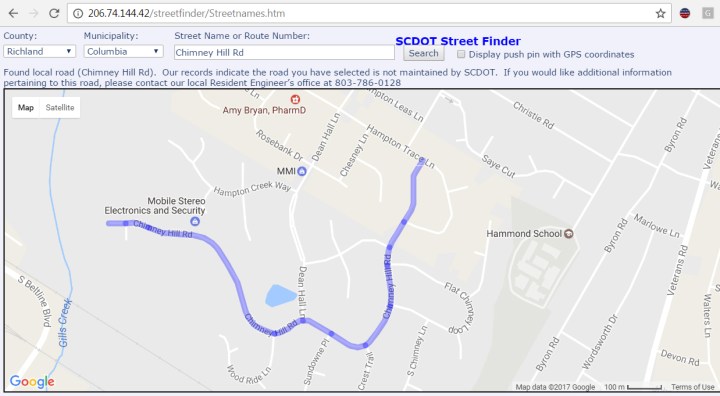
I entered my own street, Chimney Hill Road, and found out that the DOT does not maintain my street but that I could get more information from the Resident Engineer’s office at 803-786-0128. (I know Chimney Hill Road is marginally maintained by the City of Columbia from watching the repair of the pothole in front of my house at least annually.)  Here’s what the website shows:

blog-screenshot-1

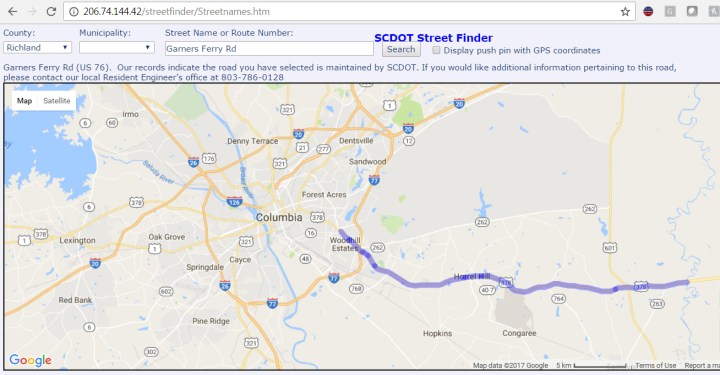
Then, I tried Garners Ferry Road (U.S. 76) and learned that the DOT does maintain this road.  Here’s the map:

blog-screenshot-2

Trying another County, I entered one of my favorite roads (the road to the beach!), Highway 17 (Ocean Highway S) in Georgetown County. This road is maintained by the DOT, and the phone number for the local office, for more information, is 843-546-2405.

blog-screenshot-3

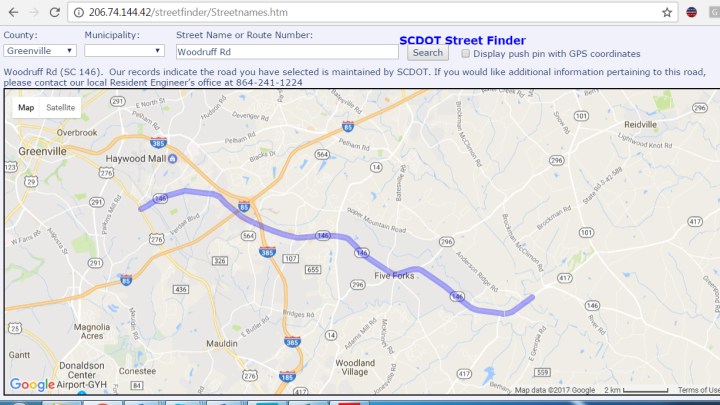
Turning to the upstate, I tried Woodruff Road (SC 146) in Greenville County and learned that this road is maintained by the DOT, and the phone number for the local office, for more information, is 864-241-1224.

blog-screenshot-4

I hope this website will provide real estate closing attorneys with some quick information when road maintenance becomes an issue.