Supreme Court calls Awendaw’s annexation efforts “nefarious conduct”

Standard

Conduct results in standing for challengers
awendaw

The Town of Awandaw’s annexation of a ten-foot wide, 1.25 mile-long parcel of land within beautiful Francis Marion National Forest was challenged by two individuals and the South Carolina Coastal Conservation League in a recent South Carolina Supreme Court case.*

The sole question before the Court was whether the challengers had standing to contest the annexation in a case where the “100 percent method” of annexation is used, meaning all property owners petition the municipality to have their property annexed.

The case involved three parcels of land serving as links in a chain necessary to satisfy the contiguity requirement of annexation. The first link is the ten-foot strip managed by the United States Forest Service. The second link is owned by the Mt. Nebo AME Church, and the third link is approximately 360 acres of unimproved real estate surrounded by the National Forest on three sides and owned by Defendant EBC, LLC.

In the fall of 2003, the Town sought to annex the ten-foot strip which required a petition signed by the Forest Service. Town representatives sent the Forest Service four letters seeking approval. Through verbal discussions, the Town learned the Forest Service was opposed to annexations because of their impact on the Service’s ability to conduct controlled fire burns. Additionally, the Forest Service indicated any petition would have to come from Washington, D.C., officials, a process that might take several years.

The Town annexed the property anyway in 2004, relying on a 1994 letter from a Forest Service representative, stating it had “no objection” to annexing several strips of property in the same vicinity. However, the Town had previously stated that it realized this letter was unclear.

In 2009, EBC, LLC requested that Awendaw annex its property, and the Town passed an ordinance annexing that property and simultaneously rezoning it as a “planned development” to permit residential and commercial development. In annexing the EBC property, the Town relied on the ten-foot National Forest strip as well as the church property. Without either component, there would be no contiguity and annexation would be impossible.

In November of 2009, the petitioners filed a complaint against the Town and EBC alleging, among other things, that the Town lacked authority to annex the ten-foot strip of National Forest property because the Forest Service never submitted an annexation petition. The Town and EBC moved for partial summary judgment contending the petitioners lacked standing and that the statute of limitations had run.

At trial, a surveyor testified that the 1994 Forest Service letter referred to a different strip of land. The Town’s administrator responded that the Town had used the 1994 letter at least seven times, and that he believed the letter incorporated the property in question. The petitioners testified they were concerned about potential harm caused by developing the property, including damage to unique species of animals. They testified that they were also concerned that the proposed development would threaten the Forest Service’s ability to conduct the controlled burns necessary to maintain the health of the forest.

The trial court found that the petitioners had standing and concluded that the annexations were void because the Town never received the required petition from the Forest Service. The Court of Appeals concluded that the petitioners lacked standing.

In analyzing the standing issue, the South Carolina Supreme Court discussed its prior cases that held “non-statutory parties” (meaning, non-property owners of the annexed properties) lacked standing to challenge a purportedly unauthorized annexation. Those cases, however, were premised on good faith attempts by annexing bodies, according to the Court.

The opinion at hand stated that the Court did not believe the General Assembly intended in establishing the statutory framework for annexation to preclude standing where there is a credible allegation that the annexing body engaged in “deceitful conduct”. The Court held that a party that can demonstrate the annexing body engaged in “nefarious conduct” has standing to challenge the annexation.

The Court also discussed the public importance exception to the standing rule. This exception states that standing may be found when an issue is of such public importance as to require its resolution for future guidance. The Court stated that the petitioners had satisfied the “future guidance” prong of the public importance exception because the Town had used the 1994 letter numerous times and fully intended to use it again.

The case was remanded to the Court of Appeals to address the Towns’ remaining arguments.

*Vacary v. Town of Awendaw, South Carolina Supreme Court Opinion No. 27855 (December 19, 2018).

Deadline approaching for new HOA recording requirement

Standard

“Governing documents” should be recorded by January 10

gavel house

The South Carolina Homeowners Association Act, an amendment to Title 27 of the South Carolina Code which included new §27-30-130, was signed into law by Governor Henry McMaster and became effective on May 17.

The act states that in order to continue to be enforceable, a homeowners association’s governing documents must be recorded in the county where the property is located by January 10, 2019 for associations in place on the effective date of the legislation. For new associations or for amendments to governing documents, recording must take place by January 10 of the year following the adoption or amendment of the documents.

The requirement to record Master Deeds is, of course, not new to South Carolina practitioners. We have recorded Master Deeds and their required attachments since the creation of Horizontal Property Regimes became possible in South Carolina. The new requirement applies to rules, regulations and bylaws of associations, including amendments to rules, regulations and bylaws. Practitioners have not routinely recorded these documents. It is interesting that recording rules, regulations and bylaws will not be subject to the requirement of witnesses and acknowledgements of §30-5-30.

A memorandum from the Register of Deeds of Horry County states that these documents will be accepted electronically and across the counter. Documents recorded across the counter must contain an original wet signature plus the printed name and title of the signatory. Horry County will also require contact information (address, email address or telephone number) of the person recording the document, the Homeowners Association’s name and the physical address or legal description of the property. Horry County also highly recommends, but does not require, the book and page number of the recorded Master Deed. This additional information may be included in a cover sheet.

The law also creates a new duty to disclose whether real property being sold is part of a homeowners association and a duty to disclose the condition of floors, foundations, plumbing, electrical and other components of the property. Real estate practitioners may be called upon to assist with these newly-created disclosures.

Another requirement of the legislation includes a 48-hour notice for meetings that are intended to increase budgets by more than ten percent. A requirement for access to community documents by owners was also added. This requirement was previously in place for associations that are created as non-profit corporations. The new law makes it clear that all homeowners associations must provide similar access to documents for owners. The law also gives magistrate’s courts concurrent jurisdiction for monetary disputes of up to $7,500 involving homeowners association disputes.

SC Court reverses itself on “active energy” judgment issue

Standard

law-books-gavel1

South Carolina dirt lawyers seldom breathe a sigh of relief when our Supreme Court decides a real estate case. But the November 21 opinion in Gordon v. Lancaster* was greeted with a collective “thank goodness”!  We were living with a less-than-exact term for the viability of a judgment, and we didn’t like it.

The question in this case was whether a creditor may execute on a judgment more than ten years after enrollment when the ten-year statutory period for execution** expires during the course of litigation. The Court overturned its 2010 decision in Linda Mc Co. v. Shore***, which held that, despite the passage of more than ten years, the judgment continued to have “active energy” because the judgment creditor had filed for supplemental proceedings.

In the current case, a judgment was enrolled in 2002 against Rudolph Drews, the now-deceased uncle of the Petitioner Donald Lancaster, in connection with a civil action for violating securities laws in an investment scheme for a new business venture in Charleston. Frank Gordon, the creditor, filed a petition for supplemental proceedings in 2006. During the hearing, Gordon’s counsel became suspicious that Drews’ wife and Lancaster were attempting to shield Drews’ assets from creditors. The hearing was continued when Drews failed to produce tax and financial documents.

Drews died in 2007. Gordon sought to continue supplemental proceedings, but there were delays in the estate administration. In 2010, suspicions were confirmed about hiding assets when Lancaster was deposed. Soon after, one day before her scheduled deposition, Drews’ wife died. Gordon filed this action, asserting Lancaster assisted Drews is hiding assets in violation of the Statute of Elizabeth. In 2011, Drews’ estate confessed judgment in the approximate amount of $300,000, and his wife’s estate settled with Gordon for $60,000.

During a bench trial in 2013, Lancaster moved for a directed verdict based on Gordon’s prior concession that the suit was based on the earlier judgment, which was obviously older than ten years. The trial court and the Court of Appeals disagreed, relying on the holding in Linda Mc: If a party takes action to enforce a judgment within the ten-year statutory period of active energy, the resulting order will be effective even if issued after the ten-year period has expired.

The Court noted that Linda Mc represented a departure from its historic approach and created confusion in what was formerly a well-settled area of the law. (To that I would like to very politely reply “duh”.) The Court overruled itself and returned to the bright-line ten-year rule.

In a footnote, the Court stated that it is overruling Linda Mc prospectively. The same footnote referred to Justice Pleicones’ dissent in Linda Mc, which predicted confusion in a previously settled area of the law.

Justice Few concurred in the result but disagreed with overruling Linda Mc, which he said created a narrow exception to the bright-line ten-year rule for the issuance of an execution on a judgment. There was a discussion in the opinion and the concurring opinion about dictum vs. holding, but, thankfully, nothing concrete came out of that. Justice James concurred in part and dissented in part, agreeing that Linda Mc should be overruled, but believing that Gordon should have received relief because of the prospective nature of the decision.

Pennsatucky AmenAs a title insurance lawyer and title examiner from way back, I am happy to see us return to a common sense, bright-line approach to the ten-year rule. Can I get an “Amen”?


* South Carolina Supreme Court Opinion 27847, November 21, 2018.

** South Carolina Code Section 15-39-30.

*** 390 S.C. 543, 703 S.E.2d 499 (2010).

Welcome to The Hotel California*

Standard

You can resign; but you can never stop paying dues


hotel california

A recent South Carolina Supreme Court case deals with whether the governing documents of a Beaufort County development, Callawassie Island, unambiguously require equity members to continue paying expenses after resignation.** The trial court and Supreme Court found no ambiguities. The Court of Appeals and Supreme Court Justice Hearn disagreed.

In 1999, Ronnie and Jeanette Dennis purchased a home on Callawassie Island for $590,000 and joined a private club known as the Callawassie Island Club, paying $31,000 to become “equity members”. The governing documents in place at the time of the purchase provided that an equity member who resigns will be obligated to continue to pay dues and food and beverage minimums to the Club until the equity membership is reissued.

In 2010***, Mr. and Mrs. Dennis decided to resign their membership in the club but to retain ownership of their home. They sent a letter of resignation to the club and stopped making all payments. At that time, the required payments included $634 monthly as membership dues, $100 monthly in special assessments, and $1,000 yearly in food and beverage minimums.

The governing documents were amended many times over the years, and the dissent argued that the controlling documents at issue in the case could not even be identified by the Club. The Supreme Court held, however, that all versions of the documents contained the language requiring the continued payments.

Mr. and Mrs. Dennis argued, and the Court of Appeals agreed, that the Club’s interpretation violates §33-31-620 of the South Carolina Nonprofit Corporation Act which provides that a member of a nonprofit corporation may resign at any time. The Supreme Court pointed to subsection (b) of that statute, however, which states that a resignation does not relieve the member from any obligations incurred prior to the resignation. The dissent said the majority’s interpretation effectively eliminates any meaningful right of resignation.

The dissent called the majority’s result “harsh” and stated that taking the majority’s view to its “logical end”, the monetary obligations to the club would extend beyond a member’s lifetime. The majority stated that they were not deciding whether the governing documents could support perpetual liability. The emphasis was provided by the Court.

The Supreme Court suggested that Mr. and Mrs. Dennis could have eliminated their obligations to the Club by selling their home. In footnote 7, the dissent countered that the majority “blithely” suggests selling the house, which may be easier said than done.

The footnote refers to a news article included in the record that reveals the Club’s membership scheme has significantly chilled potential buyers. **** According to this article, one member failed to sell her property for more than two years, despite listing it for $1. As of July of 2016, according to the article, eight lots were listed at less than $10,000 each. The footnote asserts that these facts bely the use by the majority of the description of Callawassie Island property as “exclusive.”

The circuit court had awarded the Club summary judgment, and the Supreme Court reinstated that order. What an interesting case! I hope some of my lawyer friends from Beaufort County will let me know whether the homes in this development are selling better in 2018.


*Not my joke.  See footnote 4 of the case:  “Although we disagree with the court of appeals’ legal reasoning here, we do applaud the reference to the Eagles’ hit Hotel California.”  Who said justices aren’t funny?

**The Callawassie Island Members Club, Inc. v. Dennis, South Carolina Supreme Court Opinion 27835 (August 29, 2018).

***Keep in mind how dismal the economy continued to be in South Carolina in 2010.

****Kelly Meyerhofer, Callawassie Club ruling: Court sides with members, cited Eagles song, The Beaufort Gazette (August 5, 2016).

Can an alley be the basis of an appurtenant easement in SC?

Standard

The Court of Appeals says it can

Charleston houses

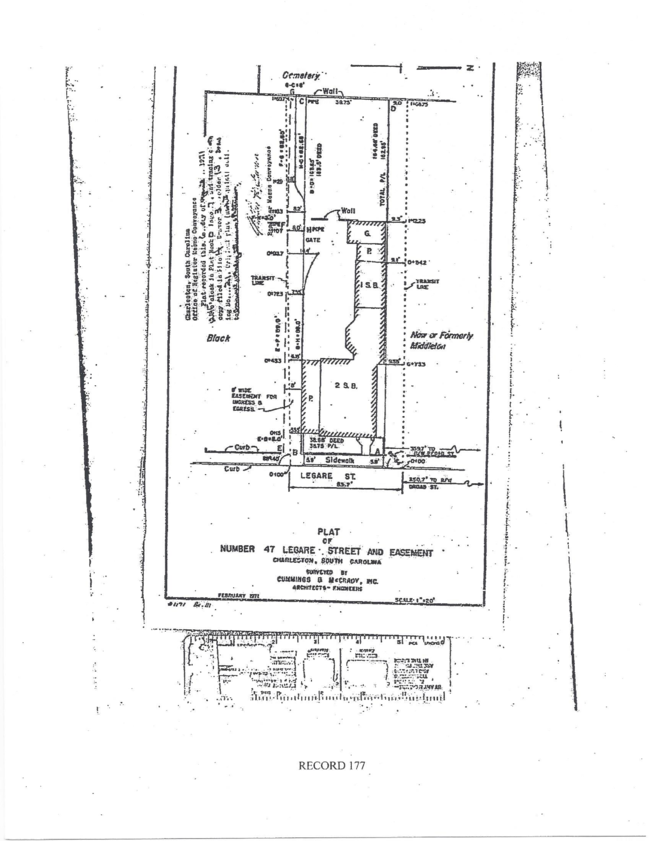
Two valuable downtown Charleston residential lots were the subject of an easement case decided by the South Carolina Court of Appeals on September 19.* Much to the dismay of the owners of 45 Lagare Street, the Court held that an appurtenant easement exists in the form of an alley that runs along a boundary of 45 Lagare Street for the benefit of 47 Lagare Street.

Master-in-Equity Mikell Scarborough had granted summary judgment in favor of the owner of 47 Lagare Street, finding an easement appurtenant burdened 45 Lagare Street, and the Court of Appeals affirmed.

In 1911, the properties were considered a single lot known as 47 Lagare Street owned by W.G. Hinson. That year, Hinson divided the property, creating 45 Lagare Street, and conveying that lot to his niece. The 1911 deed established an easement for the benefit of the 47 Lagare Street, which Hinson retained. This language established the easement:

Also, the full and free use and enjoyment as an easement to run with the land of the right of ingress, egress, and regress, in, over, through, and upon the alley-way eight (8) feet wide as a drive way or carriage way, situation, lying, and being immediately to the south of (47 Lagare), and being the southern boundary of said (47 Legare).

Title to both lots passed to third parties, and in 1971, a new survey was drawn,** and the owners of both properties provided verbatim descriptions of the original easement and covenanted that the no buildings or obstructions would be erected on the easement area. The documents stated that the covenants would run with the land.

The most recent deed of the benefited property recited the existence of the easement, but the most recent deed of the burdened property did not. In 2004, the owner of the benefited property added a chain-link fence and masonry wall along the border with the burdened property.

During the trial, the Appellants argued that the easement had been abandoned and stated that the only time it was used was to allow for the Respondent’s landscapers to walk down the driveway to use the gate. Respondent testified that the easement area is also used by her family members, guests, tradesmen and other permittees to access the rear of 47 Legare for large-scale appliances, equipment, and machinery and to provide access to the only suitable area for off-street parking. She also claimed that she uses the easement to access the back of her property in a golf cart.

The first issue on appeal became whether a terminus existed on 47 Legare, a requirement for an appurtenant easement. Two Supreme Court cases were discussed, Whaley v. Stevens, 21 S.C.221 (1884), which held that the terminus requirement in South Carolina only requires the dominant estate to be contiguous or adjacent to the easement. A later case, Steele v. Williams, 204 S.C. 124 (1944) held that an alleyway was an easement in gross rather than an appurtenant easement because it lacked a terminus.

The Court of Appeals found Whaley controls although no South Carolina case has explicitly defined the terminus requirement. The Court held that the terminus issue is a fact-specific inquiry and that, intuitively, the dominant estate must have access to the purported easement.

In addition, the Court stated, an appurtenant easement might be found if the purported easement (1) at least touches the dominant estate and (2) in cases where the easement is an adjacent boundary between—or runs parallel—to the dominant and servient estates, such as the case at hand, the easement does not extend beyond the dominant estate’s boundary. (At most, the easement ends at the lot line of the dominant estate.) In Steele, the alley extended beyond the appellant’s property.

The intent of the parties was held to be determinative, and the Court held that the 1911 common owner, Hinson, clearly intended that the driveway would be an easement appurtenant.

The Court next discussed the appurtenant easement requirement of necessity. 47 Legare Street obviously has direct public access on Lagare Street, but the Court held that the easement was necessary to reach the rear of the property by large-scale equipment and tools and to provide for off-street parking.

We will wait to see whether our Supreme Court has the opportunity to weigh in on this issue.


* Williams v. Tamsberg, S.C. Court of Appeals Opinion No. 5596 (September 19, 2018)

** Plat of Number 47 Legare Street and Easement surveyed by Cummings & McCrady, Inc., dated February 1971, is attached.

Redevelopment of golf courses might be possible in South Carolina

Standard

In April, this blog discussed the redevelopment of two Horry County golf courses. The North and South courses at Deer Track Golf Resort in Deerfield Plantation have been closed for more than ten years and are finally being redeveloped as residential lots. Adjacent lot owners waged class actions in Horry County seeking to have the use of the properties in question restricted to golf courses or open spaces. While these battles were being waged in court, nature attempted to reclaim the properties. One property owner testified that his views changed from overlooking a manicured golf course to overlooking a “sea of weeds”.

Similar battles have been successful in other parts of the country. The cases are fact intensive and turn on the law of implied easements, which, of course, varies widely from state to state. Plats showing golf courses may provide rights in adjacent lot owners, depending on the recorded documents, the sales program and the law of implied easements in the location.

golf course

I wanted to invite those interested in this area of the law to take a look at an article published in June by www.citylab.com. The article, written by Nolan Gray, is entitled “Dead Golf Courses Are the New NIMBY Battlefield”. In the interest of full disclosure, I had to Google NIMBY. This acronym stands for “not in my back yard”.

The article states that golf is dying, according to many experts. One study cited in Citylab’s article found that the number of regular golfers fell from 30 to 20.9 million between 2002 and 2016. The thinking is that the fall of Tiger Woods may have led to much of this gloom and doom around golfing. But Mr. Gray believes that the bigger story involves the sport’s aging demographics and the fact that millennials are not interested in the expensive, slow sport that provides few health benefits.

Golf courses and golf clubs across the country are closing, leaving the land to be redeveloped. Mr. Gray’s article states that the average 18-hole golf course sits on 150 acres, property that could host around 600 new single-family detached homes. Add to this mix the fact that many golf communities were built in areas with good schools and work opportunities. These properties are, therefore, particularly valuable in areas where housing inventory is a challenge.

So, what prohibits the development of these properties into residential subdivisions? Zoning is one of the challenges. Many golf courses are zoned for commercial uses to accommodate clubhouses, restaurants, pro shops and bars. But the main stumbling block, according to Mr. Gray, is the NIMBY attitude of neighbors. Residents near golf courses prefer that the properties be turned into parks, open spaces and natural preserves.

Let’s look, for example, at the Deerfield Plantation cases. First, the facts: The golf courses and surrounding residential subdivisions were originally developed beginning in the late 1970’s. The plats contained notes to the effect that the streets were dedicated for public use but the golf courses were to be maintained privately and were specifically not dedicated to public use.

The covenants gave the lot owners no rights, property, contractual, or otherwise, in the golf courses. A Property Report that was delivered to all prospective lot purchasers described the costs of golf memberships, which were not included in lot prices, and stated that to be allowed to use the golf courses, members would be required to pay initial dues and annual dues and fees. The real estate agents made it clear during the sales program that the mere purchase of a lot did not give a lot owner any right or entitlement to use the golf courses. The deeds of the lots did not convey any easements or other interests in the golf courses.

One plaintiff, who was also a real estate agent, testified that he was never told the golf courses would operate in perpetuity and that the real estate agents never told other potential purchasers that the golf courses would always exist on the properties.

What caused the golf courses to fail? When the golf courses opened, there were 30 – 40 golf courses in the Myrtle Beach area. By the time the golf courses closed, there were nearly 125 courses. Property taxes in the golf courses increased from $7,800 per year to $90,000 per year.  And then the economy tanked. These three factors have occurred across the country to varying extents.

Now, let’s look at South Carolina law. In one of the cases, a 38-page Order of Thomas J. Wills, Special Referee, examined the law of implied easements in South Carolina. I’m summarizing and eliminating the citations for this brief discussion.

The Order states that implied easements are not favored by the courts in South Carolina and must be strictly construed. The intent of the parties controls the existence and scope of implied easements, and the best evidence of that intent is the recorded documents. While case law in South Carolina is clear that lot owners in subdivisions hold easements in streets shown on plats by which their lots are sold, the order states that this rule does not extend beyond access, which is necessary and expected for residential purposes. Finally, the order states that no implied easements in views, breezes, light or air exist in this state.

Finally, these golf courses will be redeveloped into new residential subdivisions. Will we see more of this litigation in South Carolina?  Probably. While the law in South Carolina appears generally to favor redevelopment in these cases, there is no doubt that the facts in some of the situations may give rise to implied easements in adjacent lot owners, even in the face of our law. As long as we have NIMBY attitudes of those who live near defunct golf courses, we will continue to see litigation in this area.

Tax titles are precarious in SC

Standard

New Court of Appeals case demonstrates this fact again

A South Carolina Court of Appeals case* decided on June 20 demonstrates once again how precarious real estate titles coming through tax sales can be in South Carolina.

The unfortunate facts are not unusual. Bessie and Willis Thompson owned a residence in Bamberg County. They died in 2004 and 2005, respectively. The residence was devised to three grandchildren, one of whom, Corretta McMillan, was involved in this case through the appeal. The estates of Mr. and Mrs. Thompson were not probated, leaving the Thompsons as the title holders of record.

tax button calculator

Corretta McMillan paid the 2005 property taxes, but she did not notify Bamberg County of the deaths of her grandparents, nor did she provide a substitute address for tax notices. The 2006 property taxes were not paid, resulting in a letter to the residence from Bamberg County in the spring of 2007. In May of 2007, Bamberg County sent a second notice to the residence via certified mail. The letter was returned undelivered with the receipt marked “Deceased” above the names of Mr. and Mrs. Thompson. McMillan never received the notices, and she rented to house to Bernard Hallman in the summer of 2007.

Bamberg County referred the property to the Delinquent Tax Office which held a tax sale in November of 2007. The tax office submitted a minimum bid on behalf of the Forfeited Land Commission (FLC), a commission within each county which exists to bid on real properties not otherwise sold at tax sales. Following this tax sale, however, Ralph Johnson contacted the tax office with an offer to purchase several dozen tax sale properties. The tax office assigned to Johnson the bids it had submitted on behalf of the FLC, allowing Johnson to purchase 39 tax sale properties, including the residence involved in this appeal.

In January of 2009, McMillan paid a portion of the outstanding property taxes. Bamberg County sent her a notice acknowledging receipt of her payment and informing her that there were still delinquent taxes due. No mention was made of the tax sale.

Johnson acquired a deed to the property in February of 2009, at which time he learned the property was still occupied by Hallman. Johnson asked Hallman to move out and later filed an eviction action. Hallman notified his landlord, McMillan, of the eviction action.

The magistrate held Johnson’s eviction proceeding in abeyance when the FLC filed suit against Johnson alleging the tax office had inappropriately assigned its bids to Johnson without FLC’s authority. This suit also alleged the tax sales had not been conducted in compliance with the “rigid statutory structure.” Johnson answered, cross claimed and counterclaimed. One of his theories was the two-year statute of limitations on challenging tax sales set out in South Carolina Code §12-51-160.

During a November 2013 hearing, McMillan appeared and informed the court that she was an heir of the Thompsons. The FLC abandoned its suit and the circuit court dismissed the FLC’s complaint and Johnson’s counterclaims with prejudice. The circuit court then entered a default judgment in favor of Johnson on his cross claims to quiet title.

On April 8, 2014, McMillan filed an answer and counterclaim to Johnson’s quiet tile action. Johnson maintained McMillan could not contest the validity of the tax sale because the claim was barred by the two-year statute of limitations. At trial, there was no evidence that the property was properly posted with a notice of the tax sale once the second notice was returned marked “Deceased”.  The circuit court granted the quiet title demand.

On appeal, the Court of Appeals reversed and remanded, discussing the two-year statute of limitations and the technicalities required for a successful tax sale. The Court sited earlier cases which held that defects in quiet title actions are jurisdictional and may prevent the statute from running. Other cases have suggested that even in the absence of strict compliance, the statute of limitations will begin to run when the purchaser at the tax sale takes possession of the property.

In this case, the purchaser never took possession because he was unable to evict the tenant. That fact, and the fact that the property was not properly posted with a notice of the sale, led to the Court’s conclusion that the two-year statute did not run.

The moral to this story is simple: always discuss tax sale titles with your friendly and smart title insurance company underwriter. They generally keep up with these cases, no matter how tedious. **

*The Forfeited Land Commission of Bamberg County v. Beard, South Carolina Court of Appeals Opinion 5570 (June 20, 2018).

**Please see footnote 5 in this case. It’s rare that a footnote in an appellate case can make a lawyer cry (unless the lawyer lost the case), but this footnote summarized the exemplary career of the late Tanya Gee, who died in 2016. This case would have been her first case as a temporary justice on the Court of Appeals. After her death, the appellate process had to begin again. Rest in peace, Justice Gee!

SCOTUS refuses to review SC Episcopal property dispute

Standard

It has been close to a year that I wrote in this blog that I was thankful to be a real estate lawyer as I attempted to decipher the South Carolina Supreme Court’s 77-page opinion involving the Episcopal Church published on August 2, 2017*. I continue to be thankful that my mission is limited to the real estate issues in this difficult case because the United States Supreme Court refused to review that ruling on June 11. We are left with the difficult opinion issued in Columbia, and church officials and members from both sides of the dispute are left to sort out their on-going concerns in light of that ruling.

I don’t have to solve the mystery of the rights of gays in churches. I don’t have to ascertain whether the “liberal mainline” members or the “ultra-conservative breakaway” members make up the real Episcopal Church.  I don’t have to delve into the depths of neutral principles of law vs. ecclesiastical law. I don’t have to figure out who will own the name “Episcopal Diocese of South Carolina.”

The real estate issues are sufficiently thorny to occupy our collective real estate lawyer brains, but I am attempting here to boil those issues down to a manageable few words for all of us.

the_episcopal_church_welcomes_you

News articles refer to the properties as being valued at hundreds of millions of dollars. The historic value of the properties, including St. Michael’s and St. Philip’s of Charleston, is also quite significant.  I assume a petition for rehearing will ensue as well as an appeal to the United States Supreme Court. Nothing is settled at this point. Let’s not try to insure these titles anytime soon.

The controversy began more than five years ago when 39 local parishes in eastern South Carolina left the Episcopal Church over, among other issues, the rights of gays in church. Since then, the two sides have been involved in a battle over the church’s name, leadership and real estate.

Interestingly, prior to the ruling by the South Carolina Supreme Court, the national church had offered a settlement to the breakaway parishes that would have allowed them to retain their properties if they gave up the name and leadership issues. That settlement offer was apparently summarily rejected.

South Carolina’s ruling upheld the Episcopal Church’s position that it is a hierarchal church rather than a congregational church in which the vote of church membership can determine the fate of real property. It also orders the breakaway group to return 29 properties to the national church. Seven parishes may maintain their independence.

The position of the properties turns on whether the local parishes agreed to be bound by the “Dennis Canon” which was enacted in 1979 and provided, in effect, that real property of a parish is held in trust for the national church and the local Diocese, subject to the power of the local parish over the property, so long as the parish remains a part of the national church and Diocese. No evidence was found in the records of the seven parishes that those parishes ever agreed to be bound by the Dennis Canon. The other 29 properties were the subject of documentation to the effect that the local churches intended to hold the property in trust for the denomination. The opinion did not uphold the Dennis Canon in and of itself. Explicit recognition of the Canon was required.

That, in short, was the result of the 77-page opinion on real estate lawyers. We will need watch for a potential settlement. In the meantime, we will sit tight and not involve ourselves in sales and mortgages of these properties.

Now that I’ve had a chance to think about it, I am always thankful to be a real estate lawyer!

*The Protestant Episcopal Church in the Diocese of South Carolina v. The Episcopal Church, South Carolina Supreme Court Opinion 27731, August 2, 2017.

New Cybersecurity law in SC affects insurance companies and agents

Standard

The effective date is January 1, 2019

South Carolina’s legislature passed a cybersecurity bill on April 18, and Governor Henry McMaster signed it into law on May 3. The new law, which requires that insurers and producers (agents) must establish “strong and aggressive” programs to protect companies and consumers from data breaches, goes into effect at the beginning of next year. The law is called South Carolina Data Security Act, and it will be found at §38-99-10 et seq. of the South Carolina Code.

Insurers and agents must develop, implement and maintain a comprehensive written information security program based on internal risk assessments which contain administrative, technical and physical safeguards for the protection of nonpublic information.

New rules were created that include overseeing third party providers, investigating data breaches and notifying regulators, including the South Carolina Department of Insurance, of cybersecurity events.

security unlocked data breach

Notification is required to the DOI within 72 hours after determining a cybersecurity event has occurred. Each incident must also be investigated to determine the scope of the breach, the nonpublic information compromised, and the measures to restore the security of the information.

Safe guarding individual insurance policy holders’ personal information is a high priority in the wake of several major insurance companies’ data breaches. Insurers and agents are required to mitigate the potential damage caused by date breaches.

South Carolina was the first state to pass this measure based on the model law developed by the National Association of Insurance Commissioners Cybersecurity Working Group. South Carolina Insurance Director Raymond Farmer chaired the group.

How will this new law be applied to real estate lawyers who are also title insurance agents?  My guess is that the title insurance companies, which probably already have complying programs in place, will provide guidance to their agents between now and the end of the year. Stay tuned!