
A Certain Path to Disbarment:

Standard

Fake a title insurance agency and ignore a real estate practice!

In the Matter of Samaha* is a South Carolina Supreme Court attorney disciplinary case that resulted in disbarment.

This lawyer was creative; you have to give him that!

For starters, he witnessed and notarized the signature of his client’s late wife, who had died seven years earlier. He typed, witnessed and notarized a revocation of a durable power of attorney for an 83 year old retired paralegal with cognitive and physical limitations.

Perhaps the most interesting violations, however, had to do with the title insurance. (What? It’s tough to make title insurance interesting. Trust me. I try and fail on a daily basis. This stuff is only interesting to title nerds like me!)

dark path forest

A relationship with a title insurance company is essential to a real estate practice in South Carolina. The closing attorney must either be in a position to issue his own title insurance commitments and policies as an agent, or to certify to a title insurance company as an approved attorney to obtain those documents.

Consider the activities of  Mr. Breckenridge, the lawyer who was publicly reprimanded this spring for allowing non-attorney entities to control his real estate practice.** During oral arguments, he stated that he preferred to handle closings in the customary manner in South Carolina, where the attorney acts as agent for a title insurance company as well as closing attorney. But he had been suspended by the Supreme Court for a short time and, as a result, had been canceled as an agent by his title insurance company. He said he was then forced to work for an entity that hires lawyers to attend closings only.  When a problem arose with the disbursement of one of those closings, he found himself in front of the Supreme Court again.

Mr. Samaha had also been canceled by his title insurance companies. That did not stop him and his staff from proceeding full steam ahead with closings in the customary manner.  Although he originally denied any knowledge that documents had been forged in his office, he ultimately admitted that closing protection letters had been forged and issued to lenders.

A mortgage lender later uncovered not only forged closing protection letters, but also forged title insurance commitments and policies. It was not possible for Mr. Samaha to obtain any of these documents legitimately during this timeframe, because his status had been canceled as an approved attorney as well as an agent. The Court commented that, absent the forgeries of these documents, the lawyer’s real estate practice could not have functioned.

(This is not the first disbarred lawyer in South Carolina to have included the forgery of title insurance documents in his repertoire of misdeeds.***)

The Court stated that Mr. Samaha allowed his staff to, in effect, run his office. He failed to supervise them and failed to supervise and review closing documents.  He, in effect, completely ignored his real estate practice.


He also committed professional violations of a more mundane but equally scary nature. For example, he made false and misleading statements on the application for his professional liability insurance.

red card - suitHe failed to pay off four mortgages. By his own calculations, the loss was more than $200,000, but the Office of Disciplinary Counsel stated that his financial records and computers had been destroyed, making it impossible to prove the true extent of the financial mismanagement and misappropriation.  Apparently, the money from new closings was used to fund prior closings, up until the date of Mr. Samaha’s suspension from the practice of law.

 

*In the Matter of Samaha, South Carolina Supreme Court Opinion 27660 (August 24, 2016)

** In the Matter of Breckenridge, South Carolina Supreme Court Opinion 27625 (April 20, 2016)

*** In the Matter of Davis, 411 S.C. 209, 768 S.E.2d 206 (2015)

Another South Carolina Arbitration Case

Standard

Following these cases is like watching a tennis match!

This is the third blog on this topic this summer! The June 7 blog surrounded a South Carolina Court of Appeals case* that held an arbitration clause in a roofing supplier’s warranty provision was not unconscionable. The lower court had ruled that the supplier’s sale of shingles was based on a contract of adhesion and that the injured property owners lacked any meaningful choice in negotiating the warranty and arbitration terms, which were actually contained in the packaging for the shingles.

The Court of Appeals indicated that the underlying sale was a typical modern transaction for goods in which the buyer never has direct contact with the manufacturer to negotiate terms. The Court found it significant that the packaging for the shingles contained a notation:  “Important: Read Carefully Before Opening” providing that if the purchaser is not satisfied with the terms of the warranty, then all unopened boxes should be returned. The Court pointed to the standard warranty in the marketplace that gives buyers the choice of keeping the goods or rejecting them by returning them for a refund, and blessed the arbitration provision.

SCORE:  15- Love in favor of arbitration

tennis ball court

Let’s Talk Dirt on July 14 addressed a South Carolina Supreme Court case that appeared to take the opposite approach. ** A national residential construction company’s contract contained a number of “oppressive and one-sided provisions”, including an attempted waiver of the implied warranty of habitability and a prohibition on awarding money damages of any kind. The Supreme Court held that the home purchasers lacked a meaningful ability to negotiate their contract, the only remedy through which appeared to be repair or replacement.

SCORE:  15-all.

Note that Justices Kittredge and Pleicones dissented, stating that the contract involves interstate commerce and, as a result, is subject to the Federal Arbitration Act (FAA), “a fact conspicuously absent in the majority opinion”. The dissent stated that federal law requires that unless the claim of unconscionability goes to the arbitration clause itself, the issue of enforceability must be resolved by the arbitrator, not by the courts. The majority construed the Warranties and Dispute Resolution provisions of the contract as comprising the arbitration agreement and thus circumvented controlling federal law, according to the dissent.

Since the property owners raised no challenges to the arbitration clause itself, the dissent would have required that the other challenges be resolved through arbitration.

In a case dated August 17***, the majority decision is written by Chief Justice Pleicones with Justice Kittredge concurring. (Do you see a pattern here?) This case involved a residential subdivision that had been built on property previously used as an industrial site. The developer had demolished and removed all visible evidence of the industrial site and removed underground pipes, valves and tanks.

The plaintiffs bought a “spec” home in the subdivision and later discovered on their property PVC pipes and a metal lined concrete box containing “black sludge”, which tested positive as a hazardous substance. The present lawsuit was brought, alleging the developer failed to disclose the property defects. The developer moved to compel arbitration.

Paragraph 21 of the purchase agreement stated that the purchaser had received and read a copy of the warranty and consented to its terms. The purchasers had been provided with a “Homeowner Handbook” containing the warranty.

The circuit court, which was affirmed by the Court of Appeals, found the arbitration clause was enforceable for two reasons:

  1. it was located within the warranty booklet, making its scope limited to claims under the warranty. The Supreme Court held that the plain and unambiguous language of the arbitration clause provides that all claims, including ones based in warranty, are subject to arbitration.
  2. The alleged outrageous tortious conduct of the developer in failing to disclose concealed contamination made the outrageous torts exception to arbitration enforcement applicable. The Supreme Court overruled all South Carolina cases that applied to outrageous torts exception, making that exception no longer viable in South Carolina.

The Supreme Court discussed the heavy presumption in favor of arbitration by the FAA and in the federal courts and the push to place arbitration agreements on equal footing with other contracts and enforce them in accordance with their terms.

SCORE30-15 in favor of arbitration

You won’t be surprised to learn that there was a dissent, this time by Acting Justice Toal, and a concurrence, by Justices Hearn and Beatty.

And remember that the CFPB recently announced a proposed rule that would ban financial companies from using mandatory pre-dispute arbitration clauses to deny consumers the right to join class action lawsuits.

SCORE:  30-all

All of these authorities affect matters involving dirt law. So the tennis match involving arbitration clauses in our area is still being played, and we will continue to watch!

*One Belle Hall Property Owners Association v. Trammell Crow Residential Company, S.C. Ct. App. Opinion 5407 (June 1, 2016)
** Smith v. D.R. Horton, Inc., S.C. Supreme Court Opinion 27643 (July 6, 2016)
*** Parsons v. John Wieland Homes, S.C. Supreme Court Opinion 27655 (August 17, 2016

When Do I Have to Turn My Fellow Lawyer In?

Standard

We have a hot-off-the-presses South Carolina Ethics Advisory Opinion (16-04, July 18, 2016) in which a lawyer asks when opposing counsel must be reported to the Office of Disciplinary Counsel (ODC). The opinion only relates to dirt in that it revolves around a foreclosure matter, but all of us as attorneys may need guidance in these extremely difficult situations from time to time.

The facts are as clear as mud, but my colleague and former foreclosure lawyer, Jennifer Rubin, has attempted to decipher them for us. It appears that Lawyer A (the lawyer who is raising the question) represents a lender in the context of an ongoing mortgage foreclosure sales action. We’re guessing here, but it sounds as if the lender needs to unwind the foreclosure sale, probably because of some agreement or dispute with the borrower. Lawyer B represents the purchaser at the sale. Lawyer B’s client does not want the sale to be unwound, and Lawyer B argues that his or her client enjoys a bona fide purchaser status. Lawyer A argues that Lawyer B purportedly knew of a potential defect prior to paying the balance of the purchase price and acquiring title but failed to reveal that information to the court. In other words, Lawyer B knew his client was not a bona fide purchaser.

whistle blowerLawyer A believes Lawyer B’s conduct has damaged the lender financially and also rises to the level of misconduct that must be reported to the ODC. The question becomes whether Lawyer A must report Lawyer B’s conduct to the ODC immediately or whether the report can be made at the conclusion of the litigation or appeal.
The Ethics Advisory Committee first reviews Rule of Professional Conduct 8.3 which requires a Lawyer to report a fellow lawyer of a violation of the Rules which raises a substantial question of the lawyer’s honestly, trustworthiness or fitness to practice law. Rule 8.3 requires actual knowledge, which implies more than a suspicion of misconduct. But judgment is required of the reporting lawyer. Comment 3 gives guidance by limiting the reporting obligation to “those offenses that a self-regulating profession must vigorously endeavor to prevent.”

Why do we have to report each other? The Committee points to the preamble of Rule 8.3 which states that the legal profession is largely self-governing and that “the legal profession’s relative autonomy carries with it a responsibility to assure that its regulations are conceived in the public interest and not in furtherance of  parochial or self-interested concerns of the bar.”

So, assuming this lawyer’s conduct rises to the level that must be reported, when must the report be made? A partial answer is that the rule is silent as to timing, but the Committee points to prevailing opinions around the country that reporting should be made “promptly”. The Louisiana Supreme Court has said *, “The need for prompt reporting flows from the need to safeguard the public and the profession against future wrongdoing by the offending lawyer.”

The Committee said it believes it is appropriate for the lawyer to consider any potential adverse impact to the client in determining the timing of the report against another lawyer. And because the Rule is silent as to timing, the Committee opined that Lawyer A may wait until the conclusion of the matter if Lawyer A determines that immediate reporting may hurt the client, but the misconduct should be reported promptly at the conclusion of the litigation or appeal.

*In re Rielmann, 802 So.2d. 1239 (Louisiana, 2005)

Probate Problems: When Doing Things The Old-Fashioned Way Can Get Your Documents Rejected

Standard

This is not news, but we hear recording offices are beginning to reject documents.

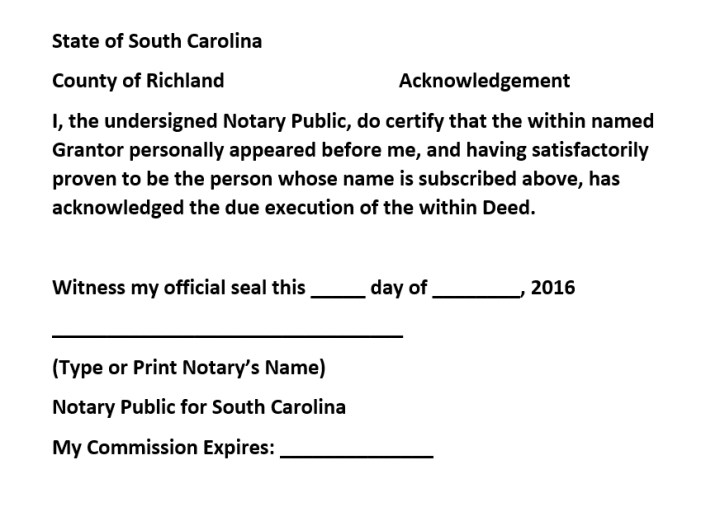
Effective June 2, 2014, South Carolina Code §26-1-120 (E) 4, dealing with notarial certificates, was amended to require that a subscribing witness in a probate form must attest that he or she is not a party to or beneficiary of the transaction.

This is a correct version of the new probate form:

Screenshot 1

Probates are notoriously difficult to complete correctly, especially for documents sent out-of-state. It is probably always a better idea to use a simple acknowledgement form, particularly in light of the statutory change:Screenshot 2Note that South Carolina Code §26-1-90(B) now requires that the notary legibly type or print his or her name near the signature.

This is a technicality, but a technicality that can cause your documents to be rejected by recording offices. Don’t let that happen!

It’s Tough to Nail Down the Treatment of Arbitration Clauses in Housing Cases

Standard

Authorities disagree!

On June 7, this blog discussed a South Carolina Court of Appeals case* that held an arbitration clause in a roofing supplier’s warranty provision was not unconscionable. The lower court had ruled that the supplier’s sale of shingles was based on a contract of adhesion and that the injured property owners lacked any meaningful choice in negotiating the warranty and arbitration terms, which were actually contained in the packaging for the shingles.

The Court of Appeals indicated that the underlying sale was a typical modern transaction for goods in which the buyer never has direct contact with the manufacturer to negotiate terms. The Court found it significant that the packaging for the shingles contained a notation:  “Important: Read Carefully Before Opening” providing that if the purchaser is not satisfied with the terms of the warranty, then all unopened boxes should be returned. The Court pointed to the standard warranty in the marketplace that gives buyers the choice of keeping the goods or rejecting them by returning them for a refund, and blessed the arbitration provision.

In a residential construction case, the South Caroline Supreme Court appeared to take the opposite approach last week.**  A national residential construction company’s contract contained a number of “oppressive and one-side provisions”, including an attempted waiver of the implied warranty of habitability and a prohibition on awarding of money damages of any kind.  The Supreme Court held that the home purchasers lacked a meaningful ability to negotiate their contract, the only remedy through which appeared to be repair or replacement.

nailing roofJustices Kittredge and Pleicones dissented, stating that the contract involves interstate commerce and, as a result, is subject to the Federal Arbitration Act (FAA), “a fact conspicuously absent in the majority opinion”.  The dissent stated that federal law requires that unless the claim of unconscionability goes to the arbitration clause itself, the issue of enforceability must be resolved by the arbitrator, not by the courts. The majority construed the Warranties and Dispute Resolution provisions of the contract as comprising the arbitration agreement and thus circumvented controlling federal law, according to the dissent.
The property owners raised no challenges to the arbitration clause itself, so the dissent would have required that the other challenges be resolved through arbitration.

Consider the CFPB’s recently-announced proposed rule that would ban financial companies from using mandatory pre-dispute arbitration clauses to deny consumers the right to join class action lawsuits. That proposed rule can be read here and is the subject of May 12 blog entitled “CFPB’s proposed rule would allow consumers to sue banks”.

It seems the authorities are all over the place on the issue of arbitration provisions affecting consumers in the housing arena. We will surely see more discussion on this topic!


*One Belle Hall Property Owners Association, Inc., v. Trammell Crow Residential Company, S.C. Ct. App. Opinion 5407 (June 1, 2016).

**Smith v. D.R. Horton, Inc., S.C. Supreme Court Opinion 27645 (July 6, 2016).

Court of Appeals Refuses to ‘Horse Around’ with Zoning Appeals Decision.

Standard

Will some Charleston carriage horses be evicted?

Condominium projects take on all shapes and sizes in beautiful, historic, downtown Charleston, where the population of tourists and residents increases daily.

An old historic house may maintain its white-columned exterior while housing four or six residential condominium units. The stately carriage house out back may be a separate unit. An office building may look like any other brick-façade four-story building from the exterior, but the interior may contain a courtyard complete with fountains, and each office may be an owned separately as a condominium unit. A residential lot may be subject to a restriction covenant that prohibits subdividing, but a creative developer may use a Horizontal Property Regime to create multiple units anyway.

But in a case decided on June 29, the Court of Appeals drew the line at a horse stable condo project that would have been created to resolve a zoning issue.*

horse carriageThe Charleston Board of Zoning Appeals had denied the application of Arkay for a special use exception to operate a carriage horse stable at 45 Pinckney Street in the historic City Market District. The property was located within 93.5 feet of a residential district, and the special exception required a separation of 100 feet.

To separate the “stabling activity” from the residential district, Arkay proposed an HPR to divide the building into two units. The rear portion of the building would house Unit A which would consist of six stalls in which the horses would be fed, groomed and stored. The front portion of the building would house Unit B which would consist of two offices and would be subject to an appurtenant easement for the benefit of Unit A for ingress and egress to Pinckney Street. Unit B would also be subject to a restrictive covenant prohibiting the use of that space as a stable.

Units A and B would be separated in the middle of the building by a common area consisting of two tack rooms, two restrooms, an area for customer waiting, and an area for customer loading and unloading. Because its horse stalls would be located 119 feet from the nearest residential zone, Arkay contended the stabling activity complied with the zoning ordinances separation requirement.

Arkay’s argument was based on the premise that the zoning ordinance’s use of the word “stable” described a use and not a physical structure. In rejecting this argument, the Board noted that only one building occupies 45 Pinckney Street, and the proposed HPR did not alter that circumstance. On appeal, the Circuit Court held that the separation requirement applied to the use, not the physical structure.

The Court of Appeals agreed with the Board, stating that the ordinance did not describe “uses” for the property but rather established prerequisites on how a stable must be configured and how it must operate to receive a special use exception. Because the building that would keep the horses encompasses the entire lot, the Court found that it is a stable for the purposes of the ordinance. Even though the horses would be kept in the rear of the building—and would be separated from the street by areas for customers, tack rooms, restrooms and offices—this does not change the building’s status as a stable, according to the Court.

Maybe the Supreme Court will see it another way, because who doesn’t love a horse-drawn carriage ride in historic Charleston?


*Arkay, LLC. v. City of Charleston, South Carolina Court of Appeals Opinion 5419, June 29, 2016.

The SC-NC Boundary Legislation Passed!

Standard

SC law “clarifying” the boundary will be effective at the beginning of the year.

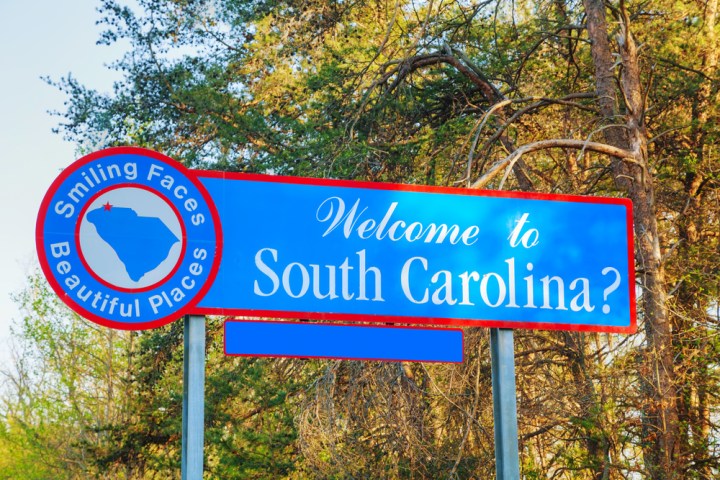
The long awaited and much debated legislation defining the boundary line between The Palmetto State and the Tar Heel State was signed by Governor Nikki Haley on June 10.  The effective date of the law is January 1, 2017.

The purpose of the law is “clarifying the original location of the boundary” with North Carolina along Horry, Dillon, Marlboro, Chesterfield, Lancaster, York, Cherokee and Spartanburg Counties and providing additional information about the plats describing the location along Greenville, Pickens and Oconee counties.  In other words, our legislature doesn’t believe the law establishes a new boundary line.

welcome to SC 2

As expected, much of the legislation deals with tax issues. The legislative intent is set out specifically, and includes the thought that no business or residence owner should be liable for back taxes to South Carolina nor refunds from South Carolina as a result of a change from one state to the other. And the Department of Revenue is given the authority to compromise taxes in cases that result in taxation in both states.

Several issues are of particular interest to dirt lawyers. For example, no deed recording fees or county filing fees may be charged for deeds recorded as a result of the boundary clarification.

On the effective date of the legislation, Registers of Deeds (and Clerks of Court in those affected counties that do not have ROD offices) will be required to file a Notice of State Boundary Clarification for each affected piece of property. The form is described specifically in the legislation and requires the legal description, tax map number, derivation (if available), the names of the owners of record and the “muniments of title”, a defined term meaning “documents of record setting forth a legal or equitable real property interest or incorporeal hereditament in affected lands of an owner”.

I’m a dirt lawyer of more years than I like to divulge, but I admit I had to investigate the meaning of that word. The learned source, Wikipedia, indicates a muniment of title is the written evidence a landowner can use to defend title, such as a deed, will, judgment or death certificate.

Apparently, lawyers in states with marketable title legislation may be familiar with this term. South Carolinians have neither the benefit of tidy legislation to correct our title problems nor the knowledge and widespread use of this nifty term, until now.  We will all need to use and pronounce the word, muniment, next year. A North Carolina colleague asked me where the RODs and Clerks of Court will obtain the information to supply the  muniments of title. My best guess is that somebody is going to have to do a lot of title work!

(Note to Professor Spitz:  I apologize if you taught me that term in law school. It’s been a long, long time!)

Also of interest to dirt lawyers are provisions relating to foreclosures. A foreclosing attorney will have to file and serve the summons and complaint along with the aforesaid Notice of Boundary Clarification and an attorneys’ certification “that title to the subject real property has been searched in the affected counties and the affected jurisdictions” on all parties having interest in the real property pursuant to the muniments of title.  Whew! The foreclosure can then proceed after thirty days. I’m not sure how all that will be sorted out. I assume South Carolina foreclosure lawyers will be hiring counterparts across the state line to assist in these title examinations.

How will dirt lawyers and title insurance companies deal with sales and mortgages for properties that change states?  I think we are going to take these issues on a case-by-case basis and work together to sort out the various issues that are surely to arise. Be sure to involve your title insurance underwriter in these decisions rather than going out on a limb alone!

Old McDonald Had a Farm

Standard

South Carolina Court of Appeals says partition actions in probate court require an open estate; sends action back to circuit court.

The South Carolina Court of Appeals held last week that probate courts in South Carolina have subject matter jurisdiction over partition actions only where open estates are involved.*

The dispute involved a farm in Darlington County originally owned by S.W. Byrd. Mr. Byrd died in 1923, and his estate was probated in Darlington County and finally closed in 1948. The estates of several of Mr. Byrd’s heirs were not subsequently probated, and in April of 2012, E. Butler McDonald filed an action for partition and the determination of heirs in the Darlington County Probate Court.

At that time, more than ten years had passed since the deaths of Mr. Byrd’s original heirs. Since §62-3-108 of the South Carolina Code establishes a time limitation of ten years after death for the administration of an estate, these estates could not be probated at the time Mr. McDonald filed his action.

farmlandThe Probate Court determined the heirs of S.K Byrd and their percentages of ownership. The Probate Court also found that no interested party had expressed a desire to purchase the property and that physical partition of the farm was impractical. The farm was ordered to be sold at a public auction, and Mr. McDonald’s reasonable attorneys’ fees were ordered to be paid.

On appeal by the other heirs, the Circuit Court affirmed. On appeal to the Court of Appeals, the appellants made several arguments, but the Court of Appeals focused on subject matter jurisdiction. Section 62-3-911 of the South Carolina Code establishes the jurisdiction for probate courts and specifically states that an heir may petition the probate court for partition prior to the closing of an estate. Since it was clearly established at trial that S.K. Byrd’s estate was closed in 1948, an action to partition his farm should have been brought in the circuit court, according to the Court of Appeals. The probate court’s determination of heirs and their percentages of ownership was affirmed, but the order was vacated as to the remaining issues.

*Byrd v. McDonald, S.C. Court of Appeals Case 5409 (June, 8, 2016)

Upscale Mt. Pleasant Condo Project Subject of Arbitration Clause Dispute

Standard

Court of Appeals sides with roofing supplier

The South Carolina Court of Appeals handed down a decision on June 1 that will delight the drafters of corporate contracts who imbed arbitration clauses within their warranty provisions.  Whether the South Carolina Supreme Court will approve remains to be seen.

The dispute arises over the construction of One Belle Hall, an upscale condominium community in Mt. Pleasant. Tamko Building Products, Inc. was the supplier of the asphalt shingles for the community’s four buildings, and placed a mandatory binding arbitration clause within its warranty provision. The warranty purported to exclude all express and implied warranties and to disclaim liability for all incidental and consequential damages.

roof shingles

At some point after construction was completed, the owners’ association determined that the buildings were affected by moisture damage, water intrusion and termite damage, all resulting from various alleged construction defects. The developer contacted Tamko to report a warranty claim on the roof shingles, contending they were blistering and defective.  Tamko sent the developer a “warranty kit”, requiring the claimant to provide proof of purchase, samples of the allegedly defective shingles and photographs. The developer failed to respond.

Two years later, the owners’ association filed a proposed class action lawsuit on behalf of all owners, alleging defective construction against the community’s various developers and contractors. Tamko filed for a motion to dismiss and compel arbitration.

Circuit Court Judge J. C. Nicholson, Jr. denied the motion and ruled that Tamko’s sale of shingles was based on a contract of adhesion and that the condominium owners lacked any meaningful choice in negotiating the warranty and arbitration terms. The trial court held the arbitration clause to be unconscionable and unenforceable because of the cumulative effect of several oppressive and one-sided terms in the warranty.

The Court of Appeals begged to differ. It held that the circuit court erred in finding the arbitration clause in the warranty was unconscionable. It stated that our supreme court has made it clear that adhesion contracts are not per se unconscionable. The underlying sale of Tamko’s shingles was stated to be a typical modern transaction for goods in which the buyer never has direct contact with the manufacturer to negotiate warranty terms.

The court found it significant that the packaging contained a notation: “Important: Read Carefully Before Opening” providing that if the purchaser is not satisfied with the terms of the warranty, then all unopened boxes should be returned. The court pointed to the standard warranty in the marketplace that gives buyers the choice of keeping the goods or rejecting them by returning them for a refund.

The appellate court also found it significant that the arbitration clause did facilitate an unbiased decision by a neutral decision maker and that the arbitration clause was separable from the warranty.

Consider the exact opposite approach of the CFPB’s recently-announced proposed rule that would ban financial companies from using mandatory pre-dispute arbitration clauses to deny consumers the right to join class action lawsuits. That proposed rule can be read here and is the subject of a May 12 blog entitled “CFPB’s proposed rule would allow consumers to sue banks”.

It’s interesting to see such different approaches by two authorities on an issue affecting consumers in the housing arena. I wouldn’t be surprised to see more to come from either ruling.

* One Belle Hall Property Owners Association, Inc. vs. Trammell Crow Residential Company, S.C. Ct. App. Opinion 5407 (June 1,2016)

SC Court Effectively Extends Statute of Limitations for Legal Malpractice

Standard

Epstein case is overruled

SC Supreme Court LogoA car dealership case against a law firm provided the South Carolina Supreme Court the opportunity to reverse its prior ruling on the point in time the three-year statute of limitations begins to run in a legal malpractice case. Interestingly, retired Chief Justice Toal’s dissent in the earlier case was adopted. The new bright-line rule in South Carolina is that the statute of limitations does not begin to run in a legal malpractice case that is appealed until the appellate court disposes of the action by sending a remittitur to the trial court.

The current case, Stokes-Craven Holding Corp. v. Robinson*, involved a negligence suit against a law firm that was dismissed at summary judgment based on the expiration of the three-year statute of limitations.  The automobile dealership had been sued by a consumer who discovered the vehicle he purchased had sustained extensive undisclosed damage prior to his purchase.  After an adverse jury verdict which was affirmed on appeal, the dealership sued its lawyer, arguing that the lawyer, among other matters, failed to adequately investigate the facts in the case, failed to conduct adequate discovery, and failed to settle the case despite the admission by the dealership that it had “done something wrong”.

scales

The lower court, following precedent, found that the dealership knew or should have known it had a legal malpractice claim against its trial counsel on the date of the adverse jury verdict.  A 2005 South Carolina Supreme Court case, Epstein v. Brown **, had held just that, despite the fact that the claimant in the earlier case, like the current case, had filed an appeal.

Epstein represented a minority position in the country, according to the current case. A majority of states have adopted the “continuous-representation rule”, which permits the statute of limitations to be tolled during the period an attorney continues to represent the client on the matter out of which the alleged legal malpractice arose.  In Stokes-Craven, our Court continued to reject the continuous-representation rule, finding that rule to be problematic because its application may be unclear under some factual scenarios.  Our Court looked to existing appellate court rules to the effect that an appeal acts as an automatic stay as to the judgment in the lower court. In other words, if the claimant appeals the matter in which the alleged malpractice occurred, any basis for the legal malpractice cause of action is stayed while the appeal is pending.

The Court stated that its new bright-line rule is consistent with the discovery rule which states that an action must be commenced within three years of the time a person knew or by the exercise of reasonable diligence should have known that he or she had a cause of action.  A client either knows or should know that a cause of action arises out of the attorney’s alleged malpractice if an appeal is unsuccessful.

Chief Justice Pleicones dissented, stating he would adhere to the discovery rule adopted in Epstein and reverse the trial court’s order granting summary judgment because there are unresolved genuine issues of material fact making that relief inappropriate.

* South Carolina Supreme Court Opinion 27572 (May 24, 2016)

** 363 S.C. 381, 610 S.E.2d 816 (2005)