“Beachfront” homeowners don’t always consider accretion to be a blessing

Standard

Sullivan’s Island litigants lose appeal on maritime forest maintenance

On August 1, the South Carolina Court of Appeals affirmed Master-In-Equity Mikell Scarborough’s award of summary judgment in favor of the Town of Sullivan’s Island in a case where homeowners sought maintenance of the maritime forest that separates their homes from the ocean.*

Many coastal communities would love to face the gradual accretion of more oceanfront property. But, in this case, the additional property became a maritime forest that, according to the adjacent homeowners, breeds snakes, rats, raccoons, bugs, spiders and other unwanted varmints and dangerous animals and also poses danger from fires and criminal activity.

The case cites University of South Carolina Law School Professor Josh Eagle’s explanation of accretion and erosion:  “Sand grains do not magically vanish from or appear on a beach; rather they are going to or coming from somewhere else along the coast.”** The Court stated that while most land use cases along our coast involve erosion, or loss of beachfront sediment, this case involves accretion, or the addition of sediment to the beach front.

sullivan's island

The unique Sullivan’s Island Lighthouse

These litigants have been involved in more than a six-year battle over what they call a “maritime jungle”. A major component of the landowner’s objection is that their properties are taxed as if they are ocean-front properties, but the value of their properties have plummeted more than a million dollars because of lack of ocean views and breezes and lack of access to the beach.

The property that separates these landowners from the ocean was conveyed by the Town to the Lowcountry Open Land Trust in 1991. Simultaneous, the Trust conveyed the land back to the town, subject to restrictions intended to preserve and conserve the natural area. The restrictions require that the property be maintained in its natural state but give the Town the authority to trim and control the growth of vegetation for the purposes of mosquito control and scenic enhancement. The Town also passed ordinances restricting the use of the property against the destruction of vegetation (except trimming, cutting and pruning).

When the 1991 deeds were executed, the ocean adjacent land was covered in sea oats and wildflowers, and the litigants’ homes had unobstructed ocean views and access to ocean breezes. The Town’s brief argued that the problem dates back to Hurricane Hugo, in 1989, which destroyed all the trees on the land. Over time, natural shrubs and trees replaced the bare, hurricane-ravaged land. At the same time, sand built up, making the houses farther from the ocean.

In the summer of 2010, the landowners applied to the Town for a permit to trim and prune the ocean adjacent property, but the Town denied the permit. This litigation followed. On appeal, the landowners argued that the deed restrictions require the Town to preserve the ocean adjacent property exactly as it existed in 1991. The Court of Appeals disagreed, finding that the deed was unambiguous and evidenced the intent that the Town would maintain the land’s natural character. The landowners’ interpretation would require the Town to continuously remove all vegetation from the beach that was not present in 1991, but the Court refused to read the deed to require such drastic management of the property.

Elizabeth Hagood, the Executive Director of the Lowcountry Open Land Trust stated in an affidavit that the Trust periodically and regularly visited the ocean adjacent land, reviewing the existing field conditions, comparing the field conditions to the deed restrictions, and finding nothing violated the deed restrictions.

As to the nuisance arguments, the Court held that those arguments sound in contract rather than tort, and nothing in the contract (the deed or the ordinances) requires the Town to clear the land.

*Bluestein v. Town of Sullivan’s Island, South Carolina Court of Appeals Opinion No. 5581 (August 1, 2018)

**Josh Eagle, Coastal Law 6 (2011)
Captain Sam’s Spit continues to be the subject of litigation

Standard

I’ve blogged about “Captain Sam’s Spit” in Kiawah Island previously. Googling that name will reveal a treasure trove of news, opinion and case law involving the proposed development of a gorgeous but extremely precarious tract of pristine beach property on South Carolina’s coast.

The South Carolina Bar’s Real Estate Intensive seminar in July of 2016 and again in July of 2018 included field trips to view this property, from a distance at least. Professor Josh Eagle of the University School of Law is an excellent tour guide, and how many opportunities do we, as lawyers, have for field trips? South Carolina Dirt lawyers should calendar the July 2020 version of this workshop.

Real estate development is my bread and butter, but two visits to the area told me that property should not be developed. A fellow field tripper, however, pointed out that the south end of Pawleys Island, where my parents took me to the beach as a child and which has been developed for many years, is just as precarious.

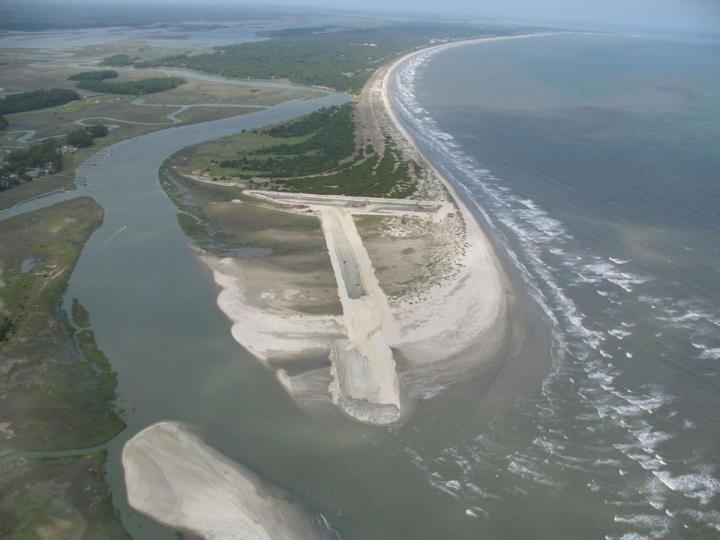
Captain Sam's Spit

Aerial view of Captain Sam’s Spit from The Post & Courier

The South Carolina Environmental Law Project located in Pawleys Island fights these cases. Amy Anderson, an attorney with that entity, joined us and explained the environmental issues as well as the legal battle.

Six months ago, the South Carolina Supreme Court held that a bulkhead and retaining wall could not be built to develop the property.  Just last month, however, Administrative Law Court Judge Ralph Anderson ruled that a road can be built to support the development because the economic benefits of building homes on Captain Sam’s Spit outweigh its natural preservation.

Here are greatly simplified facts in a very complicated South Carolina Supreme Court case: the developer and the community association entered into a development agreement in 1994. That agreement covered many issues, one of which was the proposed conveyance from the developer to the community association of a ten-mile strip of beachfront property, basically, the entire length of the island. A deed consummated that conveyance in 1995. All of the property conveyed was undevelopable because of the State’s jurisdictional lines.

I didn’t learn the following fact from the published case, but I learned it from one of the lawyers who was kind enough to speak with me. When the jurisdictional lines were redrawn by the State, the 4.62 acre tract became developable. The developer then took the position that the 1994 development agreement and the 1995 deed resulted from a mutual mistake, and that the parties never intended to include that tract.

The Master-in-Equity and Court of Appeals did not see it that way. Both found that the agreement and deed were unambiguous and that parole evidence of the intent of the parties was not allowable. The Supreme Court agreed.

In the recent Administrative Law Court case, Judge Anderson said the economic benefit of developing the property would include real property taxes of $5 million per year. This case is just the most recent in a decade of litigation.

Count on an appeal in this case and other litigation to follow. I’ll keep you posted!

Can an alley be the basis of an appurtenant easement in SC?

Standard

The Court of Appeals says it can

Charleston houses

Two valuable downtown Charleston residential lots were the subject of an easement case decided by the South Carolina Court of Appeals on September 19.* Much to the dismay of the owners of 45 Lagare Street, the Court held that an appurtenant easement exists in the form of an alley that runs along a boundary of 45 Lagare Street for the benefit of 47 Lagare Street.

Master-in-Equity Mikell Scarborough had granted summary judgment in favor of the owner of 47 Lagare Street, finding an easement appurtenant burdened 45 Lagare Street, and the Court of Appeals affirmed.

In 1911, the properties were considered a single lot known as 47 Lagare Street owned by W.G. Hinson. That year, Hinson divided the property, creating 45 Lagare Street, and conveying that lot to his niece. The 1911 deed established an easement for the benefit of the 47 Lagare Street, which Hinson retained. This language established the easement:

Also, the full and free use and enjoyment as an easement to run with the land of the right of ingress, egress, and regress, in, over, through, and upon the alley-way eight (8) feet wide as a drive way or carriage way, situation, lying, and being immediately to the south of (47 Lagare), and being the southern boundary of said (47 Legare).

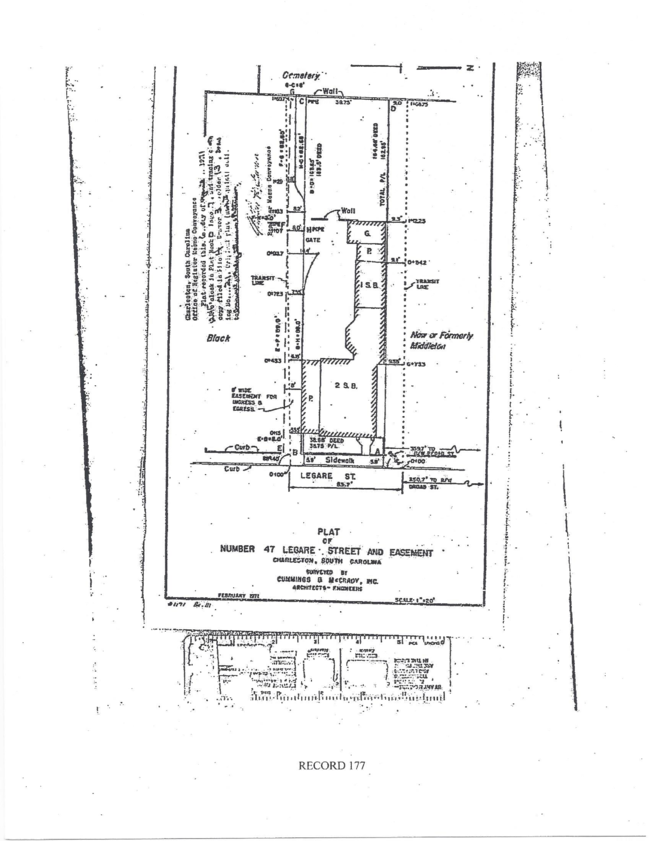
Title to both lots passed to third parties, and in 1971, a new survey was drawn,** and the owners of both properties provided verbatim descriptions of the original easement and covenanted that the no buildings or obstructions would be erected on the easement area. The documents stated that the covenants would run with the land.

The most recent deed of the benefited property recited the existence of the easement, but the most recent deed of the burdened property did not. In 2004, the owner of the benefited property added a chain-link fence and masonry wall along the border with the burdened property.

During the trial, the Appellants argued that the easement had been abandoned and stated that the only time it was used was to allow for the Respondent’s landscapers to walk down the driveway to use the gate. Respondent testified that the easement area is also used by her family members, guests, tradesmen and other permittees to access the rear of 47 Legare for large-scale appliances, equipment, and machinery and to provide access to the only suitable area for off-street parking. She also claimed that she uses the easement to access the back of her property in a golf cart.

The first issue on appeal became whether a terminus existed on 47 Legare, a requirement for an appurtenant easement. Two Supreme Court cases were discussed, Whaley v. Stevens, 21 S.C.221 (1884), which held that the terminus requirement in South Carolina only requires the dominant estate to be contiguous or adjacent to the easement. A later case, Steele v. Williams, 204 S.C. 124 (1944) held that an alleyway was an easement in gross rather than an appurtenant easement because it lacked a terminus.

The Court of Appeals found Whaley controls although no South Carolina case has explicitly defined the terminus requirement. The Court held that the terminus issue is a fact-specific inquiry and that, intuitively, the dominant estate must have access to the purported easement.

In addition, the Court stated, an appurtenant easement might be found if the purported easement (1) at least touches the dominant estate and (2) in cases where the easement is an adjacent boundary between—or runs parallel—to the dominant and servient estates, such as the case at hand, the easement does not extend beyond the dominant estate’s boundary. (At most, the easement ends at the lot line of the dominant estate.) In Steele, the alley extended beyond the appellant’s property.

The intent of the parties was held to be determinative, and the Court held that the 1911 common owner, Hinson, clearly intended that the driveway would be an easement appurtenant.

The Court next discussed the appurtenant easement requirement of necessity. 47 Legare Street obviously has direct public access on Lagare Street, but the Court held that the easement was necessary to reach the rear of the property by large-scale equipment and tools and to provide for off-street parking.

We will wait to see whether our Supreme Court has the opportunity to weigh in on this issue.


* Williams v. Tamsberg, S.C. Court of Appeals Opinion No. 5596 (September 19, 2018)

** Plat of Number 47 Legare Street and Easement surveyed by Cummings & McCrady, Inc., dated February 1971, is attached.

Check out Bloomberg Businessweek’s article about Greenville

Standard

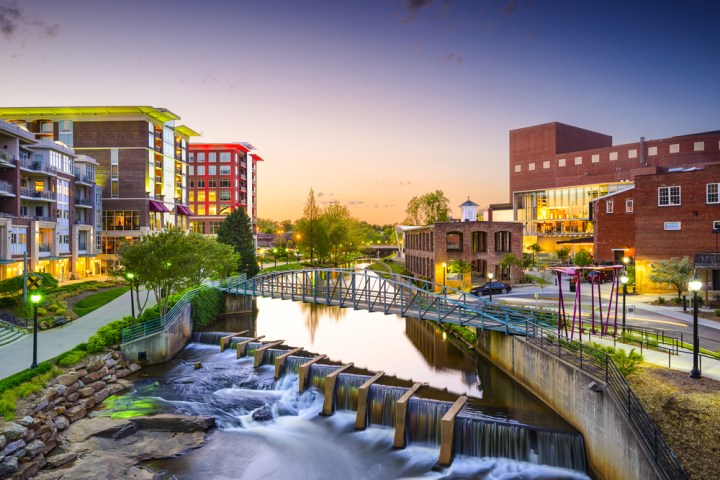
You only have to walk in downtown Greenville to see the phenomenal transformation this lovely city has made over the last two decades. The riverfront, waterfall and pedestrian bridge provide a scenic backdrop for excellent dining and cultural experiences.

My family enjoys season tickets for the Broadway series at the Peace Center which gives us a chance to enjoy top-notch shows and to check out the always-evolving restaurant scene. When we took two five-year old grandchildren to see The Lion King, we had a wonderful time enjoying the children’s fountains and mice-searching game on Main Street.

greenville.jpg

But the city planners were not only planning for culture. They were planning for business! Bloomberg Businessweek published a flattering article about the progress of businesses in Greenville on June 21. You can read it here.

The article points to decades of political commitment to creating a community that appeals to college graduates and highly skilled workers. State-of-the-art manufacturing plants have been built in the area by Michelin ad BMW. Our company has excellent attorney agents in large and small law firms who work on Main Street and surrounding areas. They report to us that they love their Greenville home.

Greenville was once a hub for textile and apparel production, but now, in addition to the manufacturing plants, Greenville supports entrepreneurs who are locating their start-up businesses downtown. One co-working space houses about a dozen start-ups, according to the article.

The author correctly points out that Greenville has excelled at creating an appealing and walkable commercial district. While downtown may have been unappealing twenty years ago, now many new inhabitants (the population has grown by 20 percent from 2000 -2016) are able to live downtown and walk to work.  Greenville has been successful, according to this article, in creating what economists call an “innovation cluster”.

Read the article and visit Greenville! I recently blogged that Charleston is exploding, and Greenville may follow suit! And I am fortunate to live in Columbia, also a great city, and within two hours of each of our sister cities, not to mention the beach and the mountains. South Carolina has so much to offer!

FORE!! Now Columbia sees new golf course redevelopment issues

Standard

Golf course redevelopment is clearly a hot topic in the real estate industry, and this is my third blog on the topic in 2018. The first blog discussed the decade-long litigation surrounding two golf courses in Myrtle Beach that eventually allowed for redevelopment despite strenuous objections of neighbors. The second blog discussed the national trend of neighbors objecting to golf course redevelopment on “NIMBY” (not in my back yard) grounds. This blog discusses a golf course closer to home, in Blythewood, The Golf Club of South Carolina at Crickentree.

golf ball

An article in The State newspaper dated July 29 by Jeff Wilkinson discussed the bankruptcy, foreclosure and eventual planned redevelopment of Crickentree. The article states that two weeks ago, E-Capital, the national investment firm that owns the mortgage on the golf course, announced this bad news by email to the neighboring homeowners. A public meeting followed where an attorney for that firm told neighbors that the intent is to subdivide the golf course into small lots and build 450 homes. Basic math would indicate the planned density will be much greater than that in the surrounding neighborhood.

The property must be purchased through the bankruptcy proceeding and then rezoned in order to accommodate a residential subdivision on property now zoned for recreational use. And, of course, the neighbors are quite concerned about potentials hits on their property values.

According to Mr. Wilkinson’s article, the Columbia area may suffer from an oversaturation of the market with golf courses. Recently, he said, the former Rawls Creek of Coldstream golf course in Irmo closed, and its owner, the Mungo Homes Co., donated the 116-acre property to the Irmo Chapin Recreation Commission. The commission plans to link the 4.5 miles of cart paths to the Three Rivers Greenway river walks in Columbia and Lexington County. Donating golf courses for recreational purposes avoids possible rezoning and litigation issues that neighbors may raise.

Many golf communities were built in areas with good schools and work opportunities, making them particularly valuable for residential redevelopment. Developers generally do not want to walk away from that value.

So, what prohibits the development of these properties into residential subdivisions? Zoning is one of the challenges. Many golf courses are zoned for commercial uses to accommodate clubhouses, restaurants, pro shops and bars. Some, like Crickentree, are zoned for recreational purposes. But the main stumbling block may be the NIMBY attitude of neighbors. Residents near golf courses prefer that the properties be turned into parks, open spaces and natural preserves.

In the Deerfield Plantation cases in Myrtle Beach, the golf courses and surrounding residential subdivisions were originally developed beginning in the late 1970’s. The plats contained notes to the effect that the streets were dedicated for public use but the golf courses were to be maintained privately and were specifically not dedicated to public use.

The covenants gave the lot owners no rights, property, contractual, or otherwise, in the golf courses. A Property Report that was delivered to all prospective lot purchasers described the costs of golf memberships, which were not included in lot prices, and stated that to be allowed to use the golf courses, members would be required to pay initial dues and annual dues and fees. The real estate agents made it clear during the sales program that the mere purchase of a lot did not give a lot owner any right or entitlement to use the golf courses. The deeds of the lots did not convey any easements or other interests in the golf courses.

One plaintiff, who was also a real estate agent, testified that he was never told the golf courses would operate in perpetuity and that the real estate agents never told other potential purchasers that the golf courses would always exist on the properties.

What caused the golf courses to fail? When the golf courses opened, there were 30 – 40 golf courses in the Myrtle Beach area. By the time the golf courses closed, there were nearly 125 courses. Property taxes in the golf courses increased from $7,800 per year to $90,000 per year.  And then the economy tanked. These three factors have occurred across the country to varying extents.

Now, let’s look at South Carolina law. In one of the Deerfield orders, Thomas J. Wills, Special Referee, examined the law of implied easements in South Carolina. I’m summarizing and eliminating the citations for this brief discussion.  The Order states that implied easements are not favored by the courts in South Carolina and must be strictly construed. The intent of the parties controls the existence and scope of implied easements, and the best evidence of that intent is the recorded documents. While case law in South Carolina is clear that lot owners in subdivisions hold easements in streets shown on plats by which their lots are sold, the order states that this rule does not extend beyond access, which is necessary and expected for residential purposes. Finally, the order states that no implied easements in views, breezes, light or air exist in this state.

After many years, these Myrtle Beach golf courses will be redeveloped into new residential subdivisions. It may take many years before the Crickentree property will be in a position to be redeveloped. Will we see more of this litigation in South Carolina?  Probably. While the law in South Carolina appears generally to favor redevelopment in these cases, there is no doubt that the facts in some of the situations may give rise to implied easements in adjacent lot owners, even in the face of our law. As long as we have NIMBY attitudes of those who live near defunct golf courses, we will continue to see litigation in this area.

Charleston is exploding!

Standard

The locals are expecting a quarter-million neighbors!

Last weekend, about sixty commercial dirt lawyers attended South Carolina Bar’s Dave Whitener Real Estate Intensive Workshop in Kiawah Island. This workshop is held every-other-year and honors the memory of the late, great real estate lawyer and law school professor who planned and moderated it for many years until his untimely death in 2014. I think Dave would have enjoyed the collaboration and education we all enjoyed last weekend*.

And I think he would have been shocked at changes in the Charleston area!

Charleston Ravenel Bridge

Charleston is exploding! Kiawah Island itself is in the throes of a major renovation anticipating its next PGA tournament in 2021. As we left Kiawah Island early Sunday morning, a time we could survey our surroundings with no traffic, we were amazed at the new subdivisions that have sprung up between the beautiful island and I-26 as well as those in the North Charleston area where the Boeing plant is located. The area is changing so fast it’s hard to recognize even for someone who does business in the area and visits it often.

I was not surprised to see this Charleston Post and Courier article entitled “105,000 homes await construction in the Charleston metro area” by David Slade dated July 18. The article begins with the premise that Charleston-area residents are about to welcome 250,000 neighbors—roughly equal to the population growth Charleston, Berkeley and Dorchester Counties have experienced since 1990. Wrap your brain around that thought! The anticipated housing, according to this report, is nearly enough to accommodate the combined populations of Charleston and neighboring Mount Pleasant, which are the largest and fourth-largest cities in South Carolina.

Traffic is already horrible in the area. We hear from many lawyer friends and their staff members who fight increasing traffic to get into work each morning. When the I-526 bridge over the Wando River was closed recently for emergency repairs, we heard that some lawyers found it easier to take boats to work rather than to deal with the detour around the bridge. The emergency repairs required for this bridge are an example of the challenged infrastructure in the area.

But, as this article points out, area governments will see added tax revenues from the new growth, which will be needed for the roads and other infrastructure. Mr. Slade points out that residents of John Island, Kiawah Island, Seabrook Island and Wadmalaw Island have been waiting for many years for planned improvements to the Maybank Highway and River Road intersection which bottlenecks each day. The islands are beautiful places to live, but getting into Charleston to work can be problematic at best.

Charleston is the number 1 tourist destination in the United States and the number 2 tourist destination in the world. All of us in the real estate business will be looking with interest as this anticipated growth unfolds in the Holy City and its surrounding areas.


*Among the speakers this year was Dave’s widow, also a commercial real estate lawyer extraordinaire, Patricia Wharton Whitener, and two of Dave’s best friends, litigator Robert E. Stepp and USC Law Professor S. Alan Medlin. The line-up was excellent, and I encourage other lawyers who practice in the area of commercial real estate to attend this workshop at each offering!

Redevelopment of golf courses might be possible in South Carolina

Standard

In April, this blog discussed the redevelopment of two Horry County golf courses. The North and South courses at Deer Track Golf Resort in Deerfield Plantation have been closed for more than ten years and are finally being redeveloped as residential lots. Adjacent lot owners waged class actions in Horry County seeking to have the use of the properties in question restricted to golf courses or open spaces. While these battles were being waged in court, nature attempted to reclaim the properties. One property owner testified that his views changed from overlooking a manicured golf course to overlooking a “sea of weeds”.

Similar battles have been successful in other parts of the country. The cases are fact intensive and turn on the law of implied easements, which, of course, varies widely from state to state. Plats showing golf courses may provide rights in adjacent lot owners, depending on the recorded documents, the sales program and the law of implied easements in the location.

golf course

I wanted to invite those interested in this area of the law to take a look at an article published in June by www.citylab.com. The article, written by Nolan Gray, is entitled “Dead Golf Courses Are the New NIMBY Battlefield”. In the interest of full disclosure, I had to Google NIMBY. This acronym stands for “not in my back yard”.

The article states that golf is dying, according to many experts. One study cited in Citylab’s article found that the number of regular golfers fell from 30 to 20.9 million between 2002 and 2016. The thinking is that the fall of Tiger Woods may have led to much of this gloom and doom around golfing. But Mr. Gray believes that the bigger story involves the sport’s aging demographics and the fact that millennials are not interested in the expensive, slow sport that provides few health benefits.

Golf courses and golf clubs across the country are closing, leaving the land to be redeveloped. Mr. Gray’s article states that the average 18-hole golf course sits on 150 acres, property that could host around 600 new single-family detached homes. Add to this mix the fact that many golf communities were built in areas with good schools and work opportunities. These properties are, therefore, particularly valuable in areas where housing inventory is a challenge.

So, what prohibits the development of these properties into residential subdivisions? Zoning is one of the challenges. Many golf courses are zoned for commercial uses to accommodate clubhouses, restaurants, pro shops and bars. But the main stumbling block, according to Mr. Gray, is the NIMBY attitude of neighbors. Residents near golf courses prefer that the properties be turned into parks, open spaces and natural preserves.

Let’s look, for example, at the Deerfield Plantation cases. First, the facts: The golf courses and surrounding residential subdivisions were originally developed beginning in the late 1970’s. The plats contained notes to the effect that the streets were dedicated for public use but the golf courses were to be maintained privately and were specifically not dedicated to public use.

The covenants gave the lot owners no rights, property, contractual, or otherwise, in the golf courses. A Property Report that was delivered to all prospective lot purchasers described the costs of golf memberships, which were not included in lot prices, and stated that to be allowed to use the golf courses, members would be required to pay initial dues and annual dues and fees. The real estate agents made it clear during the sales program that the mere purchase of a lot did not give a lot owner any right or entitlement to use the golf courses. The deeds of the lots did not convey any easements or other interests in the golf courses.

One plaintiff, who was also a real estate agent, testified that he was never told the golf courses would operate in perpetuity and that the real estate agents never told other potential purchasers that the golf courses would always exist on the properties.

What caused the golf courses to fail? When the golf courses opened, there were 30 – 40 golf courses in the Myrtle Beach area. By the time the golf courses closed, there were nearly 125 courses. Property taxes in the golf courses increased from $7,800 per year to $90,000 per year.  And then the economy tanked. These three factors have occurred across the country to varying extents.

Now, let’s look at South Carolina law. In one of the cases, a 38-page Order of Thomas J. Wills, Special Referee, examined the law of implied easements in South Carolina. I’m summarizing and eliminating the citations for this brief discussion.

The Order states that implied easements are not favored by the courts in South Carolina and must be strictly construed. The intent of the parties controls the existence and scope of implied easements, and the best evidence of that intent is the recorded documents. While case law in South Carolina is clear that lot owners in subdivisions hold easements in streets shown on plats by which their lots are sold, the order states that this rule does not extend beyond access, which is necessary and expected for residential purposes. Finally, the order states that no implied easements in views, breezes, light or air exist in this state.

Finally, these golf courses will be redeveloped into new residential subdivisions. Will we see more of this litigation in South Carolina?  Probably. While the law in South Carolina appears generally to favor redevelopment in these cases, there is no doubt that the facts in some of the situations may give rise to implied easements in adjacent lot owners, even in the face of our law. As long as we have NIMBY attitudes of those who live near defunct golf courses, we will continue to see litigation in this area.

Unpublished easement case takes a common sense approach

Standard

Access to Lake Murray must have been intended

Although an unpublished opinion has no precedential value, an easement case* decided by the Court of Appeals on May 16 takes an interesting, common sense approach that may be useful for our analysis of future easement issues.

Hamilton Duncan and Ray and Elizabeth Drasites are owners of two adjacent properties located on an inland cove of Lake Murray. Mr. and Mrs. Drasites’ property abuts the water and is situated between the lake and Mr. Duncan’s one acre parcel. Both parties acquired their respective properties with reference to an easement granting Duncan a right of access over the Drasites’ property to a terminus at the 360 foot contour of Lake Murray.

Lake Murray

Testimony before the Master-in-Equity established that the 360 foot contour is Lake Murray’s high water mark and represents the boundary between the lake, managed by South Carolina Electric and Gas Company (SCE&G), and privately-owned property.

Master-in-Equity Strickland ordered that Duncan has an easement for the purpose of accessing Lake Murray, that Duncan can use the easement to launch small watercraft, and that the Drasites are enjoined from interfering with the easement. The Drasites acknowledged the existence of an easement for a road running generally along the southeastern boundary of their property, but they argued that the length of the easement did not extend to the lake.

The Court of Appeals indicated that common sense and good faith are the leading touchstones in determining the extent of an easement and that consideration must be given to what is essentially necessary to the enjoyment of the dominant property. The Court stated it did not believe it was the grantor’s intent to give the dominant estate a right of access just shy of the lake depending on whether the water level is high or low or for a dirt road traversing the southern boundary of the Drasites’ property but just short of the lake.

The Court held that Duncan is responsible for bearing the cost of maintaining the easement, and any improvements must be subject to the approval of SCE&G. And the Court reminded Duncan that an easement is limited to a use that is reasonably necessary and convenient and as little burdensome to the servient estate as possible. Stated another way, the Court held that the owner of an easement has all the rights incident or necessary to its property enjoyment, but nothing more.

I always prefer a common sense approach. There was apparently little evidence of the extent of the easement since no survey was prepared contemporaneously with it. With the exception of the plats prepared for litigation, all plats in the parties’ chains of title show the easement terminating at the waters of Lake Murray. The Drasites based their argument on a plat outside the chains of title which depicted the road short of the lake. The Court was not impressed with that evidence.


* Duncan v. Drasites, Unpublished Opinion No. 2018-UP-211 (May 16,2018)


Family squabble leads to promissory estoppel claim

Standard

SC Court of Appeals doesn’t buy it

The facts of a recent Court of Appeals* case involve a dispute between brothers who immigrated from India. Sam Patel moved first, in 1979, and settled in Chicago. Sam’s extended family followed and lived with Sam and his wife. In 1989, Sam moved to Lynchburg, South Carolina, after he purchased a store on Willow Grove Road.

Sam’s family, along with his parents and his younger brother, Kim, followed. The family worked in and lived on the store property. The business grew, and the brothers acquired a store in Sumter. Kim Patel operated the store in Sumter, while Sam Patel continued to operate the store in Lynchburg. Over the years, Sam helped Kim financially.

grocery store country

By 2010, Sam owned three parcels in Lynchburg and operated a liquor store, a grill and a gas station. Sam, himself, faced financial difficulties at this time, and his properties were foreclosed on by First Citizens. At Sam’s request, Kim purchased the properties through the foreclosure in the name of a limited liability company. Sam continued to run businesses on the properties and placed his businesses in the name of another limited liability company.

Sam’s LLC obtained the operating, lottery and alcohol licenses for the properties and made improvements. But Kim’s LLC expended funds for gasoline purchases and property taxes. There was never a lease or written agreement between the brothers or their entities concerning rent and expenses. And when Sam failed to pay rent, Kim’s LLC brought a suit for ejectment and damages. Sam and his LLC counterclaimed, alleging Kim had promised to convey the title to him.

At trial, the brothers gave conflicting accounts of their verbal arrangement. Kim testified that he told Sam he could continue to operate the businesses for six or seven months rent-free so Sam could get back on his feet. After that time frame, Kim expected his brother to pay rent, taxes, insurance and maintenance. Sam testified that Kim purchased the properties in order to convey them back to Sam. Sam intended to repay Kim over three to five years and have title returned to him after repayment.

The special referee’s order stated that Sam owned an equitable interest in the properties and had a right to repurchase them, but that Sam owed Kim approximately $42,000 for expenses.

The Court of Appeals held that Sam’s claim of an equitable interest based on promissory estoppel failed, stating that promissory estoppel is a flexible doctrine that aims to achieve equitable results, but it, like all creatures of equity, has limitations. The court said promissory estoppel is a quasi-contract remedy with four elements:  (1) a promise unambiguous in its terms; (2) reasonable reliance upon the promise; (3) the reliance is expected and foreseeable by the party who makes the promise; and (4) the party to whom the promise is made must sustain injury in reliance on the promise. The court held that Sam’s claim failed on the first two elements.

The testimony of Sam and Kim at trial made it clear, according to the Court, that there was no meeting of the minds as to the terms of the alleged contract. In other words, there was no unambiguous promise to be enforced. And Sam’s reliance was held to be unreasonable in light of the ambiguities of the alleged promise.

The case was remanded to the special referee to conduct the eviction proceeding and to determine rent and expenses between the parties.


A&P Enterprises, LLC. v. SP Grocery of Lynchburg, LLC, South Carolina Court of Appeals Opinion 5545 (March 28, 2018).