FCC Publishes Scam Glossary

Standard

FCC Seal

The Federal Communications Commission recently published a Scam Glossary, which you can access here. The glossary provides a helpful description robocalls, spoofing scams and related consumer fraud.

The FCC tracks these nefarious items through consumer complaints, news reports and notices from other governmental agencies, consumer groups and industry sources.

The glossary includes links to more detailed information posted in the FCC’s Consumer Help Center and trusted external sources.

Here are a few of my least favorite schemes from the glossary:

“Can You Hear Me” Scam: Scammers open by asking a yes-or-no question, such as: “Can you hear me?” or “Is this X?” Their goal is to record you saying “yes” in response. They then may use that recording to authorize charges over the phone.

Flood Insurance Scam: After floods, scammers may target hard hit areas with fake calls about flood insurance to steal private information or money. They may spoof a legitimate flood insurance company to appear more convincing.

Google Listing Scams: Some scammers claim that they can add or remove you or your business from Google searches or similar services. These callers, unaffiliated with Google, seek payment for services they can’t deliver.

Jury Duty Scams: Callers pose as local law enforcement, claiming they have a warrant for your arrest because you missed jury duty. They may instruct you to pay a fine by wiring money or using gift cards.

Porting: A scammer gets your name and phone number, then gathers other identifying information that can be used for identity theft. Pretending to be you, they then contact your mobile provider to report your phone as stolen or lost, and then ask for the number to be “ported” to another provider and device. They can use your number to gain access to your financial accounts and other services with two-factor authentication enabled.

Smishing: Short for “SMS phishing”, smishing often involves text messages claiming to be from your bank or another company. The message displays a phone number to call or a link to click, giving scammers the chance to trick you out of money or personal information.

Wangiri/One Ring Scam: When your phone rings only once, late at night, you may be tempted to call back. But the call may be from a foreign country with an area code the looks deceptively like it’s in the U.S. If you dial back, international calling fees may wind up on your bill. Such cons are known by the Japanese term “Wangiri”.

Check out this useful list, share it with your office and your family members. And be careful out there!

Amazon-Realogy partnership is making news in the housing market

Standard

New home buying program not yet available in South Carolina

Amazon Turnkey smaller

According to several news sources, Amazon announced in late July that it will partner with residential real estate services company Realogy Holdings Corp. to launch a new home-buying program called TurnKey.

A TurnKey portal will be available through Amazon’s gigantic retail platform, Amazon.com. Potential home buyers who use that portal will be matched with real estate agents from one of Realogy’s brands like Coldwell Banker, Century 21 and Sotheby’s. Realogy is purportedly the largest residential real estate brokerage company in the country.

Potential buyers will go to Amazon.com/TurnKey and answer four questions about who they are and where they live. They will next get a phone call from a Realogy representative who will attempt to determine what sort of home they are seeking and how serious they are about buying. Information about the best prospects will be sent to Realogy real estate agents.

Home buyers who close with Realogy agents will receive up to $5,000 in products and services. Coupons for $450 – $1,500 in Amazon Home Services like unpacking, cleaning and furniture assembly will be available in addition to between $500 and $3,500 in smart-home products. Purchase of a $700,000 house will be required to receive the top credit.

The two giant companies are interested in finding out whether home buyers will look for new homes in the same place where they already shop for everything else. The credits for products and services will give Amazon a new way to market things it already sells, such as handyman services and smart-home gadgets like Alexa-powered speakers, doorbells and security cameras. The new lead-generating program will seek to help Realogy recruit and retain agents and increase market share.

The new program is starting in 15 markets, including Atlanta, Chicago, Seattle and San Francisco. We’ll have to wait to see how quickly it moves to South Carolina.

ProPublica publishes interesting heirs’ property story

Standard

Check out the July 15, 2019 story by Lizzie Presser

NC oceanfront property

Image courtesy of ProPublica.org

Several of our staff members stay well informed about current events, and Cris Hudson, our IT professional, is no exception. Cris pointed me to this story published by ProPublica on July 15 entitled “Their Family Bought Land One Generation After Slavery”. The subtitle is “The Reels Brothers Spent Eight Years in Jail for Refusing to Leave it.” Cris told me I should blog about this story, so here goes.

ProPublica calls itself a “nonprofit newsroom that investigates abuses of power”. The story is about brothers, Melvin Davis and Licurtis Reels, who lived in Carteret County, on the central coast of North Carolina, on land they considered to be owned by dozens of their family members. The property consists of 65 marshy acres. Melvin Reels ran a club on the property and lived in an apartment above the club. He also had established a career shrimping in the river that bordered the land. Licurtis had spent years building a house near the river’s edge, just steps from his mother’s house.

Mr. Davis’ and Mr. Reels’ great grandfather, Mitchell Reels, bought the land just one generation removed from slavery. The land was said to contain the only beach in the county that welcomed black families. Mitchell didn’t trust the courts and didn’t leave a will, so, when he died in 1970, the property became heirs’ property.

In 2011, the brothers appeared before a judge to argue that they owned the waterfront portion of their property, which had purportedly been sold, without their knowledge or consent, to a developer. They were not allowed to argue their case that day. Instead, the judge sent them to jail for civil contempt. They were never charged with a crime nor given a jury trial, but they spent the next eight years fighting their case from jail.

As any practitioner who has handled quiet title suits for heirs’ property can attest, the suits can be expensive and complex. Nonprofit organizations, like The Center for Heirs’ Property Preservation, in South Carolina, assist in litigating these matters.

The story quotes Josh Walden of the Center who said that organization has worked to clear more than 200 titles in South Carolina the past decade, protecting land valued at nearly $14 million. Mr. Walden told the reporter that the center has mapped out a hundred thousand acres of heirs’ property in South Carolina and is careful to protect the maps from potential developers.

Back to the North Carolina story, a great uncle of Mitchell and Licurtis apparently obtained the waterfront property through an adverse possession action and began sending trespass notices to the brothers in 1982. The brothers could not believe the adverse possession action could have been “legal” since they had lived on the land their entire lives. Soon afterward, the great uncle sold the waterfront portion of the land to developers.

The family members knew that if the waterfront was developed, the tax values of their adjacent properties would skyrocket, and they would have difficulty paying the taxes and maintaining their properties. Tax sales have historically been the cause of the loss of many heirs’ properties.

(I got confused in one part of the story when the author talked about “nearby” Hilton Head. We drove from Hilton Head to Outer Banks once, and I promise you, the two locations are not “nearby”. We could have driven to Disney World in the same time frame.)

Like tax sales, partition actions have been a tool used to separate heirs from their properties. A developer can buy the share of one heir and then force a partition of the entire property. While South Carolina has passed partition legislation to protect against this danger, North Carolina has held out against this reform, according to the story.

The brothers continued to rot in jail after the judge indicated there was no time limit on civil conspiracy, and that the brothers had to move their houses from the properties to be released. The brothers refused and were locked in a hopeless clash with the law, according to the story.

Eight years later, the brothers appeared before a judge who agreed to release them but warned them that if they returned to their homes, they would return to jail. They have still not been able to return to the waterfront property.

I invite you to read the entire story for a history of heirs’ property in the South. It is indeed a sad tale of greed and legal wrangling to remove properties from heirs. The Reels’ story is just one example.

Commercial lawyers: you’re not immune from fraud!

Standard

This high-dollar scam was reported to our company

hacker mask

Our company publishes an excellent newsletter entitled “Fraud Insights”. The Editor, Lisa Tyler, National Escrow Administrator, deals mostly with residential transactions. It’s unusual for her to report on a scam involving a commercial transaction, but the edition that hit my in-box today outlines the story of a chilling scam involving a commercial transaction in New York. Fortunately, the scammers were not successful despite their best efforts.

Here are the facts. On April 10, 2019, an attorney at a large, prestigious New York City law firm sent a settlement services office in Lake Success, New York, a payoff letter for a private mortgage. The payoff letter said $1.7 million should be wired to a bank account in New Jersey.

The afternoon before the closing, the settlement office received an email purportedly from the payoff attorney’s office with revised payoff instructions for a bank in the Netherlands.

The closing was postponed for reasons not involving the loan payoff. When the closing was rescheduled, the settlement office emailed the lawyer and his assistant inquiring about the change in the wiring instructions. The responding email confirmed that the change was legitimate.

Reviewing the emails carefully, the closer noticed the domain name for the lawyer’s office contained an extra “s” beginning with emails dated April 16. The attorney’s email signature was also partially cutoff beginning April 16.

Two hours before the closing, the attorney’s assistant purportedly sent the closer an email asking if the wire had been sent. The closer did not want to alarm her that her email had been compromised, so he responded that the closing was happening shortly, and he would be in touch. The closer then searched the law firm by Internet and called the main telephone number, asking for the assistant directly. She answered the phone and said the original payoff letter was the only payoff letter, and she had not sent the recent email. She was, of course, alarmed.

She said her attorney was in court and she would relay the distressing information to him immediately. She was asked to refrain from using email for that notification because the emails were clearly being watched. Regardless, she emailed the attorney. At that point, the scammers were tipped off that their scheme had been uncovered.

While the legal assistant and the closer were discussing the situation by phone, the closer received another email purportedly from the assistant demanding that he call the lender to confirm the payoff information. Immediately following that exchange, a man called the closer office to confirm the altered wiring instructions.

At this point, everyone involved with the closing knew for sure that they were dealing with attempted fraud. The closing took place, but the payoff was accomplished via bank check.

The closer said his office tries to remain on the cutting edge of technology and industry news. His sharp eye in pinpointing the email discrepancies kept the closing from being another cybercrime news story. Commercial lawyers may feel somewhat insulated from the rampant cyber fraud that plagues residential practices, but this cautionary tale is an example of penetration into a sophisticated law firm. Be careful out there!

Let’s collectively start a trend in South Carolina: Shifting home closings away from the end of the month

Standard

I’m going on the record with a strong second to my friend, Gary Pickren’s blog!

end of month calenda NOPE.

Gary Pickren, an excellent residential real estate attorney with an outstanding law firm, Blair|Cato|Pickren|Casterline, here in Columbia posted a blog on May 12 entitled “Save Yourself a Huge Headache!!!!” You can read Gary’s blog in its entirety here.

Gary was apparently reacting to a crazy month-end for his office in April. He reported 25 closings on Tuesday, April 30 as opposed to 3 or 4 on Wednesday, May 1. And the closings that occurred on May 1 were a result of late loan packages from lenders. He was asking his real estate agents to save themselves headaches by scheduling closings throughout the month.

Closings at the end of the month are not a new phenomenon. As far back as I can remember (and that’s a long way back), real estate agents have scheduled closings at the end of the month. Why? Because interim interest has to be paid for only one day, reducing the funds the buyer has to bring to the closing.

Does closing at the end of the month save the buyer money? No! Interest will be paid from the date of the closing regardless. The only difference is the amount of the interim interest, the funds brought to the closing table. If interest is not brought to the closing, it is paid with the first payment.

I sent Gary’s blog around to my office members and got some unexpected strong reactions!

TAnderson

Troyce Anderson, who was formerly a closing paralegal in Greenville, said scheduling closings throughout the month would probably reduce claims because law firms would be able to close with less stress and avoid common mistakes.


MTucker

Melissa Christensen, who was formerly a closing paralegal in the Myrtle Beach area, said her daughter, Savannah, was born on May 30, and the family always has to schedule birthday parties in early June.


SSigwart 2018

Speaking of birth issues, Sara Sigwart, who was formerly a closing paralegal in Hilton Head and Charleston, said that one of her fellow closing paralegals successfully searched for a doctor who would schedule a delivery of her child on the 20th of the month so she could celebrate birthdays with her child on the actual birth date.  Sara’s other reply to Gary’s blog was “PREACH!”


DSeay


Denise Seay, who was formerly a real estate paralegal in Hilton Head said, “Oh good grief-we used to say Realtors only knew one day in the month!”


If our office staff reacted this strongly, imagine how strongly your paralegals, who are currently in the closing trenches, would react. Think about how much easier it would be to manage your office and everyone’s schedules! Your holidays and vacations would even be more manageable.

Gary’s blog calls the end of the month in a residential closing office “organized chaos”.  It might also be termed a huge “traffic jam” for lenders, real estate agents, closing attorneys, paralegals, abstractors, and even buyers and sellers. Let’s follow Gary’s advice and spread closings throughout the month!

You don’t have to be the “bad guy” by using your own words to pass this thought on to real estate agents. Send them this blog!

HUD accuses Facebook of housing discrimination

Standard

facebook-dislike-thumb.jpgThe U.S. Department of Housing and Urban Development (HUD) announced last week that it has filed a civil complaint against Facebook, Inc. alleging violations of the Fair Housing Act as a result of Facebook’s ad-targeting system. Twitter, Inc. and Google have been notified that their similar practices are under scrutiny.

Facebook’s ad-targeting system allows advertisers the ability to direct messages to target audiences with precision.  HUD charges this system has allowed real estate companies to unlawfully discriminate on the basis of race, nationality, religion, color familial status, sex and disability.

The complaint alleges Facebook is guilty of “encouraging, enabling and causing” unlawful discrimination when it allows advertisers to exclude users by certain characteristics, for example, whether they are interested in Hispanic culture and food, whether they are parents and whether they are non-citizens or non-Christians. Some ads are only shown to women. Other ads may exclude neighborhoods or geographic areas like ZIP codes. Secretary of HUD Ben Carson said using a computer to limit a person’s housing choices can be just as discriminatory as slamming a door in that person’s face.

HUD alleges Facebook mines users’ extensive personal data and uses characteristics protected by law to determine who can view housing ads.

This is not the first time Facebook has been in trouble for ad-targeting. An earlier investigation by ProPublica found the advertising practices acted to exclude African American, Latinos and Asian Americans. HUD had filed an earlier complaint last August alleging ethnic groups were excluded from viewing some ads. Facebook took action by removing 5,000 ad target options.

The ACLU was not happy with that result and filed a lawsuit. That lawsuit was settled recently with Facebook announcing substantial changes to its platform including withholding a wide array of demographic information often used as indicators of race. Facebook also agreed to create a tool that would allow users to search for housing ads whether or not the ads could be viewed in individual news feeds.

HUD was apparently dissatisfied with the settlement as not going far enough to remedy housing discrimination and responded with the current complaint.

Landlords may have “sweeping” new duty to protect tenants in SC

Standard

Apartments’ courtesy officer program may create liability

It is not uncommon for apartment complex managers to exchange reduced rent for the casual services of resident law enforcement officers. These services may include parking law enforcement vehicles on the property, answering security calls regarding incidents in the complex, and walking the property in uniform. A recent South Carolina Supreme Court case* may have imposed liability on apartment complexes employing these tactics to protect tenants from criminal acts of third parties.

Denise Wright was abducted and robbed at gunpoint by two assailants in the common area of Wellspring apartment complex within the Harbison community near Columbia. The incident took place after Wright left choir practice at her church at around 10 o’clock on a September night in 2008. The assailants were never apprehended. Wright had lived at Wellspring since 2003. She became interested in Wellspring because of its proximity to her job and because of recommendations from several church members. She testified that security was an important factor in her decision.

Image may contain: plant, flower and outdoor

Photo courtesy of Facebook.

Wright testified that at the time she signed her lease, a Wellspring manager told her there were security officers on duty. The defendants conceded this fact. Wright testified this representation made her believe Wellspring would be a safe place to live.

An internal Wellspring employee manual stated, “We generally do not provide security for our residents, and employees should never indicate that we do so.” Wellspring had designed a courtesy officer program allowing residents affiliated with law enforcement to receive reduced rent in exchange for spending a minimum of two hours daily of their off-duty time walking the property, answering calls regarding incidents on the property and submitting daily reports to the property manager. The parameters of these agreements were not revealed to other tenants. Wellspring published a “security pager” number in a monthly tenant newsletter. The newsletter also prominently noted that security was a top priority with the complex and advised tenants to call the security pager or Richland County Sheriff’s Department if they saw “anything suspicious”.

There were no courtesy officers at Wellspring on the night of the abduction and robbery; in fact, the last time a courtesy officer had been employed was the previous July. Wellspring had continued to publish the pager number in its monthly newsletter. The tenants were not informed that there were no courtesy officers.

Wright argued, among other things, that Wellspring was negligent in failing to execute its courtesy officer program in a reasonable manner. The defendants argued that they did not owe Wright a duty to provide security and that, even if they did, that duty was not breached, and even if the duty was breached, their alleged negligence was not a proximate cause of the harm. The trial court granted the defendants’ motion for summary judgment. A divided Court of Appeals affirmed. On a writ of certiorari, the sole question before the Supreme Court was whether the Court of Appeals erred in failing to apply section 323 of the Restatement (Second) of Torts, which provides:

“One who undertakes, gratuitously or for consideration, to render services to another which he should recognize as necessary for the protection of the other person or things, is subject to liability to the other for physical harm resulting from his failure to exercise reasonable care to perform his undertaking, if

  1. his failure to exercise such care increases the risk of harm, or

  2. the harm is suffered because of the other’s reliance upon the undertaking.”

The Supreme Court stated that it is well settled in South Carolina that a landlord generally does not owe an affirmative duty to a tenant to provide security. An “affirmative acts” exception exists, however, where one assumes to act even though under no obligation to do so. Wright’s brief acknowledged that South Carolina case law is not clear as to how the “affirmative acts” exception differs from the “undertaking” exception of the Restatement. The Supreme Court found that Wright’s negligence cause of action invoked the undertaking exception and held that summary judgment should not have been granted. The Court stated that there are questions of fact that a jury must resolve to ascertain whether a duty of care arose in this case.

Justice Kittredge’s strongly worded dissent said that the majority took the common existence of an apartment complex’s security officer program and morphed that limited undertaking into a sweeping duty to protect tenants from unforeseen criminal acts of third parties. The dissent found particularly troubling a lack of proximate cause.

Dirt lawyers who represent owners or managers of apartment complexes should take a careful look at this case with their clients.

*Wright v. PRG Real Estate Management, Inc., South Carolina Supreme Court Opinion 27868 (March 20, 2019)

ALTA’s Board approves revision to Best Practices

Standard

Change would require ALTA ID

alta registry

The Board of Governors of American Land Title Association approved a motion on February 21 to revise the Title Insurance & Settlement Company Best Practices to include a requirement for companies to be listed in the ALTA Registry. The amendment is under a 30-day review period ending April 12. Comments may be sent to bestpractices@alta.org.

The proposed amendment to Pillar 1 of Best Practices includes the following requirement:

  • “Establish and maintain a unique ALTA Registry Universal ID (ALTA ID) using the ALTA Registry platform for each settlement office location (subject to those business entity types supported by the ALTA Registry).

ALTA, the national trade association of the land title insurance industry, formally launched the national ALTA Registry in 2017, allowing title insurance agents and settlement companies to communicate with underwriters to confirm their company name and contact information.

Using the ALTA Registry, lenders and their vendors are able to identify title agents, title underwriters and other participants in the closing process and communicate in a timely and consistent manner throughout the mortgage transaction.

Because there has been no unique ID number used across the industry to help match provider records in different databases, communication has often been difficult and costly for the title industry and its customers. This is especially important with new regulations driving vendor oversight requirements and the need for collaboration.

The ALTA Registry is a free, searchable online database of underwriter-confirmed title agent companies and underwriter direct offices. The registered information includes the title agent’s legal entity name, location and contact information. ALTA offers a unique 7-digit identifier, the ALTA ID, which is automatically assigned to each new database record as a permanent ID number and is never changed, reassigned or reused. ALTA ID numbers are available free of charge to title agents and real estate attorneys.

ALTA’s Best Practices is designed to assist lenders in managing third-party vendors. Pillar 1 requires title companies (closing attorneys in South Carolina) to maintain licenses for doing business in the title industry. This includes the license required by the South Carolina Department of Insurance and the ALTA policy forms license. The registry helps lenders determine they are working with legitimate title providers.

The Power of a System

Standard

How to build the law practice of your dreams

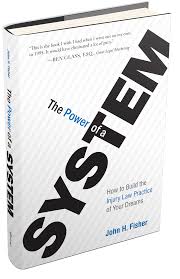
power of a systemReaders of this blog know it includes a random book report from time to time, and this is one of those times. I read John H. Fisher’s The Power of a System; How to Build the Injury Law Practice of Your Dreams last summer and I have bought it for more than one real estate practitioner. Today, I recommend it as excellent reading for the readers of this blog.

At the beginning of his medical malpractice firm, Fisher wished for a step-by-step manual for running a profitable practice because, like the rest of us, he was not taught strategic planning, goal setting, business metrics, managing employees, managing clients and marketing in law school.

The author has developed that manual for a personal injury law firm, not just technical systems for running a business, but also the managerial and entrepreneurial principles to keep a constant stream of new cases and clients coming down the pipe.

The three parts of the book, The Technician, The Manager and the Entrepreneur, are based on Michael E. Gerber’s classic book, The E-Myth Revisited, another favorite of mine for law firm management. Gerber’s message is that every lawyer should set aside time each day to work on the business through strategic thinking instead of only spending time working in the business through technical legal work. Fisher’s book provides systems for all three roles the law firm owner must play.

Mr. Fisher provides us with a glimpse into his daily work life through his office rules. Those rules are based on the theory that staff members should handle every aspect of a practice that don’t absolutely have to be handled by the attorney. In the residential real estate practice, the functions the attorney must handle would include the closing, the second review of title, and the resolution of legal issues that arise in connection with conflicts, title and closing. Rules in a residential practice would be in writing and would make it clear that staff members are responsible for keeping attorney time free to touch those matters that only the attorney can handle.

The author’s rules deal with dress code, internet use, cell phone use, personal errands and timeliness, how to avoid interruptions and completing assignments. He has “scripts” in place for handling telephone calls, and insists on answering the phone with a smile. My favorite is his “no-gossip rule”. His rules are robust and demanding. But putting those guidelines in practice and enforcing them would ease day-to-day conflicts and stresses that arise among staff members.

This law firm outsources manual tasks by using companies such as Elance.com (now Upwork.com), Your Man in India (YMII) and Brickwork. The author believes that outsourcing has allowed his business to become a 24 hour/day law firm.

Fisher’s emphasizes treating new clients with “shock and awe” to demonstrate that he “shows up like no one else”. His package includes his book The Seven Deadly Mistakes of Malpractice Victims. Each book is personalized and signed, for example, “Dear Mary”. The package also includes audio informational CDs and a binder of office policies including a “Client Bill of Rights”. Each client should understand communicating with his or her lawyer from the outset of the relationship.

Mr. Fisher believes in setting goals and measuring everything. Measuring law suit time frames reduces costs and increases profitability. Real estate lawyers should set goals and measure time frames for closings. By measuring time frames for title work, surveys, termite letters, receipt of closing numbers, receipt of lender closing packages, commitment preparation, closing document preparation, recording, disbursement, satisfactions and distributing final documents, a real estate practitioner would ascertain where systems are routinely bogged down and would be able to work toward fixing those pressure points.

The author believes in marketing to the “ideal client”. While I usually have to translate books like this for real estate practices, Mr. Fisher did the translation for me in this regard. This is his paraphrased message to us:

If you are a real estate lawyer, are your ideal clients the homeowners buying a new house? No! The homeowners will use your services one time for a fee of $750, and you will likely never hear from them again until they buy another home. You will be broke by the time the homeowners need you again. The ideal client for a real estate lawyer is the real estate agent who refers a steady stream of new homeowners. The goal is not to make money on a single transaction. Rather, the goal is to develop relationships with your ideal client that will generate new clients and a steady stream of income for the rest of your career. The lifetime value of your ideal client is far greater than the value of a single transaction.

The book outlines three simple marketing rules that the author says will place a lawyer ahead of 98 percent of the competition:

  1. An informational-powerhouse website that provides killer content on a daily basis;
  2. A monthly newsletter targeted to the ideal client; and
  3. Regular seminars and workshops that provide valuable content to the ideal client.

He gives details on producing the monthly newsletter and establishing regular event marketing in the form of seminars and workshops.

We could all use an entire school-year class in law office management including each aspect of the work Mr. Fisher emphasizes. Since that class doesn’t seem to exist, I will do my best to obtain and communicate the information dirt lawyers need in this regard. As a favorite political pundit routinely says, “watch this space.”

Forgive me for repeating myself

Standard

But practitioners really need to read The Lean Law Firm

In October, this blog discussed a book I had just read,  the 2018 ABA Law Practice Division book, The Lean Law Firm, How to run your firm like the world’s most efficient and profitable businesses.  Now that I have attended a South Carolina Bar seminar by the authors, I am even more convinced that the methodology this book embraces is exactly what residential real estate practitioners need to adopt to assist them in reducing stress and growing value in their practices.

lean law firm4

One of the authors is Columbia consumer lawyer Dave Maxfield, who happens to be the brother-in-law of my co-worker, Dorothy Boudreaux. The other lawyer, Larry Port, is CEO of Rocket Matter, the cloud based legal practice management software company. The January 31 seminar made an impactful initial point: most law firms are in survival mode. They won’t progress unless the lawyers step back and take a look at the business to gain perspective.

What is a lean law firm?  In the words of Larry Port, being lean is not about cost cutting. “It’s more about creating systems and then finding the constraints and inefficiencies that impede them. Lean lawyers believe in measurement, reducing waste, and producing as much value as they can for their clients. And more than anything else, Lean is about experimentation and continuous improvement.” The processes set out in this book are intended to teach lawyers how to increase their income while they are reducing their stress.

Unfortunately, most lawyers have little or no awareness of the value of creating systems. We are not taught to run businesses in law school. The lawyers I know and love are so busy practicing law that they don’t take the time to modernize, to focus on processes, and to create the systems that will allow them to run their firms like efficient and profitable businesses.

Wouldn’t your closing process be improved if you were able to figure out and reduce or eliminate those matters that cause delay? I was in an office recently and noticed a great deal of foot traffic by staff members. I asked where everyone was heading and was told they were all probably looking for files. Wouldn’t that office’s process be improved by using closing software that makes every file constantly available to every person involved in the closing? I was in another firm with multiple branches and learned one branch had templates for the title work for each subdivision, but the other branches didn’t have access to the templates. Sometimes, just stepping back to take a look will reveal small tweaks that can vastly improve systems.

One of my favorite suggestions from the book is the use of Kanban boards, a project management tool used to visually depict work at various stages. The simplest Kanban boards would have three columns: “to-do”, “doing” and “done”. A Kanban board for a residential closing office might have these columns:  “file opening”, “pre-closing”, “title”, “document preparation”, “closing”, “recording”, “disbursement” and “post-closing”. Each closing would be depicted in the appropriate column. By paying attention to this workflow tool, a closing attorney would learn quickly where work bottlenecks, and improvements could be made efficiently.

I believe the advice I once heard:  every time you touch a closing file after the closing, you lose money. A Kanban board might reveal whether reducing the numbers of post-closing touches in your office would increase the income from each closing.

Does the book sound like dry reading to you? It is not that at all. In fact, it is the first book published by the ABA to employ the graphic novel approach. It is written in the form of a story about Gray Law Firm, a small struggling firm, it’s newly-hired, former big law lawyer, Carson Wright, who wants to help  “fix” the law firm, and Carson’s friend, Guy Chaplin, who runs an extremely successful racing bicycle manufacturing and distribution company.  Guy slowly teaches Carson the business principles that make his company successful. And Guy helps Carson figure out how to apply those principles to his law firm.

I have to warn you that the book contains a lot of math. I am not a math scholar by any stretch of the imagination, and I was able to follow the formulas and to see how they would work well in a law firm that handles real estate, especially residential real estate. In fact, my only complaint about this book is that it is not geared specifically to real estate practitioners.

The book gives very specific advice about the basics of management, standardization, written procedures, checklists, marketing, goal setting and technology. A South Carolina real estate lawyer might find that some of the advice doesn’t apply, but I’m betting that most of it does apply, and I am encouraging everyone to order a copy of this book at www.ShopABA.org and to take its advice to heart.

I am now in the process of twisting Dave’s arm to translate “Lean” to residential real estate. If I am successful, I will certainly share his wisdom with my friends who practice residential real estate in South Carolina who are probably battling survival mode as they read this.