A useful SCDOT website for South Carolina dirt lawyers

Standard

opposite-road-signs-sc-dot My colleague Tom Dunlop recently shared a South Carolina Department of Transportation website with me that is a nifty tool for determining whether the DOT maintains a road.  Check out the site here.

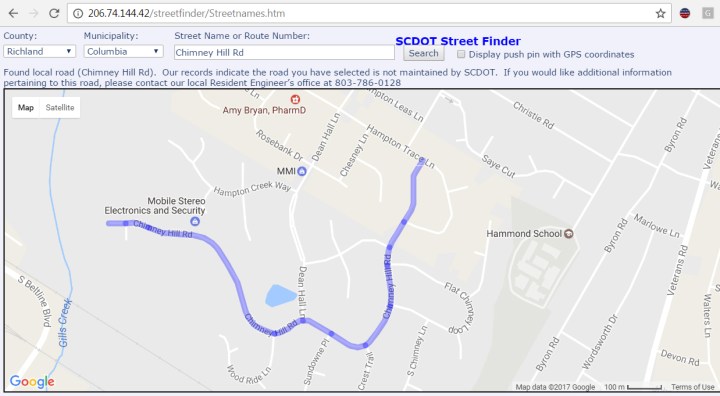
I entered my own street, Chimney Hill Road, and found out that the DOT does not maintain my street but that I could get more information from the Resident Engineer’s office at 803-786-0128. (I know Chimney Hill Road is marginally maintained by the City of Columbia from watching the repair of the pothole in front of my house at least annually.)  Here’s what the website shows:

blog-screenshot-1

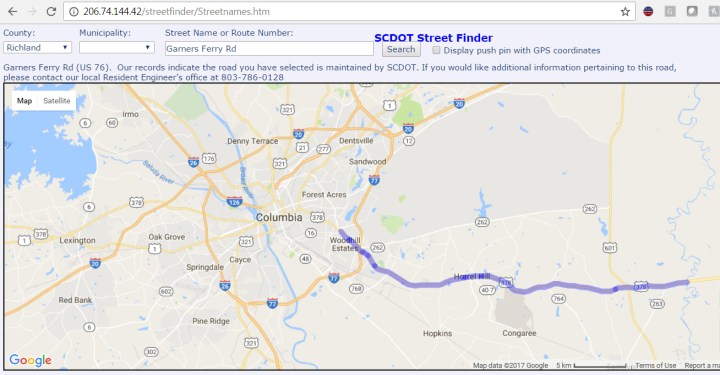
Then, I tried Garners Ferry Road (U.S. 76) and learned that the DOT does maintain this road.  Here’s the map:

blog-screenshot-2

Trying another County, I entered one of my favorite roads (the road to the beach!), Highway 17 (Ocean Highway S) in Georgetown County. This road is maintained by the DOT, and the phone number for the local office, for more information, is 843-546-2405.

blog-screenshot-3

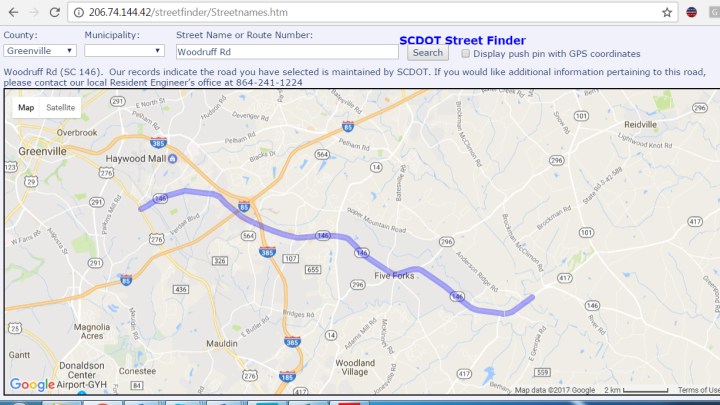
Turning to the upstate, I tried Woodruff Road (SC 146) in Greenville County and learned that this road is maintained by the DOT, and the phone number for the local office, for more information, is 864-241-1224.

blog-screenshot-4

I hope this website will provide real estate closing attorneys with some quick information when road maintenance becomes an issue.

One of President Trump’s first official actions affects housing

Standard

presidential-seal

The Federal Housing Administration (FHA) announced on January 9 that it planned to reduce mortgage insurance premiums effective January 27. Mortgage insurance protects lenders from borrower defaults and is common where the down payment is less than 20%.

The Democratic view of this issue is that sufficient reserves and four years of economic growth allowed the FHA to pass along some modest savings to consumers. Additionally, the move was viewed as an attempt to help first-time and lower income home buyers to access the market at a time when mortgage rates were rising.

The Republican view is that such reductions put taxpayers at risk by decreasing the funds the FHA has to deal with mortgage defaults. In other words, taxpayers might be at a greater risk for footing the bill for another bailout if FHA’s reserves were reduced.

President Trump’s advisors criticized the Obama administration for adopting new policies as it prepared to leave office. During Dr. Ben Carson’s confirmation hearing for Secretary of the Department of Housing and Urban Development (HUD), FHA’s parent agency, he expressed disappointment that the cut was announced so late in President Obama’s term.

On January 20, shortly after he was sworn in, as one of his first substantive actions, President Trump undid this new policy before it took effect by signing an executive order.

HUD then issued a letter stating that more analysis is needed before changes are made, and the rates will remain the same for the time being.

It appears industry groups may have differing opinions on whether President Trump’s executive order will affect home buying. Will this action reduce opportunities for first-time buyers? Or will it eventually allow FHA’s reserves to be increased to a point where it can offer more services to borrowers? Industry groups will continue to weigh in, and this blog will continue to keep South Carolina dirt lawyers posted on developments.

A little mundane, but useful, information for your New Year

Standard

paperwork-stacks

York County’s Register of Deeds office recently informed local dirt lawyers that it will begin using a new system on January 23. The new system will require labels containing recording information to be attached to recorded documents.

This County will require a three-inch margin at the top or bottom of the front page of each recorded document. Documents that do not meet the margin requirement may be rejected because the label may conceal a portion of the document.

I am confident York County lawyers are informed of this development but wanted to get the word out to the remainder of the state to benefit lawyers who may handle a transaction in that County from time to time.

SC residential tax breaks are “two ships in the night”

Standard
ships passing night.jpg

“Ships that pass in the night, and speak each other in passing, only a signal shown, and a distant voice in the darkness”  – Longfellow

Tax cases can be complicated, but this one seems relatively simple. The South Carolina Court of Appeals held in late December that the homestead exemption and the primary residence (4%) classification are two entirely separate matters*.

The taxpayer, Frank Mead, turned sixty-five in 2004 and received the homestead exemption from 2005 to 2010 on his home located in beautiful Hilton Head Island. In 2011, he had a brilliant idea and rented his home for 138 days during which he traveled part of the time and stayed in a rental apartment the remainder of the time.

The Beaufort County Tax Assessor didn’t approve of Mr. Mead’s brilliant idea. She revoked the homestead exemption for 2011 on the theory that he no longer qualified because he rented his home for more than fourteen days.  Mr. Mead believed the fourteen-day limitation applied only to the primary residence (4%) classification and appealed to the Beaufort County Tax Equalization Board.

He lost in that forum but then appealed to the Administrative Law Court. The ALC found for Mr. Mead and determined that the homestead exemption and the primary residence classification are “two ships in the night” with different requirements. The Tax Assessor appealed to the Court of Appeals.  The issue was whether the homestead exemption under §12-37-250 of the South Carolina Code is available only to property that also qualifies for the preferential residential assessment ration set out in §12-43-220(c).

Section 12-37-250 provides for a homestead exemption for a person sixty-five or older when that person has been a resident of South Carolina for at least one year. Section 12-43-220(c) provides for a special property tax assessment ratio of 4% (as opposed to the normal 6%) for owner occupied legal residences.

To make the matter a little more complicated, but more advantageous to the taxpayer, the assessment ratio statute further provides that the owner-occupant of a legal residence is not disqualified from receiving the 4% classification if the requirements of Internal Revenue Code §280A(f)[2] as defined in section 12-6-40 (A), meaning the property may be rented for less than fifteen days.

The Court of Appeals noted that nothing in the homestead exemption statute makes reference to the primary residence classification statute and that the 14-day rule applies only to the four percent assessment ratio. Simple, right? Not quite so simple: interestingly, the Department of Revenue had taken the same position in a 1997 memorandum that the Tax Assessor in this case took, but withdrew that memorandum two years later.

For now, the rules are separate and distinct, and the taxpayer wins!

Goodbye old friend

Standard

And hello 2017!

I bought a car on the first business day of 2017.

For most folks, buying a car is not a big deal, but I am definitely not a car person!  I drove my mother’s last car for almost eleven years after her death in 2006 and was embarrassed to shed a few tears at the dealership when I sentimentally traded it in on January 2. That car has 200,000 miles on its odometer! It’s still in great running condition, and I hope it finds a good home with someone, maybe a teenager, who needs safe and inexpensive transportation. Before my mother’s car, I drove a car I bought from a deceased friend’s estate. Are you detecting a pattern in my vehicular history?  Until this week, no car dealership had made a dime on me in the past 15 years!

My colleague and friend, Tom Dunlop, on the other hand, is definitely a car person. He currently drives a bright red late model Mercedes which he will upgrade this spring for the mere reason that two years have passed. His dealership loves him! In addition to trading every two years, Tom takes donuts to the staff when his car is serviced. What a nice guy! We’ve enjoyed that shiny red Mercedes as our lunch vehicle and can’t wait to see what Tom decides will be our new fancy ride in the spring.

new-year-new-startWhy is this car talk relevant to dirt law in 2017? It’s relevant because our success in the housing industry this year may depend on whether Americans and specifically South Carolinians are really home ownership people.

There are some reasons for concern. Interest rates are climbing. The mortgage interest rate deduction is under attack in Congress. The future of the CFPB may be precarious under the new administration and because of pending litigation challenging its constitutionality.  Some financial advisers are recommending renting as a better economic alternative for many Americans. Some retirees are being advised to sell the large homes where they raised their families in exchange for nifty, low-maintenance town homes, condominiums and even rental apartments.

But unlike my personal lack of thirst for new cars, I believe many Americans and many South Carolinians have an enduring thirst for new and upgraded residences. And I believe their thirst is most often quenched only by purchasing those residences. We have been taught that home ownership is an excellent investment vehicle coupled with a tax advantage. This advice goes back several generations. This wisdom is so ingrained that the counsel to retirees to rent shocked me! I had to read it from several sources to believe it was serious and sound advice for some folks.

And, thankfully, the economy is continuing to improve. Zillow is reporting that the U.S. housing market has regained all the value it lost during the housing crisis. South Carolina is particularly poised for success. Charleston is one of the fastest growing markets in the country. Hilton Head is digging out and rebuilding from Hurricane Matthew. The Rock Hill/Fort Mill area is growing toward Charlotte rapidly. It is impossible to ride around Myrtle Beach, Greenville and even Columbia without dodging construction activity. My own office’s numbers have improved during 2016, and I budgeted up for 2017. I suspect most South Carolina dirt lawyers are looking for a better year in 2017 than in 2016 assuming they can maintain their momentum and sustain the excellent staffing that momentum requires.

I am optimistic!  Here’s hoping Americans and South Carolinians continue to be home ownership people. And here’s hoping 2017 is a healthy, happy and prosperous year for you!

The housing industry is crying Bah! Humbug!

Standard

Congress may eliminate mortgage interest deduction

Mike Goodwin, the “Bow Tie Comedian” based here in Columbia, mike-goodwin-bowtie-comedianentertained us during lunch at our recent Chicago Title seminar. A joke that bubbled up through his very funny presentation was a line his mother used to keep him on the straight and narrow during his childhood, “what you NOT gonna do is…..”

For example, she would say, what you NOT gonna do is to stand there and hold that refrigerator door open while you try to decide what you want to eat. During one lull in the laughter, Mike said to us, “what you NOT gonna do is sit there and not laugh at my jokes.” (So we laughed.)

While some of us believe America is about to be made great again, some of us might like to borrow Mike’s line to deliver a Bah! Humbug! message to Congress:  What you NOT gonna do is to eliminate, or effectively reduce the effectiveness of, the mortgage interest deduction. Many homebuilders, lenders and real estate agents (and South Carolina dirt lawyers) believe that’s one thing we don’t need 2017.

The mortgage interest deduction is a major driver of the housing market. One reason American dreamers strive for home ownership is to take advantage of this tax break. That, along with the property tax deduction, the points deduction, the PMI deduction and the home office deduction, make owning a home a wise move from a tax standpoint. Eliminating or reducing the effectiveness of the home interest deduction, which many consider as American as apple pie, might put a damper on the improved economy we have been experiencing in 2016.

But that approach is definitely going to be under consideration by Congress, and players in the housing industry are preparing to defend the deduction. The plan under consideration involves not a direct elimination of the deduction, but an indirect attack via an increase of the standardized deductions, now at $6,300 for a single taxpayer and $12,600 for married taxpayers filing jointly. By doubling these standard deductions, many taxpayers would have no need to take the mortgage interest deduction.

The mortgage interest deduction is the largest deduction currently available to homeowners, allowing a write-off of interest from up to a $500,000 loan for a single taxpayer and up to a $1 million loan for joint filers. The deduction is especially important during the early years of a mortgage when the majority of payments are applied to interest rather than principal.

megaphone-businessman-2

“Congress … what you NOT gonna do is … “

If a single taxpayer pays mortgage interest of $8,000 in the first of home ownership, for example, that amount exceeds the current standard deduction of $6,300, and that taxpayer would itemize to claim a better tax break. If the standardized deduction is doubled, itemization is much less likely.

President-Elect Trump’s nominee for Secretary of the Treasury, Steven Mnuchin, has stated that the administration is planning to create the largest tax change since Reagan. Simplifying the tax code is one of the stated objectives, and a larger standard deduction is one method of simplification. In addition to the mortgage interest deduction, the charitable deduction would be affected in a similar manner.  Some say that as the standard deduction goes up, the incentive to give is reduced.

Any step that would reduce incentives for homeownership would likely encourage renting rather than buying. Home values might suffer, and the housing industry might suffer as well.

All Americans are interested in the changes that are about to happen, and those of us in the housing industry may be more interested than most! I have already seen prognosticators reducing their optimism about 2017, but I just got off the phone with a local wise man. He said that I should relax. 2017 is going to be a banner year, he said, because America is going to be great again. I hope he’s right!

Wells Fargo distributes new settlement agent memo

Standard

wells fargo 2

Wells Fargo circulated a new Settlement Agent Communication on December 15, addressing several points that may be of interest to South Carolina closing attorneys. 

  • The Seller Closing Disclosure must be delivered to Wells Fargo prior to closing, and Wells’ performance reports of settlement agents will soon include proper receipt of the Seller CD.
  • Wells Fargo is adamant that the Borrower Closing Disclosure must be the form provided to the closing attorney by the lender. Wells will not tolerate substitutions or additions to the Borrower CD.
  • Closing attorneys are encouraged to communicate with the lender before, during and after closing to insure the accuracy of signing and disbursement dates on the borrower CD.
  • Closing attorneys are instructed to refrain from adding per diem interest charges in the payoff calculations of a Wells Fargo first mortgage when that mortgage is being refinanced with Wells. These payoffs will be net funded and will be the responsibility of the lender.
  • When a title insurance policy is delivered to the lender electronically, there is no need to also provide a paper copy.

The memo also contained a brief RESPA update indicating that despite the July 11 ruling against the CFPB by the D.C. Circuit Court of Appeals in the PHH Corp. v. CFPB case, Wells will continue to adhere to the 2015 bulletin distributed by the CFPB indicating Marketing Service Agreements are in disfavor.

New DOI rule: SC title insurance agents must be fingerprinted (Lawyers included!)

Standard

Listen up, South Carolina dirt lawyers!

All title insurance agents must be fingerprinted for their next license renewals! The Department of Insurance has passed a new rule, effective January 1, 2017, requiring fingerprinting for all resident producers.

The DOI published a bulletin which you can read here. South Carolina Law Enforcement Division has established a contract with IdentoGo by MorphoTrust to handle the fingerprinting process. All title insurance agents will need to go to this company’s website, www.IdentoGo.com, to set up an appointment to be fingerprinted. Your zip code will be used to find the most convenient location.

fingerprints

It is important that you do not wait until the month your license renews to begin this process. The bulletin advises that scheduling and processing may take up to ninety days. The cost for fingerprinting is $50.50.

Every lawyer’s first question is going to be, can’t they use my fingerprints from my Bar application?  The answer, we have been told verbally, is absolutely not. The DOI is emphatic that it will not accept fingerprinting from any other agency nor any other vendor. Every lawyer’s second question is going to be, does this apply to my staff members who are licensed agents?  It does.

Nonresident producers are not required to be fingerprinted.

As a reminder, licenses are renewed in your birth month. If you were born in an odd-numbered year, your next renewal will be in 2017.  If you were born in January or February of an odd-numbered year, you may be late if you haven’t already begun this process.  For those born in even-numbered years, you are safe until 2018.

Good luck!  Call your title insurance company if you have questions or need assistance.

Into the mystic: Fannie and Freddie predict what is in store for housing in 2017.

Standard

businessman-crytal-ball

In a sign that the average cost of houses is increasing across the country, the conforming loan limit for loans to be purchased by Fannie Mae and Freddie Mac will increase in 2017 for the first time in ten years.

The Federal Housing Finance Agency has announced the maximum conforming loan in most parts of the country (including South Carolina) will increase from $417,000 to $424,100. Stated another way, a borrower will not have to qualify for a “jumbo loan” unless the amount to be borrowed exceeds $424,100.

This change should help qualified buyers, particularly in our coastal areas where home prices are higher, obtain mortgages backed by Fannie Mae and Freddie Mac, even though credit remains tight and interest rates are likely to increase.

This is the time of the year when all of us involved in the housing industry are charged with looking into the proverbial crystal ball and projecting how we think the real estate market for the new year will compare with the current year.  For what it’s worth (and this and $5 will buy you a cup of coffee at Starbucks), I’m projecting around a 3 percent increase for next year in South Carolina. Let me know what your crystal ball is disclosing!

What’s in Store for Dodd-Frank and Seller Financing?

Standard

The Washington Post and The New York Times are both reporting on potential restructuring of the financial system when the new administration takes over in January.

We all heard President-Elect Donald Trump call the Dodd-Frank Act a “disaster” during his campaign. The Washington Post article reports his transition team has a stated goal, “to dismantle the Dodd-Frank Act and replace it with new policies to encourage economic growth and job creation.” What, exactly, does this mean?  At this point, we don’t know.

But The New York Times article states Representative Jeb Hensarling, a Texas Republican who chairs the House Financial Services Committee, has long been an opponent of Dodd-Frank and has introduced his idea for reform, the Financial Choice Act. “Choice”, according to the article, stands for Creating Hope and Opportunity for Investors, Consumers and Entrepreneurs.

financial-systemIt seems clear that the Republican controlled Congress will work hard to make sweeping changes to this legislation that has basically rocked our collective worlds with the implementation of new forms and rules for closings. We promise to keep everyone up to date as this drama unfolds. We can only hope that, from a closing standpoint, the changes won’t be as sweeping as those we have just tackled!

In other CFPB news, the Bureau is investigating seller financing situations involving National Asset Advisors LLC, National Asset Mortgage LLC and Harbour Portfolio LLC. Orders involved in these investigations can be read on CFPB’s website.

We should pay attention to these enforcement proceedings because seller financing for residential owner-occupied residences has become a concern in South Carolina as a result of the interplay of the federal and state SAFE Acts, HUD’s final rule, released in 2011, and Dodd Frank’s Consumer Financial Protection laws.

The interplay between these laws appears to require licensing and registration of mortgage loan originators for mortgages of owner-occupied residences other than the sale of the seller’s residence. Clients who fail to become licensed as loan originators or fall into an exemption may find they are unable to close, and may, along with the attorneys who closed the transactions, be subject to claims and litigation.

The CFPB has broad enforcement powers, including the power to impose civil monetary penalties ranging from $5,000 to $1 million per day. South Carolina’s legislature could improve this situation greatly by addressing certain inconsistencies between our version of the SAFE Act and the federal version. Again, we will attempt to keep everyone up to speed on this issue as it develops.