
HOA threatens to fine members over negative social media comments

Standard

hoa

Living in a community with a homeowners’ association is not always for the faint of heart. My husband and I attended our very first (and what turned out to be our last) annual meeting when we bought a new property several years ago.

A kindly looking older gentleman raised his hand to ask what appeared to us to be an innocuous question, and the president immediately threatened to have him escorted from the meeting. There were audible gasps…two from the Mannings in attendance. There was never a public explanation of what had just happened, but there was a lot of post-meeting gossip and sniping.

We’ve learned a lot about the personalities of the other property owners since that meeting. One thing we know for sure is to never step between this kindly looking gentleman and his kindly looking female neighbor across the street. It’s not a safe place to be. We don’t even drive our golf cart down the street that separates their houses. (I’m kidding, but we do laugh about that meeting when we drive down that road.)

One lesson we learned for sure is that retired folks who formerly had high-powered jobs up north can be prickly when it comes to their properties. And they have lots of time on their hands to manage things.

We decided we would be good neighbors. We would pay our assessments on time, keep our property clean and up to neighborhood standards, join in clean-up efforts and generally be happy and friendly neighbors.

But we decided we would never actively participate in the governance of the owners’ association.

Some homeowners in a community in Phoenix, Arizona have probably decided on the same course of action. Apparently, board elections got heated in the Val Vista Lakes community, and the neighbors engaged in a heated debate on social media, specifically on the association’s Facebook page. The debate included topics concerning the qualifications of the individual candidates and how the association was spending money.

The administrator of the Facebook page has apparently been instructed to take down the negative comments. But, more drastically, the Val Vista Lakes owners’ association sent out a letter threatening to fine residents as much as $250 per day for posting negative comments on social media.

Some residents have claimed this action would result in censorship.

What do you think, lawyers? Would this fine be enforceable in South Carolina? Would we need to read the formative documents to determine whether the association has the power to levy this fine? Would any of us want to live in that community?

“Carolina Crossroads” may sound like a vacation spot

Standard

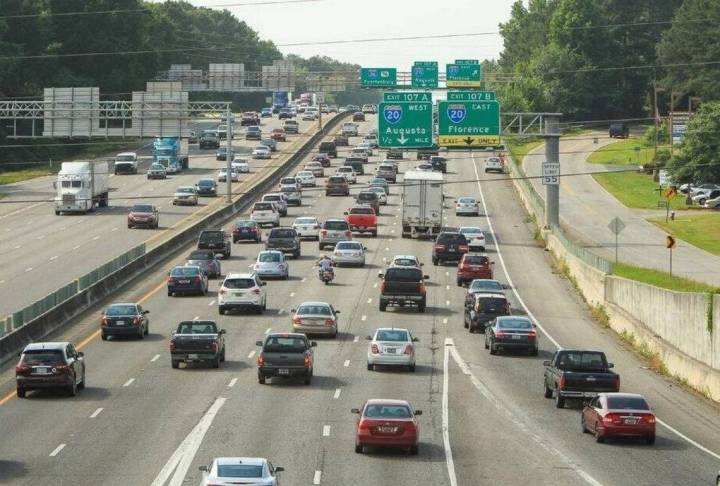
But it’s “Malfunction Junction”, which is about to get a much-needed rebuild

malfunction junction

Image courtesy of The State

I’ve lived in Columbia since college with the exception of four years in Winnsboro, where my husband and I landed to split the distance between our jobs. The people in Winnsboro were delightful, but we were chastised routinely because our travel and work routines kept us away from home. The town and church ladies were especially bothered that they couldn’t drop in during the week.

A tornado that temporarily separated our growing family caused us to reevaluate our choices and to move jobs and home to one location. After much debate, Columbia won because it wasn’t easy for a female lawyer to find a small-town job in the 1980s. Let me rephrase that. A female lawyer could find a job in a small town if she didn’t need much pay or respect. But that’s a whole “nother” story, as we say in the South. Suffice it to say the city won.

Although schools and housing prices were much more promising in the Irmo area north of Columbia, we decided we didn’t have the patience to handle the commute that ran through the intersection of I-20 and I-26, commonly called “Malfunction Junction”. So I have never battled that disaster area routinely. But any Friday afternoon escape from “Famously Hot” Columbia to the cool of the North Carolina mountains required bravely timing the travel and negotiating the traffic.

I’ve seen friends and co-workers schedule their travel times to downtown Columbia to avoid hitting that area during rush hour. And I’ve seen them justify the commute because of beautiful lakefront homes and great schools. I get it! I just never had the patience for it! I’ve heard tales of the 12-mile commute taking an hour or more. That would require a big investment in audio books for me!

The Department of Transportation plans to alleviate my friends’ pain, but it’s going to take awhile. If you Google “Carolina Crossroads”, the name the DOT has given the project, you will be able to read about the ten-year plan to fix the problem. Yes, I said ten years. Here is a time-line projection.

Why will it take so long?  First, the properties must be acquired. The DOT says it plans to spend $240 million to acquire real estate including gas stations, homes, apartment buildings and a Motel 6. Dirt lawyers, if you handle condemnations as a part of your practice, this may be a time for you to shine!

The new interchange will add lanes to ease merging issues and will connect I-20, I-26 and I-126. The goal is to reduce the number of accidents and the amount of time commuters spend negotiating the area. Apparently 134,000 cars travel through the interchange every day. The $1.5 billion project is being split into five phases.

The first phase includes Colonial Life Boulevard. The second includes Broad River Road. The third will involve the main interchange of the interstate highways and will include St. Andrews Road and Bush River Road.  The fourth phase will include Harbison Boulevard, and the fifth and final phase will involve widening I-26 west of St. Andrews Road.

The DOT says one of the problems with the long-range project is that contractors are reluctant to bid on the massive project. That’s one reason the project was divided into phases. We began to hear rumblings that the project was coming as early as 2015, but the federal government didn’t sign off until spring of 2019.

I can’t wait to hear the stories about how construction will affect the commute. And our vacations may have to avoid the mountains for the next ten years!  But we’re all looking forward to the project’s completion!

“Curbed” article outlines the experience of iSellers

Standard

computer house digital sales smaller

iSeller may not be a “thing”, but iBuyer definitely is. I invite you to read the February 7 article by Jeff Andrews on curbed.com. This article outlines the experience of sellers who deal with Zillow, Opendoor and similar iBuyers. By extension, this article provides insight to real estate lawyers who want to remain in the real estate closing game after iBuyers make their way to South Carolina.

“iBuyer” is short for “instant buyer.” iBuyers buy houses for prices determined by their respective algorithms in the markets where they operate. The article contains a map showing those locations. South Carolina is not among those locations, but Atlanta, Charlotte, Raleigh-Durham, Jacksonville, Birmingham and Nashville are. How far behind can we be?

Selling a home through an iBuyer can be much simpler than the market we currently occupy. The homeowner opens the iBuyer’s website, enters their address and some basic information about the house. Within a few days, the iBuyer will make an offer.

The seller doesn’t have to clean the house, stage the house, store excess furniture, board pets, leave home for open houses, or any of the other indignities suffered under our current system. It’s a much easier process.

What’s the catch? The seller may be leaving money on the table. The offer will be less than the amount the homeowner could receive if all the games are properly played on the open market.

According to this article, if the offer is acceptable to the seller, he or she will schedule a time for a representative from the iBuyer to visit and asses the home. If maintenance issues are spotted, the seller may choose to complete the repairs or to allow the iBuyer to complete them at the seller’s expense.  At that point, a final offer will be made.

The seller is allowed to select a closing date, typically within 60-90 days. The closing date is typically flexible and within the seller’s control. There is no worrying about the contingency of the buyer to sell their house or obtain financing.

While the real estate agents in normal closings might charge a total of 6 or 7 percent for commission, the iBuyer might charge a transaction fee of 7.5 percent. According to this article, the iBuyer makes most of its money in these transaction fees. The houses are subsequently sold on the open market, so there will be a profit, but the iBuyer is not a home flipper. Substantial repairs are not made, and substantial profits are not made.

So the dichotomy for the seller seems to be convenience vs. price. If the amount the seller loses in price is worth it because of the convenience, then the seller is a prime candidate to do business with an iBuyer.

We’ll pay attention as this phenomenon grows, and we’ll definitely report when it hits South Carolina!

State challenges Hobcaw Barony’s claim to North Inlet

Standard
Hobcaw Barony

Photo courtesy of The Post and Courier

This blog recently discussed an interesting lawsuit brewing in Georgetown County involving the property of Hobcaw Barony and adjacent North Inlet. The owner of Hobcaw, the Belle W. Baruch Foundation, is claiming title to 8,000 acres of marsh at North Inlet, a vast marshland that has always been used by the public for recreational purposes. The lawsuit claims title to the property by virtue of a Kings Grant.

Local gossip indicates the Foundation simply intends to clean up title issues and does not intend to preclude the public from enjoying the property. But the complaint reads like a normal quiet title action of marshland property and the locals are nervous. An easement has been suggested to resolve the conflict, but this suggestion has been rebuffed by the Foundation.

The State of South Carolina has now filed responsive pleadings asking for an order declaring that the property is dedicated to public use. The State’s response to the Foundation’s complaint alleges that the Foundation lacks the power to exclude the general public from the property because the public has a right to the use of navigable waters.

The State claims the public is entitled to the marshland through continued use of the property for fishing, shrimping, crabbing and similar activities for generations.

I’ll keep you posted as this issue is litigated.

Hobcaw Barony owner claims title to North Inlet

Standard
hobcaw-church

Image from south-carolina-plantations.com

I grew up in Georgetown, SC, and enjoyed visiting the beach with my family on Pawleys Island. Between the City of Georgetown and the beautiful “arrogantly shabby” Pawleys beach lies Hobcaw Barony, a gorgeous stretch of land that was developed as a winter hunting resort by Bernard Baruch.

Bernard Baruch is a name South Carolinians should cherish. Baruch was born in Camden in 1870 and became a Wall Street financier, stock investor, philanthropist, statesman and political consultant. After his success in business, he devoted time advising war-time Presidents Woodrow Wilson and Franklin Roosevelt. He was a personal friend of Winston Churchill.

Between 1905 and 1907, Baruch purchased a total of 69,690 acres of the former 18th century Hobcaw Barony, consolidating 69 plantations located on the peninsula known as Waccamaw Neck between the Winyah Bay and the Atlantic Ocean. Famous visitors included presidents, royalty and world leaders.

For an interesting and entertaining history of the plantation properties developed by wealthy northerners in Georgetown County for hunting purposes, I highly recommend Columbian David Hodges’ book Sunset Lodge in Georgetown: The Story of a Madam.  Hodges is a frequent visitor to Georgetown who conducted extensive interviews and research about Hazel Weisse, who moved to Georgetown in 1936, when the International Paper Company plant was being built, and established a brothel to entertain the builders. Despite being illegal, the business remained open for thirty-three years until Weisse retired in 1969.  Do yourself a favor, South Carolinians. Read this book.

But I digress.

Hobcaw Barony is a treasure. Baruch’s daughter, Belle, established a foundation to use the property as an educational and research preserve. The property includes 37 historic buildings representing the 18th and 19th century rice growing industry and the 20th century winter hunting resort. Tours of the property are open to the public. My brother, Alec Tuten, is one of the tour guides who will happily talk your ear off given half a chance.

The picturesque property reminds me of George Washington’s home at Mount Vernon but, sadly, little or no funding was established to maintain the buildings, so they are not preserved to the standards of Mount Vernon. The grounds, on the other hand, are beautifully maintained. For example, both Carolina and Clemson have established coastal and marine sciences programs at Hobcaw. Wetlands, forests and coastal ecosystems are studied. The entire property was named to the National Register of Historic Places in 1994. I recommend a visit to this little-known local gem!

An interesting lawsuit is now brewing in Georgetown County involving the property of Hobcaw Barony and adjacent North Inlet. The Baruch Foundation is claiming title to 8,000 acres of marsh at North Inlet, a vast marshland that has always been used by the public for recreational purposes. The lawsuit claims title to the property by virtue of a Kings Grant.

stay tuned

Local gossip indicates the Foundation simply intends to clean up title issues and does not intent to preclude the public from enjoying the property. But the complaint reads like a normal quiet title action of marshland property and the locals are nervous. An easement has been suggested to resolve the conflict, but this suggestion has been rebuffed by the Foundation.

Stay tuned to learn more about what will happen to this slice of God’s country.

HOA seeks to oust orphan from age-restricted neighborhood

Standard
HOA grandparents grandson

Image from KOLD.com (News 13), Tucson, Arizona


A fifteen year-old California lad lost both of his parents last year. Collin Claybaugh’s mother, Bonnie, died in the hospital from a long-term illness. And his father, Clay, took his own life two weeks later.

What do good able-bodied grandparents do in this situation besides grieve the loss of their children? They take in their grandson, of course. That’s what Randy and Melodie Passmore did. The Passmores are both in their 70’s and live on a small pension plus social security. They own their home in The Gardens at Willow Creek, a 55-plus community in Prescott, Arizona.

The age restriction apparently has a limited exception for residents who are 19 years of age and older. But a 15-year old boy is definitely not allowed by the rules.

The Passmores received a letter from the homeowners’ association advising them that Collin must move out. The letter said that the board must balance the interests of all parties involved, not just the Passmores. The HOA board said they are concerned that if they fail to enforce the age restriction, they could endanger the ability for the development to remain an age-restricted community.

The Passmores’ only alternative is to sell their home and move, which they believe will be difficult considering their age and financial position. They do not have funds to mount a legal battle.

My husband and I would love to downsize at this point in our lives, and we would be interested in living in a community where the exterior and grounds are maintained by someone else. But this story convinces me to stay clear of age-restricted communities.

How do you think this story would play out from a legal standpoint in South Carolina?

Recent HOA foreclosure case leads to new rule in Beaufort County

Standard

Master imposes rule based on Chief Justice Beatty’s concurring opinion

foreclosure notice

This blog recently discussed the remarkable homeowners’ association foreclosure case, Winrose Homeowners’ Association, Inc. v. Hale, South Carolina Supreme Court Opinion 27934 (December 18, 2019.) You can read the earlier blog here.

The case focused on the inadequacy of the foreclosure sales price and the business model of a third party to leverage a nominal debt to secure an exorbitant return from homeowners who fear eviction. I believe the case will require HOA foreclosure attorneys to rethink their approach going forward.

In his concurring opinion, Chief Justice Beatty said he would go a step further than the majority opinion and adopt the equity method of determining an adequate sales price for residential property in a foreclosure. The equity method compares the winning bid price to the equity in the property. The alternative debt method compares the total debt on the property to its fair market value.

The majority opinion stated that our courts have not established a bright-line rule for what percentage “shocks the conscience”, but a search of our South Carolina’s jurisprudence reveals that our courts have consistently held a price below ten percent definitely does. In this case, the debt method would have resulted in a ratio of 53.9 percent, while the equity method would have resulted in a ratio of 4.9%.

The new rule of the Beaufort County Master-in-Equity Marvin Dukes focuses on a totally separate issue in the case. The homeowners, who were in default, did not receive a notice of the date and time of the foreclosure sale. Judge Dukes’ office disseminated a message to foreclosure attorneys requiring new wording in foreclosure orders.

The new required wording entitled “Special Default Foreclosure Order and Sale Notice Service Instructions” reads as follows:

That, in addition to all notices to the property owner(s) which are required by the  SCRCP or other law, in a case involving property owner’s SCRPC 55 default, or any other case or circumstances where property owner(s) would not ordinarily receive a copy of the Order of Foreclosure and/or Notice of Sale, the party seeking foreclosure (Foreclosing Party) shall, within 5 (five) days of the execution of this Order cause this Order and Notice of Sale (if available) to be served by US Mail upon said property owner(s).

An affidavit of such service shall be filed with the Clerk of Court expeditiously.

In cases where the Notice of Sale is executed later in time than the Order, service shall be accomplished separately, and shall be sent no later than 5 (five) days from receipt by the Foreclosing Party.”

I suspect additional guidance will be coming from our courts about whether the Winrose case will have broad application in foreclosure cases or be limited to its facts. I’m confident foreclosure attorneys feel they need more information.

Supreme Court to hear CFPB Constitutionality Challenge

Standard

Seila Law, LLC v. Consumer Financial Protection Bureau likely to be heard by mid-2020

CFPB building

The United States Supreme Court has chosen a case to decide the constitutionality of the CFPB. The case is Seila Law LLC v. Consumer Financial Protection Bureau (U.S. Supreme Court 19-7). The announcement was made on Friday, December 27. The allegation in question is that the structure of the agency grants too much power to its director, in violation of the Constitution’s separation of powers doctrine.

Under the current structure, the director of the CFPB cannot be fired by the president absent “inefficiency, neglect of duty, or malfeasance in office.” The heads of other federal agencies may be removed at the pleasure of the president.

The order posted by the Court requested that both sides address the following question: “If the Consumer Financial Protection Bureau is found unconstitutional on the basis of separation of powers, can 12 U.S.C §5491(c)(3) be severed from the Dodd-Frank Act?”

The United States House of Representatives’ motion to file an amicus curiae brief because the Department of Justice has chosen not to defend the constitutionality of the agency.

Concern about the structure of the agency has been voiced since its inception based on the fact that such huge power has been placed in the hands of one individual director. The argument continues that the CFPB has more power than any agency ever created by Congress. While most federal agencies are controlled by commissions or by a director who serves at the pleasure of the President, the CFPB’s sole director is removable only for cause. Also, since all of the funding of the agency is not controlled by Congress, there is little legislative oversight.

In previous hearings, when the CFPB has been asked what the appropriate remedy should be if the structure of the agency is held to be unconstitutional, the CFPB has maintained that formative statute would have to be amended to allow the President to remove the director with or without cause.  Some have suggested that all of the actions of the CFPB might be suspect if its structure is held unconstitutional. Others have suggested that agency should be headed by a multi-person, bi-partisan commission rather than a single director for greater transparency and accountability.

If a decision in the case is announced in mid-2020, the presidential election could be affected since Sen. Elizabeth Warren’s role in creating the agency is a central pillar of her presidential bid.

Justice Brett Kavanaugh has made clear in a previous dissent that he believes the structure of the agency is unconstitutional.

Eighth Circuit Court ruling makes loans disappear

Standard

The decision could make significant changes in the secondary market

foreclosure

I refer you to this article from Bloomberg that led me to read the Eighth Circuit Court of Appeals case decided last month, CityMortgage, Inc. v. Equity Bank, N.A.*.

In South Carolina and most other states, the bank has the power to pursue the borrower personally if it can’t sell the property that is subject to a mortgage for the full amount of the loan after a foreclosure. There are a handful of “non-recourse” states where it is not possible to pursue the borrower personally. But this case was decided under Missouri law, and Missouri is not one of those unusual states.

The article makes a point that’s news to me: non-recourse mortgages are standard in most countries other than the United States.

The case involved a repurchase demand under an agreement between CityMortgage and Equity Bank. Twelve loans were involved, six that had been foreclosed and six that had not. The surprising ruling relates to the six mortgage foreclosures. The Eighth Circuit affirmed the lower court, which had held that the six loans that had been foreclosed no longer existed.

The dissent got it right, however, by stating that the loans were not “liquidated” or “extinguished” by the mortgage foreclosures. The dissent states the obvious: a mortgage is a security interest in real property that serves as collateral for the borrower’s loan. When the mortgage is foreclosed, the underlying promissory note survives and the borrower continues to be liable for the resulting deficiency (absent further action such as a new agreement or a discharge in bankruptcy.)

The article correctly states that the Eighth Circuit transformed recourse loans into non-recourse loans by its ruling. The article also states that non-recourse loans may lead to higher interest rates and larger swings in housing prices.  Purchasers on the secondary market won’t pay as much for non-recourse loans, and, for that reason, this case could have a significant impact on the secondary market if other circuits follow the lead of the Eighth Circuit.

* No. 18-1312 (8th Cir. 2019)

Motley Fool: “Zillow Plans to Do to Real Estate What Amazon Did to Retailing”

Standard

Zillow Offers is not available in South Carolina yet, but it may be a matter of time

zillow logo magnified

This blog has promised to keep South Carolina dirt lawyers informed about the growing phenomenon of home “iBuying”. Please take a look at two recent articles from Motley Fool linked here.

One of the articles, entitled “Zillow Plans to Do to Real Estate What Amazon Did to Retailing”, indicates Zillow is aggressively taking on the neighborhood real estate broker. The other article, entitled “Why Zillow Wants to Pay More for Homes” indicates iBuying is a scale game, meaning the number of homeowners who accept Zillow’s offer increases dramatically with relatively small increases in price.

Zillow has been planning for this game for years. It already has a massive amount of traffic on its site and has accumulated an enormous amount of data. Go take a quick look at the data Zillow is showing about your own home!

To date, according to Motley Fool, Zillow faces intense competition from Opendoor, which leads the iBuying industry, already serving more than 40,000 customers. But Zillow is working hard to catch up. Opendoor operates in 21 markets. Zillow is in 17 of those markets, four additional markets, and plans to open in five more by the middle of 2020.

In early 2017, Zillow dipped its toe into the process of selling homes by launching a product it called “Instant Offers”. The product was initially tested in Las Vegas and Orlando and was described as a method for homeowners to sell their homes for a discounted price without the traditional complications of repairing, listing, staging and allowing for open houses.

The process started with a homeowner providing basic information via Internet about the home (square footage, number of bedrooms and bathrooms, and remodeling information) and uploading photos. The Zillow product then connected the homeowner with investors who buy homes in the area, and, typically, an all-cash offer was made by one or more of the investors. The homeowner paid no fee for the service and was not obligated to accept any offers. Zillow touted the product as a method to alleviate the seller’s stress and to allow the seller to close in a shorter time frame.

Other companies, Opendoor and Offerpad were already operating in this space at the time of the Zillow launch. The launch was called another example of technology disrupting the process of closing real estate transactions.

Real estate agents, of course, met the news with alarm. They said sellers would be suckered into making mistakes that might cost them the education of their kids, vacations or just the ability to sleep better at night because they have more money in their bank accounts. An online petition was initiated, asking the National Association of Realtors to threaten Zillow with being removed from access to listings. The NAR responded that it could not sponsor or encourage such a boycott.

Zillow has always stated publicly that it is not in the business of getting rid of real estate agents. Its executives called Zillow a media company, not a real estate company, and said it sold ads, not real estate. Even the Instant Offers program encouraged sellers to use a realtor even while avoiding the traditional listing and sales process. The question then became the amount of commission the real estate agent would earn for reduced services. When real estate agents initially complained about Instant Offers, Zillow responded that 70% of its revenue came from working with real estate agents.

In early 2018, however, Zillow announced that it would begin buying homes directly from sellers and then turning around and selling them. With this announcement, Zillow began selling ads and houses. Two test markets were announced, Las Vegas and Phoenix. Zillow said that when it buys homes, it will make the necessary repairs and updates and list the homes as quickly as possible. Zillow said local real estate agents would represent Zillow in the transactions. Zillow also announced in a press release that the vast majority of sellers who requested an Instant Offer ended up selling their homes with agents.

So far, nothing is in the works for South Carolina as far as we know, but since it is just next door in Atlanta and Charlotte, how long can it be?

Stay tuned for more news on this topic. Real estate lawyers will need to figure out how to remain in the game whether properties are sold through the Internet or not!