Wells Fargo distributes new settlement agent communication

Standard

Note: Settlement agents are scheduled to be re-evaluated

Wells Fargo delivered a memo entitled “News for Wells Fargo Settlement Agents” on March 23. The first paragraph cryptically announced that future communications will detail the Uniform Closing Dataset (UCD) that will become effective for lenders in 2018.

StageCoachLogo

For insight into the UCD, review Fannie Mae’s or Freddie Mac’s websites. Briefly, the UCD is going to be a common industry dataset to allow information on the Closing Disclosure to be communicated electronically. Fannie Mae and Freddie Mac have developed the UCD at the direction of the Federal Housing Finance Agency in an effort to enhance loan quality and consistency through uniform loan date standards. Stay tuned for more information on this topic and lenders gear up to comply.

The Wells Fargo memo also touted continued expansion of settlement agents who are using Closing Insight™.  Settlement agents who are just getting started were asked to take advantage of the support available at RealEC’s Closing Insight Resource Center at http://www.closinginsightresourcecenter.com or to contact the company at CISupport@realec.com or 800.893.3241. I encourage all South Carolina closing attorneys to get up to speed on this system as soon as possible.

The serious news from Wells Fargo, however, relates to a new effort to evaluate settlement agents.

The memo warned that Wells Fargo will evaluate the population of settlement agents who have closed loans within the past twelve months for problems such as missing documents, execution errors and other frequent problems that require curative work. As a result, settlement agents may receive letters indicating they are being removed from Wells’ list of approved settlement agents.

Processes are in place, however, to accommodate the customer’s choice for a settlement agent who is not on the approved list. Apparently, a new approval process will be instituted, but no detail on this process is provided.

house made of cashThe memo further indicates that attorneys’ ability to act as counsel for customers will not be impacted.  I don’t read this last directive to mean that attorneys who are not on the approved list will be in a position to close loans. They will only be in a position to dispense legal advice, if I am interpreting this correctly.

Settlement agents with questions are encouraged to communicate with Wells at WellsFargoSEttlementAgentCommunicatons@wellsfargo.com. I urge anyone who is interested in continuing to close Wells Fargo loans to hang onto this information.

Finally, the memo is requesting acknowledgement of Master Closing Instructions from all active and approved settlement agencies. Requests for this acknowledgement are coming from Wells Fargo in the form of e-mails to settlement agents. Please respond!

All lenders are beginning to hold settlement agents to higher standards. South Carolina closing attorneys are encouraged to stay abreast of changes and train, train, train staff members.

And, as always, contact your title insurance companies for insight into these matters.

Statute of Elizabeth case provides important reminders

Standard

Conveyance to an LLC is set aside

A recent South Carolina Court of Appeals case* affirmed a Circuit Court order that set aside a conveyance under the Statute of Elizabeth. This is yet another tale of woe from the economic downturn.

scales - blue background

Kenneth Clifton was a successful real estate developer who commonly purchased investment property in his own name. When he developed property, he transferred his interest to a limited liability company (LLC). He organized more than forty LLCs during his career.

In 1993, Clifton and Linda Whiteman purchased approximately 370 acres in Laurens County in their individual names as tenants in common.

Clifton routinely borrowed money from lenders to finance his developments. At issue in this case were three loans from First Citizens Bank totaling around $4 million. These loans were renewed over the years as Clifton made progress payments.

When the real estate market slowed in 2008, Clifton sought additional extensions for two of the loans. First Citizens asked for a personal financial statement. Clifton’s financial statement claimed a net worth of $50 million with real estate comprising over $48 million. The subject 370 acres in Laurens was included. The statement stated Clifton owned a 50% unencumbered interest valued at approximately $1.5 million. Relying on this financial statement, First Citizens renewed the loans to mature in 2009.

Later in 2008, Clifton requested an extension on the third loan. Just prior to receiving the extension, Clifton and Whiteman transferred their interests in the property to Park at Durbin Creek, LLC (PDC). Clifton testified that he and Whiteman chose to transfer this property to PDC over Whiteman’s concern about personal liability because the property was being leased to third parties for recreational hunting purposes. All three loans were extended to mature in 2009.

Clifton failed to make payments, to provide a business plan or to secure additional collateral. First Citizens initiated foreclosure proceedings in February of 2009 and eventually secured a deficiency judgment of $745,000 against him.

During the foreclosure proceedings, Clifton and his daughters entered into an assignment agreement resulting in a transfer by Clifton in PDC to Streamline, an LLC that was nonexistent on the date of the transfer but whose members, upon creation, were Clifton’s daughters and ex-wife.

In 2010, First Citizens initiated supplemental proceedings, but by this time, Clifton had no remaining assets. First Citizens began this case under the Statute of Elizabeth (S.C. Code §27-23-10), alleging causes of action for fraudulent conveyance, civil conspiracy and partition.

court money 2The Circuit Court found sufficient “badges of fraud” to infer Clifton possessed fraudulent intent when he transferred his 50% interest in the property to PDC.

This is the first valuable reminder from this case:  The conveyance to Streamline was held void ab initio because Streamline did not exist at the time of the conveyance. (Dirt lawyers, make sure your entities are properly created before you assist your clients in making conveyances to them!)

A second valuable reminder involves requirements concerning transfers of interests in member-managed LLCs like PDC. When Clifton attempted to transfer his interest in PDC to a separate LLC, he failed to obtain Whiteman’s consent. Section 33-44-404 (c)(7) of the South Carolina code states that, in a member-managed LLC, the admission of a new member requires the consent of all members. The lack of consent in this case would have invalided the transfer to streamline even if the transfer to PDC had been held valid. (Dirt lawyers, make sure you follow statutory procedures when dealing with transfers of interests in entities.)

The case then sets out a simple South Carolina primer on the Statute of Elizabeth. The statute provides:

Every gift, grant, alienation, bargain, transfer and conveyance of lands…for any intent or purpose to delay, hinder, or defraud creditors and others of their just and lawful actions, suits, debts, accounts, damages, penalties, and forfeitures must be deemed and taken…to be clearly and utterly void.

Citing earlier cases, the Court of Appeals stated that this statute can be used to set aside conveyances whether or not consideration is paid.

Where there is valuable consideration, the following element must be established:

  1. The transfer was made with the actual intent to defraud creditors;
  2. The grantor was indebted at the time of the transfer;
  3. The grantor’s intent is imputable to the grantee.

Where there is no valuable consideration, no actual intent to hinder or delay creditors is required. Instead, the transfer will be set aside if:

  1. The grantor was indebted to the plaintiff at the time of the transfer;
  2. The conveyance was voluntary; and
  3. The grantor failed to retain sufficient property to pay the indebtedness to the plaintiff at the time when the plaintiff seeks to collect the debt.

In this case, the Circuit Court found and both parties agreed that valuable consideration was paid. For that reason, First Citizens was required to prove that Clifton transferred the property with the intent to delay, hinder or defraud First Citizens.

Citing earlier cases again, the Court of Appeals stated that when a party denies fraudulent intent, as Clifton did, the creditor must prove “badges of fraud”. One badge of fraud may not create a presumption of fraud, but several badges of fraud does create the presumption.

Nine badges of fraud have been identified by our courts:

  1. The insolvency or indebtedness of the transferor;
  2. Lack of consideration for the conveyance;
  3. Relationship between the transferor and the transferee;
  4. The pendency or threat of litigation;
  5. Secrecy or concealment;
  6. Departure from the usual method of business;
  7. The transfer of the debtor’s entire estate;
  8. The reservation of benefit to the transferor; and
  9. The retention by the debtor of possession of the property.

The Court held that six of the nine badges of fraud were present in this case, resulting in a presumption of fraud. The Court next considered whether Clifton successfully rebutted the presumption. The Court concluded that Clifton wanted to protect the property from creditors, despite offering the legitimate reason for the transfer, that Whiteman was concerned about personal liability on hunting property.

Finally, the Court held that the invalidity of the conveyance of Clifton’s undivided 50% interest in the property does not invalidate Whiteman’s conveyance despite the fact that only one deed was used.

* First Citizens Bank and Trust Company, Inc. v. Park at Durbin Creek, LLC, South Carolina Court of Appeals Case 5469 (February 15, 2017)

Tax-related identity theft is on the rise

Standard

Some safety tips for you and your clients

The dreaded tax day is fast approaching! Please be aware of tax-related identity fraud, which we are being told is on the rise.

tax time

This fraud occurs in several forms. One scheme is to file more than one return using a single Social Security Number. The fraudster steals the SSN and other identifying information, files a return and receives the refund before the true taxpayer has a chance to file. (Or the true taxpayer is a lawyer who always files late.)

Another scheme involves calling the taxpayer to inform him that he owes additional taxes and will have collection actions taken against him. He can get off the hook by providing credit card information to resolve the problem.

A third scheme involves calling the taxpayer to inform her that she received wages or other income from an employer for whom she never worked. Again, she can resolve the problem by paying additional taxes via credit card.

In a similar situation not involving tax-identity fraud, my husband received a voicemail on his cell phone this week indicating a subpoena was about to be served on him either at home or at work and to avoid that subpoena, he could call a telephone number. He is a lawyer, so having a subpoena served wouldn’t be outside of the realm of possibility, but he was able to determine this was a scam based on very limited Internet research.

The IRS advises that anyone who receives a telephone call, letter or e-mail purporting to come from the IRS should call the agency directly at 800.908.4490 to validate the request. In other words, never contact the requester by the method indicated in the communication. Go directly to the source.

The IRS also gives some very common sense advice:  never give personal information without validating the source.

If you are a victim of tax-related identity theft, the IRS recommends the following steps:

  • Notify the IRS at 800.908.4490;
  • If instructed to do so by the IRS after the initial notification, go it its identity verification service website to report the incident.
  • If your return is rejected because of a duplicate filing, complete IRS Form 14039, Identity Theft Affidavit, available at IRS.gov.

The Federal Trade Commission recommends the following steps if you are a victim of identity theft:

  • File a complaint with the FTC at identitytheft.gov;
  • Contact one of the three major credit bureaus to place a “fraud alert” on your credit records:

Be safe out there, use common sense, advise your clients to use common sense, and get those returns filed on time, lawyers!

Dirt Lawyers: Make sure you conform(a) with your pro forma policies

Standard

businessman paper magnifying glass

Commercial real estate lawyers are routinely asked to issue pro forma title insurance policies. A friend who routinely acts as lenders’ counsel recently told me he sees lots of pro forma policies coming from borrowers’ counsel, and they are not being handled appropriately. For that reason, I thought I’d list a few reminders for all of us.

What is a pro forma policy? It is a sample policy provided to the customer and customer’s counsel in advance of closing. It outlines the actual language and format the final policy will contain, in the event the transaction actually closes and the policy is actually issued. A pro forma policy is not intended to serve as a promise to issue the final policy. And it is definitely not a substitute for a commitment.

One excellent process is to never send out a pro-forma policy independently. When I was in private practice, I issued a pro forma as an attachment to a letter which said, basically, “A policy in the form attached may be issued when the requirements in Commitment #_____, dated _____ have been satisfied.” My lenders’ counsel friend nails this matter down further by issuing the pro-forma policy as an attachment to the commitment with a note in the requirements section to the effect that upon satisfaction of all applicable requirements, a policy in the form set forth in Exhibit ___ will be issued.

A note to this effect be added to the policy:  “NOTE: This is a Pro Forma Policy. It does not reflect the present state of title and is not a commitment to insure the title or to issue any of the attached endorsements. Any such commitment must be an express written undertaking on appropriate forms.”

The pro-forma policy and all endorsements should be clearly marked “Pro-Forma Specimen” or “Sample” and should not be signed.  Many lawyers have a large “Specimen” stamp to use in these situations. My lenders’ counsel friend told me he actually stamps pro forma policies coming from borrowers’ counsel. Not all lenders’ counsel are that accommodating.

Where the policy date and policy number are requested on the form, supply the note “None”.

These rules are very simple and comply with common sense. A pro-forma policy is not a policy and should be clearly shown in every instance as a sample. Following these very straightforward rules will keep you and your title company out of trouble. And, as always, call you underwriter if you have questions or concerns!

Hot off the presses UPL case!

Standard

(But it only affects real estate peripherally)

The South Carolina Supreme Court handed down a UPL decision in a declaratory judgment action in its original jurisdiction on February 22.*

The Court accepted the action to determine whether Community Management Group, LLC and its employees engaged in the unauthorized practice of law while managing homeowners’ associations. The Court found that the respondents did, in fact, engage in UPL. At the outset of the case, the Court had issued a temporary injunction halting the offending activities.

Community Management Group, without the involvement of an attorney, prepared and recorded notices of liens and related documents; brought actions in magistrates’ courts to collect debts; and filed the resulting judgments in circuit courts. The entity also advertised that it would perform these services “in house”.

breaking-news

In a 1992 administrative order entitled In re Unauthorized Practice of Law Rules Proposed by South Carolina Bar**,  the Court had modified prior case law to allow a business to be represented by a non-lawyer officer, agent or employee. The Court had also promulgated South Carolina Magistrate Court Rule 21, which provides, “A business…may be represented in a civil magistrates’ court by a non-lawyer officer, agent or employee…”

The central question in the action at hand was whether the word “agent” in these authorities includes third party entities and individuals like Community Management Group and its employees. The Court held it does not and was never intended to.

The Court had earlier held that filing claims in probate courts does not amount to UPL, but stated in the present case that it is the character of the services rendered that determines whether the services constitute the practice of law. Filing claims in Probate Court, according to the Court, does not require the professional judgment, specialized knowledge or ability of an attorney. The Court found that the services required to represent a business in magistrates’ courts are not comparable to filing claims in probate courts.

Community Management Group conceded that it prepared a lien document for the purpose of putting a cloud on title so property could not be sold unless the homeowner paid overdue assessments. This stated purpose demonstrated to the Court that the lien documents were “instruments”, that is, written legal documents that define rights, duties, entitlements or liabilities.

Citing a 1987 case near and dear to the hearts of all South Carolina dirt lawyers, State v. Buyers Service***, the Court reminded us that preparing and recording legal documents is the practice of law.

This current case is a Per Curiam decision, but acting Justice Pleicones did not participate. We are holding our collective breath to learn the results of a Quicken Loan case pending in the original jurisdiction of the Court, and the present case may give us at least a small hint.

stay tunedWe have already received an underwriting question about this case in our office. We were asked whether our attorney agents can ignore the liens filed in contravention of this case. The answer is that we can discuss the specifics on a case-by-case basis, but it appears that although the liens may be invalidated by a court, dirt lawyers and title companies should not generally take this risk without the involvement of a court. If you run into this issue in connection with your closings, call your title insurance underwriter to discuss your options!

*Rogers Townsend & Thomas, PC v. Peck, South Carolina Supreme Court Opinion 27707 (February 22, 2017)

**309 S.C. 304, 422 S.E.2d 123 (1992)

***292 S.C. 286, 468 S.E.2d 290 (1987)

SC Dirt lawyers: check your documents

Standard

SC Supreme Court issues opinion that may keep us up at night!

Are the words “developed” and “improved” used interchangeably in your form real estate documents?  You might want to pull your documents to check based on a recent South Carolina Supreme Court case.*

The Supreme Court affirmed a Court of Appeals decision finding property had not been developed into discrete lots entitling them to voting rights under a set of restrictive covenants. While the two courts agreed on that determinative point, the Supreme Court felt the need to clarify the Court of Appeals’ opinion that may be read to “conflate” the terms “developed” and “improved”. (The only word that was unclear to me was “conflate”, which I now know means to combine two or more concepts into one.)

sc-supreme-court

The Supreme Court cited a 2007 Washington state opinion for the definition of “developed”: conversion of raw land into an area suiting for building, residential or business purposes. Improving land is subject to a higher threshold, according to the Court, and would require such actions as installing utilities or buildings.

Chief Justice Pleicones and Justice Few concurred, and the Chief wrote a separate opinion for the sole purpose of expressing concern that dictating the meanings of the terms “developed” and “improved” may inadvertently alter the meaning of documents or create a conflict with legislative enactments. He used a subsection of a statute dealing with mechanics’ liens as an example.

South Carolina Code Section 29-6-10 (2) contains the following definition of “Improve”:

 “Improve means to build, effect, alter, repair, or demolish any improvement upon, connected with, or on or beneath the surface of any real property, or to excavate, clear, grade, fill or landscape any real property, or to construct driveways and roadways, or to furnish materials, including trees and shrubbery, for any of these purposes, or to perform any labor upon these improvements, and also means and includes any design or other professional or skilled services furnished by architects, engineers, land surveyors and landscape architects.”

That definition is written as broadly as possible to protect the interests of any professional who provides labor or services in connection with developing, I mean improving, real estate.

The underlying Court of Appeals opinion** indicated that platting separate lots on paper without further steps did not rise to the level of the term “develop”, which, according to the Supreme Court, is a lower threshold than the term “improve”, which, according to the statute, includes platting. Do you see the Chief’s concern? I certainly do! Good luck with those documents!

*Hanold v. Watson’s Orchard Property Owners Association, Inc, South Carolina Supreme Court Opinion 27702 (February 15, 2017)

**Hanold v. Watson’s Orchard Property Owner’s Association, 412 S.C. 387, 772 S.E.2d 528 (2016)

IRS issues urgent warning about W-2 phishing scam

Standard

On February 2, the Internal Revenue Service issued an urgent alert to all employers about a W-2 email phishing scam. The scam was launched in 2016 but has been expanded this year, according to the bulletin, which can be read here.

The bulletin warned that cybercriminals employ a number of spoofing techniques to create an email that appears to originate from an organization’s executive. The email is sent to employees in human resources and payroll departments, requesting a list of employees and their W-2 forms. These forms, of course, contain identifying information including addresses and Social Security numbers.

w-2-image

Last year, the scam targeted the corporate sector, but this year, the scam appears to be spreading to school districts as well as nonprofit and tribal organizations. Another twist is that the cybercriminals may follow with emails requesting wire transfers. Some companies have lost funds in addition to sensitive information. Some organizations report having received these emails in 2016 and 2017.

The IRS memo urges employers to be vigilant and to share this information with their payroll, finance and human resources departments. Organizations should report incidents to phishing@irs.gov with a subject line of “W2 Scam” and should file a complaint with the Internet Crime Complaint Center (IC3).

Individuals whose W-2 forms have been stolen should take the actions set out in www.identitytheft.gov or www.irs.gov/idenditytheft.  They should also file a Form 14039, Identity Theft Affidavit, if a tax return is rejected because of a duplicated Social Security number.

IRS Commissioner John Koskinen said, “This is one of the most dangerous email phishing scams we’ve seen in a long time. It can result in the large-scale theft of sensitive data that criminals can use to commit various crimes, including filing fraudulent tax returns. We need everyone’s help to turn the tide against this scheme.”

A useful SCDOT website for South Carolina dirt lawyers

Standard

opposite-road-signs-sc-dot My colleague Tom Dunlop recently shared a South Carolina Department of Transportation website with me that is a nifty tool for determining whether the DOT maintains a road.  Check out the site here.
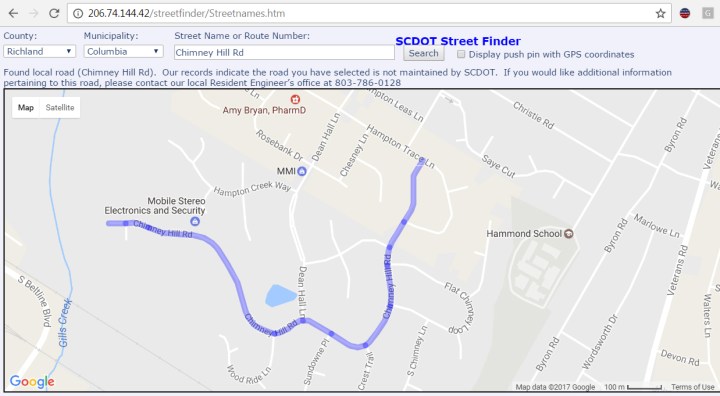
I entered my own street, Chimney Hill Road, and found out that the DOT does not maintain my street but that I could get more information from the Resident Engineer’s office at 803-786-0128. (I know Chimney Hill Road is marginally maintained by the City of Columbia from watching the repair of the pothole in front of my house at least annually.)  Here’s what the website shows:

blog-screenshot-1

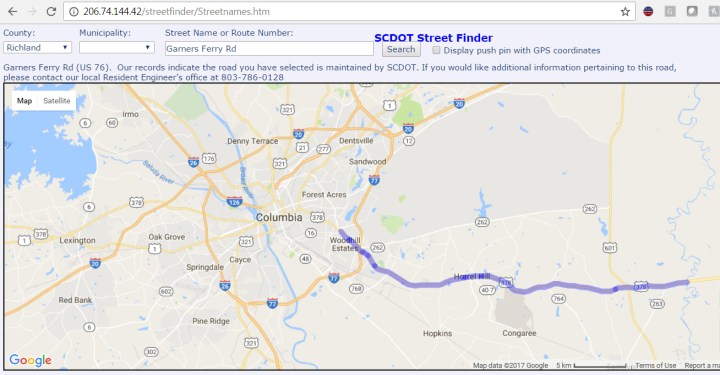
Then, I tried Garners Ferry Road (U.S. 76) and learned that the DOT does maintain this road.  Here’s the map:

blog-screenshot-2

Trying another County, I entered one of my favorite roads (the road to the beach!), Highway 17 (Ocean Highway S) in Georgetown County. This road is maintained by the DOT, and the phone number for the local office, for more information, is 843-546-2405.

blog-screenshot-3

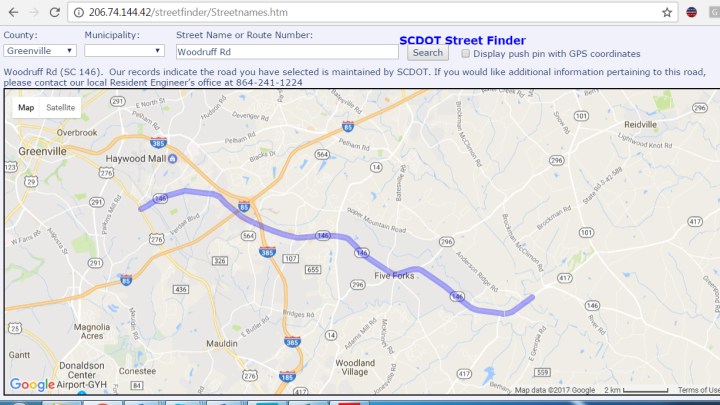
Turning to the upstate, I tried Woodruff Road (SC 146) in Greenville County and learned that this road is maintained by the DOT, and the phone number for the local office, for more information, is 864-241-1224.

blog-screenshot-4

I hope this website will provide real estate closing attorneys with some quick information when road maintenance becomes an issue.

Can you be sure your real estate agent is not a serial killer?

Standard

Maybe not! A recent South Carolina arrest brings this terrifying issue to light. Consumers visit houses accompanied only by real estate agents in South Carolina every day. Is this practice safe?

In November, Todd Kohlhepp was arrested in connection with the deaths of three individuals whose bodies were found on his property in Woodruff. Investigators were on his property near Wofford Road when they heard banging. They found a kidnap victim alive inside a large metal container “chained like a dog”. The victim had been missing for two months.

mugshot

Todd Kohlhepp – photo by myfox8.com

Kohlhepp was charged with three counts of murder, three counts of possession of a weapon during the commission of a violent crime, and one count of kidnapping. Kohlhepp is also alleged to be connected with four slayings in 2003 at Superbike Motorsports in Spartanburg.

Kohlhepp was a South Carolina licensed real estate agent. Real estate agents in South Carolina are licensed by the Department of Labor, Licensing and Regulation (LLR). A November 7 “Housing Wire” article asks how Kohlhepp got his license. The article quotes a prior article in “FOX Carolina” to the effect that LLR had stated Kohlhepp applied for a real estate license in 2006.

A background check was not required for the application. LLR’s website indicates an applicant who has been convicted or a crime must reveal that fact on the application and that the Real Estate Commission may review the application and conduct an investigation which may result in a delay in processing.

Kohlhepp had, in fact, been convicted of a 1986 kidnapping and rape in Arizona and had served 15 years in prison. But on his LLR application, according to FOX Carolina, he explained:

“I entered into a verbal agreement with my girlfriend who was also 15 at the time. I was charged with felony kidnapping due to the fact that I did have a firearm on me.”

He obtained the license and eventually established a firm of twelve agents and a reputation for being successful, professional, out-going and hard working. He was called a great salesman. He looked the part! He dressed well. He drove expensive cars.

What’s the lesson here? Consumers should eunderstand that a real estate agent’s license is no indication that the person who shows a home is honest and trustworthy.  Paying proper respect to the many, many wonderful real estate agents I know, however, it should be noted that we have seen cases in other parts of the country where real estate agents were harmed by their clients.

Unfortunately, for both sides of this equation, caution should be exercised in these situations of one-on-one contact with strangers in confined locations. Ask your friends for referrals. Do some on-line digging about the person you are about to meet. Take a business associate. Take a friend. Take your scary-looking cousin. Shoot, take your whole family. Schedule meetings during daylight hours. Let your business associates, friends and family know where you are, who you are with and how long you should be there. Keep your cell phone in your hand.

The good news is that this particular former real estate agent, who has confessed to the crimes, is likely to be off the streets permanently.

One of President Trump’s first official actions affects housing

Standard

presidential-seal

The Federal Housing Administration (FHA) announced on January 9 that it planned to reduce mortgage insurance premiums effective January 27. Mortgage insurance protects lenders from borrower defaults and is common where the down payment is less than 20%.

The Democratic view of this issue is that sufficient reserves and four years of economic growth allowed the FHA to pass along some modest savings to consumers. Additionally, the move was viewed as an attempt to help first-time and lower income home buyers to access the market at a time when mortgage rates were rising.

The Republican view is that such reductions put taxpayers at risk by decreasing the funds the FHA has to deal with mortgage defaults. In other words, taxpayers might be at a greater risk for footing the bill for another bailout if FHA’s reserves were reduced.

President Trump’s advisors criticized the Obama administration for adopting new policies as it prepared to leave office. During Dr. Ben Carson’s confirmation hearing for Secretary of the Department of Housing and Urban Development (HUD), FHA’s parent agency, he expressed disappointment that the cut was announced so late in President Obama’s term.

On January 20, shortly after he was sworn in, as one of his first substantive actions, President Trump undid this new policy before it took effect by signing an executive order.

HUD then issued a letter stating that more analysis is needed before changes are made, and the rates will remain the same for the time being.

It appears industry groups may have differing opinions on whether President Trump’s executive order will affect home buying. Will this action reduce opportunities for first-time buyers? Or will it eventually allow FHA’s reserves to be increased to a point where it can offer more services to borrowers? Industry groups will continue to weigh in, and this blog will continue to keep South Carolina dirt lawyers posted on developments.