Nat Hardwick convicted on 23 counts

Standard

Nat HardwickMany South Carolina real estate lawyers know the name Nat Hardwick.

Nathan E. Hardwick IV, 53, described himself as the face of Morris Hardwick Schneider, an Atlanta residential real estate and foreclosure firm that grew into sixteen states, including South Carolina. The firm once had more than 800 employees and boasted of offices in Charleston, Hilton Head, Columbia and Greenville.

On October 12, Hardwick was convicted in federal court in Atlanta of 21 counts of wire fraud, one count of conspiracy to commit wire fraud, and one count of making false statements to a federally insured financial institution. In federal court, sentencing is typically delayed, and the convicted person is released and allowed to get his affairs in order. In this case, however, Hardwick had been released pending trial on bond. After his conviction, he was described by the U.S. Attorney who prosecuted him as a flight risk and was handcuffed and taken to jail immediately.

This story hits close to home. My company was one of the victims of the crimes.

The prosecutor described an extravagant lifestyle that Hardwick enjoyed at the expense of others. The case was said to be particularly troubling because the illegal activity was orchestrated by a lawyer who swore an oath to uphold the law and represent his clients with integrity. The U.S. Attorney said he hoped the case sent the message that the FBI and the U.S. Attorney’s office will not tolerate this type of white-collar crime.

According to the evidence, from January 2011 through August 2014, Hardwick stole more than $26 million from his law firm’s accounts, including its trust accounts, to pay his personal debts and expenses. The firm’s audited financial statements showed that the firm’s net income from 2011 through 2013 was approximately $10 million. During that time, according to the evidence, Hardwick took more than $20 million from firm accounts.

Asha Maurya, who managed the firm’s accounting operations, was also charged. She reached an agreement in May with the U.S. Attorney’s office and pled guilty. She was expected to testify at the trial, but was unexpectedly not called as a witness.

Hardwick did take the stand in his defense and attempted to blame Maurya with the theft. He said that he trusted her to his detriment, that he was entitled to the funds, and that he was unaware that the funds were wired from trust accounts. Hardwick testified for more than a day and explained that he believed Maurya followed proper law firm procedures.

On the stand, Hardwick, described as the consummate salesman, said that he gave his cellphone number to almost everyone. He said he returned calls and messages within a few hours and instructed his employees to do the same. He apparently believed himself to be a master in marketing and customer service and prided himself in focusing on the firm’s expansion strategy. He hoped to expand to all fifty states and make money through a public stock offering.

With his ill-gotten gains, Hardwick bought expensive property, made a $186,000 deposit for a party on a private island, spent $635,000 to take his golfing friends to attend the British Open in 2014, paid off bookies, alimony obligations, and sent more than $5.9 million to various casinos, all according to trial evidence. Hardwick’s activities lead to the loss of his law license and the bankruptcy of his firm.


A scary Halloween story to keep real estate attorneys up at night!

Standard

This South Carolina man’s criminal conviction will stop you in your tracks!

pumpkin

BOO!

A South Carolina man made a name for himself this year in Washington, DC, and not in a good way. Robert McCloud, a 39-year old former resident of Warrenville, in Aiken County, was sentenced in federal court in Washington, DC, to 18 months in prison followed by three years of supervised release including six months of home confinement. He also forfeited almost $60,000 and will be required to pay restitution in an amount to be determined later. Finally, he will be required to perform 150 hours of community service.

The charges were based on wire fraud statutes and involved real estate transactions. McCloud pled guilty in June in the U.S. District Court for the District of Columbia. His sentence was imposed October 19.

McCloud and co-conspirators identified residential properties that appeared to be vacant and abandoned. They prepared and recorded fake deeds into fictitious names and later fraudulently sold the properties, using fake drivers’ licenses, to legitimate purchasers. McCloud and his co-conspirators involved unsuspecting title and escrow companies in the subsequent closings.

In his guilty plea in June, McCloud admitted to participating in two of these fraudulent transactions in 2015, which generated a total of around $580,000.  Of that total, law enforcement officials were able to seize almost $370,000 in administrative forfeiture proceedings. In both cases, the properties were unencumbered. The true owners of both properties are elderly owners and have been involved in difficult proceedings to have the properties re-titled in their names.

The harm caused to the true owners and the legitimate buyers was covered by title insurance, and the restitution represents funds owing to the title insurance companies. Dirt lawyers, when you need an example of why your clients should be protected by title insurance, you can use this story! And I have many others if you need them.

Captain Sam’s Spit continues to be the subject of litigation

Standard

I’ve blogged about “Captain Sam’s Spit” in Kiawah Island previously. Googling that name will reveal a treasure trove of news, opinion and case law involving the proposed development of a gorgeous but extremely precarious tract of pristine beach property on South Carolina’s coast.

The South Carolina Bar’s Real Estate Intensive seminar in July of 2016 and again in July of 2018 included field trips to view this property, from a distance at least. Professor Josh Eagle of the University School of Law is an excellent tour guide, and how many opportunities do we, as lawyers, have for field trips? South Carolina Dirt lawyers should calendar the July 2020 version of this workshop.

Real estate development is my bread and butter, but two visits to the area told me that property should not be developed. A fellow field tripper, however, pointed out that the south end of Pawleys Island, where my parents took me to the beach as a child and which has been developed for many years, is just as precarious.

Captain Sam's Spit

Aerial view of Captain Sam’s Spit from The Post & Courier

The South Carolina Environmental Law Project located in Pawleys Island fights these cases. Amy Anderson, an attorney with that entity, joined us and explained the environmental issues as well as the legal battle.

Six months ago, the South Carolina Supreme Court held that a bulkhead and retaining wall could not be built to develop the property.  Just last month, however, Administrative Law Court Judge Ralph Anderson ruled that a road can be built to support the development because the economic benefits of building homes on Captain Sam’s Spit outweigh its natural preservation.

Here are greatly simplified facts in a very complicated South Carolina Supreme Court case: the developer and the community association entered into a development agreement in 1994. That agreement covered many issues, one of which was the proposed conveyance from the developer to the community association of a ten-mile strip of beachfront property, basically, the entire length of the island. A deed consummated that conveyance in 1995. All of the property conveyed was undevelopable because of the State’s jurisdictional lines.

I didn’t learn the following fact from the published case, but I learned it from one of the lawyers who was kind enough to speak with me. When the jurisdictional lines were redrawn by the State, the 4.62 acre tract became developable. The developer then took the position that the 1994 development agreement and the 1995 deed resulted from a mutual mistake, and that the parties never intended to include that tract.

The Master-in-Equity and Court of Appeals did not see it that way. Both found that the agreement and deed were unambiguous and that parole evidence of the intent of the parties was not allowable. The Supreme Court agreed.

In the recent Administrative Law Court case, Judge Anderson said the economic benefit of developing the property would include real property taxes of $5 million per year. This case is just the most recent in a decade of litigation.

Count on an appeal in this case and other litigation to follow. I’ll keep you posted!

Can an alley be the basis of an appurtenant easement in SC?

Standard

The Court of Appeals says it can

Charleston houses

Two valuable downtown Charleston residential lots were the subject of an easement case decided by the South Carolina Court of Appeals on September 19.* Much to the dismay of the owners of 45 Lagare Street, the Court held that an appurtenant easement exists in the form of an alley that runs along a boundary of 45 Lagare Street for the benefit of 47 Lagare Street.

Master-in-Equity Mikell Scarborough had granted summary judgment in favor of the owner of 47 Lagare Street, finding an easement appurtenant burdened 45 Lagare Street, and the Court of Appeals affirmed.

In 1911, the properties were considered a single lot known as 47 Lagare Street owned by W.G. Hinson. That year, Hinson divided the property, creating 45 Lagare Street, and conveying that lot to his niece. The 1911 deed established an easement for the benefit of the 47 Lagare Street, which Hinson retained. This language established the easement:

Also, the full and free use and enjoyment as an easement to run with the land of the right of ingress, egress, and regress, in, over, through, and upon the alley-way eight (8) feet wide as a drive way or carriage way, situation, lying, and being immediately to the south of (47 Lagare), and being the southern boundary of said (47 Legare).

Title to both lots passed to third parties, and in 1971, a new survey was drawn,** and the owners of both properties provided verbatim descriptions of the original easement and covenanted that the no buildings or obstructions would be erected on the easement area. The documents stated that the covenants would run with the land.

The most recent deed of the benefited property recited the existence of the easement, but the most recent deed of the burdened property did not. In 2004, the owner of the benefited property added a chain-link fence and masonry wall along the border with the burdened property.

During the trial, the Appellants argued that the easement had been abandoned and stated that the only time it was used was to allow for the Respondent’s landscapers to walk down the driveway to use the gate. Respondent testified that the easement area is also used by her family members, guests, tradesmen and other permittees to access the rear of 47 Legare for large-scale appliances, equipment, and machinery and to provide access to the only suitable area for off-street parking. She also claimed that she uses the easement to access the back of her property in a golf cart.

The first issue on appeal became whether a terminus existed on 47 Legare, a requirement for an appurtenant easement. Two Supreme Court cases were discussed, Whaley v. Stevens, 21 S.C.221 (1884), which held that the terminus requirement in South Carolina only requires the dominant estate to be contiguous or adjacent to the easement. A later case, Steele v. Williams, 204 S.C. 124 (1944) held that an alleyway was an easement in gross rather than an appurtenant easement because it lacked a terminus.

The Court of Appeals found Whaley controls although no South Carolina case has explicitly defined the terminus requirement. The Court held that the terminus issue is a fact-specific inquiry and that, intuitively, the dominant estate must have access to the purported easement.

In addition, the Court stated, an appurtenant easement might be found if the purported easement (1) at least touches the dominant estate and (2) in cases where the easement is an adjacent boundary between—or runs parallel—to the dominant and servient estates, such as the case at hand, the easement does not extend beyond the dominant estate’s boundary. (At most, the easement ends at the lot line of the dominant estate.) In Steele, the alley extended beyond the appellant’s property.

The intent of the parties was held to be determinative, and the Court held that the 1911 common owner, Hinson, clearly intended that the driveway would be an easement appurtenant.

The Court next discussed the appurtenant easement requirement of necessity. 47 Legare Street obviously has direct public access on Lagare Street, but the Court held that the easement was necessary to reach the rear of the property by large-scale equipment and tools and to provide for off-street parking.

We will wait to see whether our Supreme Court has the opportunity to weigh in on this issue.


* Williams v. Tamsberg, S.C. Court of Appeals Opinion No. 5596 (September 19, 2018)

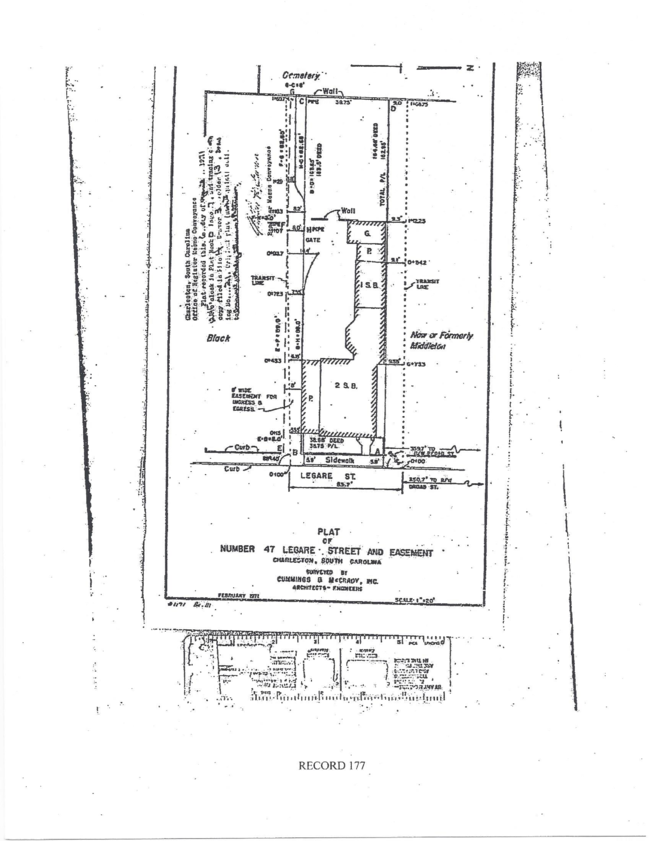
** Plat of Number 47 Legare Street and Easement surveyed by Cummings & McCrady, Inc., dated February 1971, is attached.

Take a look: deep within the Internet is a secretive place…

Standard

.. where criminals buy and sell your private information

Nobody in my household is old enough to receive publications from AARP. (And if you believe that, I should either say “thank you” or try to sell you that beautiful 8-lane bridge crossing the Cooper River in Charleston.) But, for some reason, AARP’s September Bulletin arrived in my mailbox today, and it contained an excellent article entitled “Inside the Dark Web” that provides the best information on that topic than I’ve read to date. You can read the article here.

The article, written by Doug Shadel with Neil Wertheimer, said much of the available information on the dark web comes from Brett Johnson, an “imposing and charismatic” former criminal once dubbed the “Original Internet Godfather.” Johnson created “Shadowcrew”, one of the first online forums where criminals could buy guns, credit cards, Social Security numbers, and drugs. He landed on the Secret Service’s most-wanted list and was in and out of prison for a decade. The other source of information is a character who is now in prison and who asked to be called “Blue London” in this article. Today, according to this article, Brett and Blue are willing to share detail about the dark web, Brett, as a law enforcement consultant, and Blue, as an inmate who wants to reduce his prison sentence.

dark web

The article describes the entire content of the web. The “surface web”, which makes up 5-10% of the Internet, consists of sites that show up when you use normal search engines like Google, Yahoo and Bing. These sites encompass news, entertainment, products, services and consumer information. The creators of these sites, like Wikipedia, Amazon and WebMD, want lots of people to see them.

The “deep web”, which makes up 90-95% of the Internet, consists of pages requiring a password and can’t be accessed by normal search engines. These sites include online banking, subscription websites, government records, emails and most social media content. Examples include PayPal, Netflix, LinkedIn, Instagram and Dropbox.

The “dark web”, which makes up just 01% of the Internet, consists of sites that provide anonymity to users and go largely unregulated. Many are legal. For example, sites service as outlets for human rights activists can be found on the dark web. But the dark web is also used by criminals to make illicit purchases and sales with total anonymity. Cryptocurrency like Bitcoin is used to make the transactions untraceable.

The article described AlphaBay, a site that, before it was taken down in 2017 by the FBI, had over 200,000 users and took in between $600,000 and $800,000 daily, mostly drug related. But that site also dealt in stolen personal IDs, stolen credit card numbers and hacking tools.

Brett and Blue showed the authors of the article many other inhabitants of the dark web that moved in to take the place of AlphaBay. These sites sell the items marketed on AlphaBay plus logins and passwords, credit reports, and “fullz” which translates to a “complete package of everything needed to commit identity theft: Social Security number, date of birth, mother’s maiden name, address, phone numbers, driver’s license number and more.”  Blue said a fullz can sell for $20-$130, depending on the victim’s age and credit score.

Data can also be sold piecemeal. Brett asked the author his wife’s name and quickly found her Social Security number available for purchase at $2.99. The author also paid a small fee and received a 92-page report containing all his current and previous addresses, phone numbers, social media sites and email addresses. The report also contained descriptions of his family members and neighbors and details about properties he has owned.

Much of the data, according to this article, goes up for sale shortly after it is stolen. The huge data breaches we hear about routinely apparently flood the market and deflate prices. Brett and Blue told the author that they could study social media sites to harvest data for criminal purposes. Many sites use “knowledge-based authentication” (KBA) questions, which should be information that only the user knows. But if the user adds this type of information to social media sites, the scammers can successfully mine the information.

The article provides some advice to stop the cybercriminals. First, we should all simply assume that our information is already “out there” on the Internet, and take action to protect ourselves. Cybersecurity experts and former criminals agree on three steps to help us all stay safe:  freeze credit, closely monitor all accounts and use a password manager. The author said he fully subscribes to this advice and has taken all three steps. I’m at two out of three. What about you?

(You can thank me later for directing you to this outstanding article that you are much too young to read.)

ALTA develops wire fraud rapid response plan

Standard

Dirt lawyers:  post this in your office!

alta-color-regIn this era where cybersecurity is our greatest challenge, American Land Title Association has benefited all of us in the real estate industry by developing a rapid response plan for wire fraud incidents. Two links are here, one to the plan itself and another to a response worksheet.

Many of our offices have been challenged with these incidents, and we have learned that time is of the essence. We are, in fact, hearing more and more stories where the diverted money (or some of it) actually gets returned when action is taken quickly. Every second counts! Use these resources to guide you and your staff in reacting immediately.

This plan guides offices in contacting banks, parties to the transaction and law enforcement officials at various levels. Websites for notices are included.

I recommend that you save these resources in a place where everyone in your office can access them. And I recommend that you make hard copies and post them in a central location in your office.

Be safe out there!

And thank you, American Land Title Association!

Check out Bloomberg Businessweek’s article about Greenville

Standard

You only have to walk in downtown Greenville to see the phenomenal transformation this lovely city has made over the last two decades. The riverfront, waterfall and pedestrian bridge provide a scenic backdrop for excellent dining and cultural experiences.

My family enjoys season tickets for the Broadway series at the Peace Center which gives us a chance to enjoy top-notch shows and to check out the always-evolving restaurant scene. When we took two five-year old grandchildren to see The Lion King, we had a wonderful time enjoying the children’s fountains and mice-searching game on Main Street.

greenville.jpg

But the city planners were not only planning for culture. They were planning for business! Bloomberg Businessweek published a flattering article about the progress of businesses in Greenville on June 21. You can read it here.

The article points to decades of political commitment to creating a community that appeals to college graduates and highly skilled workers. State-of-the-art manufacturing plants have been built in the area by Michelin ad BMW. Our company has excellent attorney agents in large and small law firms who work on Main Street and surrounding areas. They report to us that they love their Greenville home.

Greenville was once a hub for textile and apparel production, but now, in addition to the manufacturing plants, Greenville supports entrepreneurs who are locating their start-up businesses downtown. One co-working space houses about a dozen start-ups, according to the article.

The author correctly points out that Greenville has excelled at creating an appealing and walkable commercial district. While downtown may have been unappealing twenty years ago, now many new inhabitants (the population has grown by 20 percent from 2000 -2016) are able to live downtown and walk to work.  Greenville has been successful, according to this article, in creating what economists call an “innovation cluster”.

Read the article and visit Greenville! I recently blogged that Charleston is exploding, and Greenville may follow suit! And I am fortunate to live in Columbia, also a great city, and within two hours of each of our sister cities, not to mention the beach and the mountains. South Carolina has so much to offer!

Marketing tips for dirt lawyers

Standard

bookLast week, this blog discussed technology and marketing issues, and I warned readers to expect more on those topics. I read another great book! This one, The Power of a System, by John H. Fisher, a medical malpractice lawyer, is basically about how to build a successful plaintiff’s practice. Why, you ask, should a real estate lawyer care?

A real estate lawyer should care because Mr. Fisher included some great marketing tips for real estate lawyers. He believes, for example, in identifying the “ideal client” and marketing relentlessly to that person. Here is his quote about the “ideal client” of a real estate lawyer:

“If you are a real estate lawyer, are your ideal clients the homeowners buying a new house? No! The homeowners will use your services one time for a fee of $750, and you will likely never hear from them again…You will be broke by the time the homeowners need you again. The ideal clients for a real estate lawyer are real estate agents who refer a steady stream of new homeowners. The goal is not to make money on a single transaction. Rather, your goal should be to develop relationships with your ideal client that will generate new clients and a steady stream of income for the rest of your career. The lifetime value of your ideal client is far greater than the value of a single transaction.”

This makes perfect sense, doesn’t it? Real estate lawyers in South Carolina should devote their marketing dollars and time to courting the individuals who are in a position to send them business. In addition to real estate agents, local lenders and builders are prime targets. Analyze your market, your community, and determine who will be in a position to direct business to your practice. Call those individuals your “ideal clients” and go after them!

Mr. Fisher has developed three simple marketing tools that he says will make all the difference in a law practice:

  1. Create an information-powerhouse website that provides killer content on a daily basis;
  2. Publish a monthly newsletter targeted to your ideal client;
  3. Host regular seminars and workshops that provide valuable content to your ideal client.

As to the information-powerhouse website, you will need assistance.  There are experts who can assist you with setting up the website as well as providing content. You will, of course, have to comply with the Rules of Professional Responsibility, so you cannot let your website expert work alone. Stay tuned for later blogs about websites.

As to the monthly newsletter, Mr. Fisher was very specific. He believes newsletters are “marketing gold”, but they must be written by the attorney to show personality as well as expertise, and they must be mailed consistently on a monthly basis. He believes that mass-mailing pieces will not do the job.

He said he is always thinking and taking notes about possible articles. (I get this idea because I am always thinking about blog ideas.) He said, with collecting ideas all month, he is able to devote only two hours per month to actually writing. He writes a main article or two on law related topics. Then he answers a legal question or two. After that, he throws in a brief article about his marketing events (“What’s John up to?”). And he adds a goofy picture or two of him and his kids to humanize himself.

He hires a graphic designer to make the newsletter “pretty” and uses a “fulfillment provider” for printing and mailing.

lawyer reading

He wants his newsletter to be so good that his ideal clients (the lawyers who refer medical malpractice plaintiffs to him) will save them and post them on their bulletin boards. Can you write a newsletter that good to promote your practice? I believe you can!

As to event marketing, Mr. Fisher says events should be educational, informational and fun and they should give away secrets! He has seminars for lawyers (his referral partners) to explain his systems, how he treats his clients, etc. He says to promote the heck out of these events to your ideal clients. Mail invitations. Follow with postcards, emails and handwritten notes. He recommends using testimonials from others who have attended successful events. Keep building momentum. Obtain sponsors and vendors to assist. Make sure the events are fun! And then follow them with handwritten notes.

Our office is in the business of consulting with real estate lawyers on marketing and other issues. We can help!  And here’s a further warning about more of these topics in future blogs.

Happy marketing!