BBC reports on South Carolina “heirs’ property” saga

Standard

A December 5 article in BBC News Magazine entitled “Gullah Geechee: Descendants of slaves fight for their land”, outlines the struggles of property owners in Jackson Village to save their homes.

Jackson Village is one of three black communities in Plantersville, an unincorporated area of Georgetown County located about six miles north of the Town of Georgetown on Highway 701. The area is described as consisting of neat brick bungalows, set back form the road and protected from Highway 701 by a dense forest.

The BBC article, written by Brian Wheeler, describes 20 homes in Jackson Village being put up for auction because of the failure to pay taxes on a new sewer system. Local authorities apparently required residents to pay for hooking up to the new system because septic tanks were contaminating drinking water and becoming a health hazard. The residents complain that they were forced to pay even if their septic tanks were working well. The cost for each resident is $250 per year for the next 20 years.

Plantersville sign

Photo courtesy of BBC.com

The land is heirs’ property, land that has been passed down through the generations, usually without the benefit of deeds or probated estates. Many heirs’ property owners can trace their roots back to West African slaves who gained property rights during Reconstruction. These owners often allowed their properties to pass through the generations without formalities because they were denied access to the legal system, or because they didn’t understand it or trust it or could not afford it.

Where generations of landowners own property as tenants in common, maintaining ownership can become a risky proposition. All of the heirs own the property, whether or not they ever set foot on it.  Living on the land and paying taxes on it is certainly not a prerequisite.

Many of these properties are in or near valuable coastal areas where developers are eager to gain access.  A developer can buy the interest of one tenant in common to gain the same rights as the tax-paying residents. But distant family members looking for money can also create havoc. Partition actions are instituted, legal fees are incurred, and the result may be that the property is sold quickly and for less than fair market value.

Photo courtesy of Chicago Tribune

Thankfully, our legislature has recognized and addressed this problem. On September 22, Governor Haley signed legislation that honored the memory of Senator Clementa C. Pinkney, a victim of the Mother Emanuel A.M.E. Church mass shooting in Charleston on June 17, 2015. The new law is now known as the Clementa C. Pinckney Uniform Partition of Heirs’ Property Act, and it will become effective January 1, 2017.

The new law requires independent appraisals and open-market sales to ensure heirs receive fair prices. The new act would not prevent sales for the failure to pay taxes as described in the BBC article, but it should make sales begun by developers and distant heirs more impartial and advantageous for all property owners.

Into the mystic: Fannie and Freddie predict what is in store for housing in 2017.

Standard

businessman-crytal-ball

In a sign that the average cost of houses is increasing across the country, the conforming loan limit for loans to be purchased by Fannie Mae and Freddie Mac will increase in 2017 for the first time in ten years.

The Federal Housing Finance Agency has announced the maximum conforming loan in most parts of the country (including South Carolina) will increase from $417,000 to $424,100. Stated another way, a borrower will not have to qualify for a “jumbo loan” unless the amount to be borrowed exceeds $424,100.

This change should help qualified buyers, particularly in our coastal areas where home prices are higher, obtain mortgages backed by Fannie Mae and Freddie Mac, even though credit remains tight and interest rates are likely to increase.

This is the time of the year when all of us involved in the housing industry are charged with looking into the proverbial crystal ball and projecting how we think the real estate market for the new year will compare with the current year.  For what it’s worth (and this and $5 will buy you a cup of coffee at Starbucks), I’m projecting around a 3 percent increase for next year in South Carolina. Let me know what your crystal ball is disclosing!

What’s Happening with Our Nation’s Malls?

Standard

Three recent Realtor® Magazine articles explore the rise and fall of our nation’s malls. I highly recommend that you read the interesting articles entitled “Dying Suburbia Malls Become Housing Mecca” (October 7); “Will the Death of Malls Save the Suburbs?” (October 6); and “The Nation’s Malls are Getting Major Redo” (July 19) for the full story. The October 6 article, the most comprehensive, was written by Clare Trapasso.

empty-mall

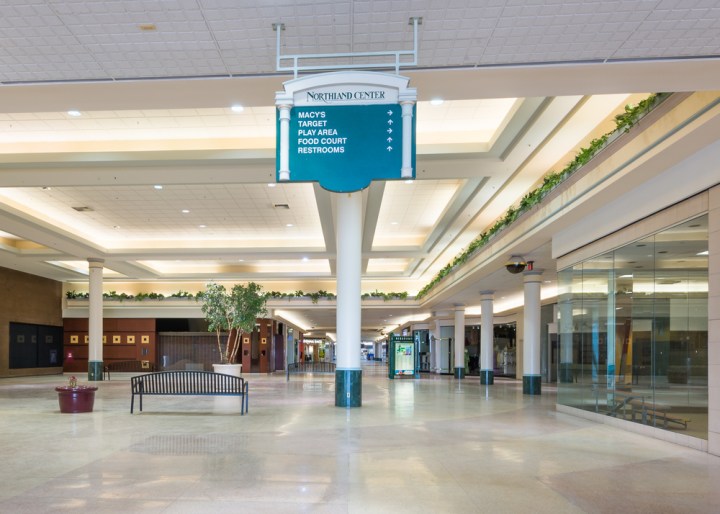
Northland Center, largest mall in the world when it opened in 1954, is now closed.

Summarizing, enclosed malls are basically a post-World War II American phenomenon. These hulking projects vary in size but may be as large as 1.2 million square feet of shopping, dining, movie and other recreation space. In 1970, there were around 300 enclosed malls across the country. By 1996, this number had increased to around 1,040.  Now major stores are closing, and many malls are going dark.

The October 7 article quotes Ellen Dunham-Jones, an urban design professor at Georgia Tech, with the statistic that around 200 malls have closed down in the past two years.

What happened to our malls? It’s a simple answer: the internet.

More and more shoppers are skipping brick-and-mortar retailers to shop online. The malls that are surviving appear to be those with high-end shops that provide luxury experiences shoppers can’t get online. Dunham-Jones pointed to valet parking and chic boutiques with fitting rooms that can take pictures from different angles.

Landlords who once courted department store anchors are now looking for funky boutiques and innovative restaurants. The prediction is that more and more enclosed malls will close, and the question becomes, what will happen to the underlying real estate?

These articles, targeting Realtors®, indicate readers may be renting and selling these properties for mixed-use purposes, including housing! Some malls are being converted into public parks, office space, medical complexes, sports facilities, micro-apartments and condominiums. The theory is that a person can live in an apartment or condo in one of these retrofitted malls and walk to shopping, movie theaters and doctors’ offices.

Some developers like the idea of transforming these acres of flat real estate with existing infrastructure. Malls often contain 50 to 100 acres, including the massive parking lots, and that’s the size of many planned communities and subdivisions. In some areas desperate for housing space, malls may provide a sensible solution.

In one California location, a 30-acre “green roof” is being considered, which would include almost 4 stay tunedmiles of public trails, vineyards and a wine bar.

It sounds as if future potential uses of our dying malls may only be limited by the imagination of developers. The developers I know and love have great imaginations, so stay tuned!

Dirt Lawyers: Prepare to Advise Clients Struck by Disaster

Standard
hurricane-matthew-georgetown

Georgetown, South Carolina (Image by abcnews.go.com)

Just prior to the destruction brought on by Hurricane Matthew to our beloved state on October 8th, I saw two funny quips, which proved that humor is not always lost in the face of disaster. A friend posted on Facebook a football metaphor, hoping Matthew’s aim would be “wide right”.  That didn’t happen. And a preacher friend of a friend put up a sign at his church:  “Mark, Luke and John, please come get your boy.”  That didn’t happen either.

What did happen, according to CoreLogic was $4-6 billion in damage from wind and storm surge damage in all states affected by Matthew. CoreLogic’s media advisory, which compares the destruction of Matthew to Katrina in 2005, Sandy in 2012, Floyd and 1999 and David in 1979, can be read here.  The damage from Katrina, for example, was in the range of $35-40 billion. Of the $4-6 billion damage from Matthew, 90 percent of insurance claims are expected to be related to wind and 10 percent to storm surge, according to the article.

hurrican-matthew-myrtle-springmaid

Springmaid Pier rubble, Myrtle Beach, South Carolina (Image by myrtlebeachonline.com)

Our hearts are breaking for our family members, friends and neighbors who have lost so much in this disaster. Some have not yet been able to return home and don’t know the extent of the damage at this point.

It was just one year ago that South Carolina was forced to begin recovery efforts from the 1,000 year-flood, and those efforts are far from complete. I said in a blog about the flood, and I will repeat here that for those of us old enough to remember, this disaster feels incredibly like the aftermath of Hurricane Hugo in 1989.

As we think back to the beautiful areas of South Carolina that were hardest hit then and reflect on those areas today, it seems that almost all of them are better and stronger and more beautiful than they were before the disaster. South Carolinians are strong and resilient, and we are stronger today than we were last year.

hurrican-matthew-charleston-market

Historic City Market under water in Charleston, South Carolina (Image by abcnews.go.com)

Dirt lawyers are in a unique position to advise clients who are not familiar with the assistance that may be available to them. I challenge each of us to pass along the information that will assist in recovery efforts.

For example, Fannie Mae and Freddie Mac wrote press releases reminding mortgagors of the options available for mortgage assistance in the affected areas. Those press releases can be read here and here.  FEMA resources are outlined here.

As always, I have confidence that South Carolina real estate lawyers will rise to the occasion and provide the best advice available for their clients. I am proud to be associated with this dedicated group of lawyers.

Court of Appeals Revises Opinion, but not Result, in Arbitration Case

Standard

It seems the arbitration cases are all over the place in 2016. We’ve discussed three cases so far this year*, and the opinion in one of these cases has been withdrawn, substituted and refiled**, but the result did not change.

The South Carolina Court of Appeals decided to make a few changes in its opinion in One Belle Hall. The earlier opinion, filed June 1, held that an arbitration clause in a roofing supplier’s warranty provision was not unconscionable. The trial court had ruled that the supplier’s sale of shingles was based on a contract of adhesion and that the injured property owners lacked any meaningful choice in negotiating the warranty and arbitration terms, which were contained in the packaging for the shingles.

The Court of Appeals indicated that the underlying sale was a typical modern transaction for goods in which the buyer never has direct contact with the manufacturer to negotiate terms. The Court found it significant that the packaging contained the notation: “Important: Read Carefully before Opening” providing that if the purchaser is not satisfied with the terms of the warranty, then all unopened boxes should be returned. The Court pointed to the standard warranty in the marketplace that gives buyers the choice of keeping the goods or rejecting them by returning them for a refund, and blessed the arbitration provision.

knotted-road-sign

In the later opinion, filed September 28, the Court of Appeals addressed the South Carolina Supreme Court’s July 6, 2016 opinion in Smith v. D.R. Horton (cited in the footnote, below). In D.R. Horton, which this blog discussed on July, 14 the Supreme Court held that a national residential company’s contract contained a number of “oppressive and one-sided provisions”, including an attempted waiver of the implied warranty of habitability and a prohibition of awarding money damages of any kind. The Supreme Court held that the home purchasers lacked a meaningful ability to negotiate their contract, the only remedy through which appeared to be repair and replacement.

The difference in the two cases appears to be the location of the offending provisions. The United States Supreme Court has ruled that an arbitration agreement is separable from the contract in which it is embedded, and the issue of its validity is distinct from the substantive validity of the contract as a whole.*** The arbitration provision in D.R. Horton was construed in its entirety because various subparagraphs addressed warranty information and contained cross-references to each other. In addition, the contract did not contain a severability clause.

In the second opinion in One Belle Hall, the Court of Appeals admitted, as the supplier had conceded, that the agreement at issue was a contract of adhesion, but noted that our Supreme Court has stated that adhesion contracts are not per se unconscionable. The Court recognized that the roofing supplier’s contract continuously used language to the effect that any attempted disclaimer or limitation did not apply to purchasers in jurisdictions that disallowed them. The Court also found it significant that the agreement contained a severability clause.

In other words, since the objectionable provisions of the contract were outside the arbitration provision, and the arbitration provision is severable from the objectionable provisions, the arbitration clause is enforceable. The Court repeated its earlier point that the arbitration provision facilitates an unbiased decision by a neutral decision maker in the event of a dispute.

I believe we will see more of these cases, and I caution lawyers to be extremely careful in their drafting endeavors.


*  One Belle Hall Property Association v. Trammel Crow Residential Company, S.C. Ct. App. Opinion 5407 (June 1, 2016); Smith v. D.R. Horton, Inc., S.C. Supreme Court Opinion 27642 (July 6, 2016); and Parsons v. John Wieland Homes, S.C. Supreme Court Opinion 27655 (August 17, 2016).

**  One Belle Hall Property Association v. Trammel Crow Residential Company, S.C. Ct. App. Opinion 5407 (September 28, 2016)

***  Prima Paint Corporation v. Flood Conklin Mfg. Co., 388 U.S. 395 (1967)

Don’t Amend Your Master Deed As A Litigation Strategy

Standard

The South Carolina Court of Appeals was not impressed!

The owners of The Gates at Williams-Brice (a great place to tailgate!) were surprised in 2012 when a maintenance company refused to bid on an exterior caulking/sealant job because of perceived construction defects.  Almost immediately, the owners’ association and an individual owner filed a complaint alleging negligence, gross negligence, breach of warranty and strict liability claims. The defendants were numerous developer and contractor entities.

The plaintiffs demanded a jury trial and sought to establish a class action for the condominium owners. The developer filed a motion for a nonjury trial and to strike the class action allegations. The Circuit Court ruled for the plaintiffs, and the defendants appealed. The Court of Appeals, in an Opinion dated August 31*, reversed.

The case contains several practice pointers for dirt lawyers, especially those who draft master deeds and amendments to master deeds and those who represent owners’ associations.

williams-brice

The Master Deed establishing The Gates at Williams-Brice contained provisions requiring arbitration, waiving the right to a jury trial, waiving the right to a class action, and eliminating the right to secondary, incidental or consequential damages.

The original complaint was filed in December of 2012. An answer, opposing the certification of a class, was filed in May of 2013. Later that month, the complaint was amended to add defendants. And on May 23, the homeowners amended the Master Deed to remove the provisions that thwarted their litigation efforts.

The Circuit Court found that the provisions at issue were no longer within the Master Deed and that the defendants were precluded from enforcing unconscionable arbitration and alternative dispute resolutions that contained oppressive, one-sided terms.

On appeal, the defendants argued that the Master Deed could not be amended retroactively to remove the provisions at issue. Neither party contested that the homeowners’ actions were taken in anticipation of litigation. The Court of Appeals held that the homeowners knowingly, voluntarily and intelligently waived their rights to a jury trial and to a class action when they signed their deeds.

Citing a North Carolina case**, the Court of Appeals said that to remove the agreed-upon waivers retroactively would effectively substitute a new obligation for the original bargain of the parties. The Court pointed to the cites in the North Carolina case that indicate several jurisdictions apply a reasonableness standard when reviewing amendments to covenants and holding a provision authorizing an owners’ association to amend covenants does not permit amendments of unlimited scope; rather, every amendment must be reasonable in light of the contracting parties’ original intent.

The Court of Appeals discounted several cases involving amendments in condominium projects by the Circuit Court as not controlling. One such case found the developer’s amendment to increase maintenance assessments was enforceable against new purchasers. Another case approved an amendment regarding leasing restrictions. A third case found that an owners’ association properly amended covenants to prohibit the developer from advertising on the property. The final case held that an amendment authorizing the association to suspend utilities for unpaid judgments was properly applied against a unit owner because any alleged retroactivity was proper based on the contractual relationship between the association and the unit owner.

Other cases cited by the Circuit Court were dismissed as neither dealing with amendments to condominium declarations nor to master deeds.

The Court stated that it was unaware of any authority in South Carolina that would permit contracting parties to unilaterally alter agreed upon provisions once litigation has started.

The developer also argued that the amendments were ineffective because they failed to obtain the required permission of lenders and other “bound parties” such as the developer. The Court declined to address that issue because of its other conclusions.

What will the Supreme Court say if it gets the opportunity to rule on this issue?


*The Gates at Williams-Brice Condominium Association v. DDC Construction, Inc., S.C. Court of Appeals Opinion 5438 (August 31, 2016)

**Armstrong v. Ledges Homeowners Ass’n, Inc., 633 S.E.2d 78 (N.C. 2006)

Another South Carolina Arbitration Case

Standard

Following these cases is like watching a tennis match!

This is the third blog on this topic this summer! The June 7 blog surrounded a South Carolina Court of Appeals case* that held an arbitration clause in a roofing supplier’s warranty provision was not unconscionable. The lower court had ruled that the supplier’s sale of shingles was based on a contract of adhesion and that the injured property owners lacked any meaningful choice in negotiating the warranty and arbitration terms, which were actually contained in the packaging for the shingles.

The Court of Appeals indicated that the underlying sale was a typical modern transaction for goods in which the buyer never has direct contact with the manufacturer to negotiate terms. The Court found it significant that the packaging for the shingles contained a notation:  “Important: Read Carefully Before Opening” providing that if the purchaser is not satisfied with the terms of the warranty, then all unopened boxes should be returned. The Court pointed to the standard warranty in the marketplace that gives buyers the choice of keeping the goods or rejecting them by returning them for a refund, and blessed the arbitration provision.

SCORE:  15- Love in favor of arbitration

tennis ball court

Let’s Talk Dirt on July 14 addressed a South Carolina Supreme Court case that appeared to take the opposite approach. ** A national residential construction company’s contract contained a number of “oppressive and one-sided provisions”, including an attempted waiver of the implied warranty of habitability and a prohibition on awarding money damages of any kind. The Supreme Court held that the home purchasers lacked a meaningful ability to negotiate their contract, the only remedy through which appeared to be repair or replacement.

SCORE:  15-all.

Note that Justices Kittredge and Pleicones dissented, stating that the contract involves interstate commerce and, as a result, is subject to the Federal Arbitration Act (FAA), “a fact conspicuously absent in the majority opinion”. The dissent stated that federal law requires that unless the claim of unconscionability goes to the arbitration clause itself, the issue of enforceability must be resolved by the arbitrator, not by the courts. The majority construed the Warranties and Dispute Resolution provisions of the contract as comprising the arbitration agreement and thus circumvented controlling federal law, according to the dissent.

Since the property owners raised no challenges to the arbitration clause itself, the dissent would have required that the other challenges be resolved through arbitration.

In a case dated August 17***, the majority decision is written by Chief Justice Pleicones with Justice Kittredge concurring. (Do you see a pattern here?) This case involved a residential subdivision that had been built on property previously used as an industrial site. The developer had demolished and removed all visible evidence of the industrial site and removed underground pipes, valves and tanks.

The plaintiffs bought a “spec” home in the subdivision and later discovered on their property PVC pipes and a metal lined concrete box containing “black sludge”, which tested positive as a hazardous substance. The present lawsuit was brought, alleging the developer failed to disclose the property defects. The developer moved to compel arbitration.

Paragraph 21 of the purchase agreement stated that the purchaser had received and read a copy of the warranty and consented to its terms. The purchasers had been provided with a “Homeowner Handbook” containing the warranty.

The circuit court, which was affirmed by the Court of Appeals, found the arbitration clause was enforceable for two reasons:

  1. it was located within the warranty booklet, making its scope limited to claims under the warranty. The Supreme Court held that the plain and unambiguous language of the arbitration clause provides that all claims, including ones based in warranty, are subject to arbitration.
  2. The alleged outrageous tortious conduct of the developer in failing to disclose concealed contamination made the outrageous torts exception to arbitration enforcement applicable. The Supreme Court overruled all South Carolina cases that applied to outrageous torts exception, making that exception no longer viable in South Carolina.

The Supreme Court discussed the heavy presumption in favor of arbitration by the FAA and in the federal courts and the push to place arbitration agreements on equal footing with other contracts and enforce them in accordance with their terms.

SCORE30-15 in favor of arbitration

You won’t be surprised to learn that there was a dissent, this time by Acting Justice Toal, and a concurrence, by Justices Hearn and Beatty.

And remember that the CFPB recently announced a proposed rule that would ban financial companies from using mandatory pre-dispute arbitration clauses to deny consumers the right to join class action lawsuits.

SCORE:  30-all

All of these authorities affect matters involving dirt law. So the tennis match involving arbitration clauses in our area is still being played, and we will continue to watch!

*One Belle Hall Property Owners Association v. Trammell Crow Residential Company, S.C. Ct. App. Opinion 5407 (June 1, 2016)
** Smith v. D.R. Horton, Inc., S.C. Supreme Court Opinion 27643 (July 6, 2016)
*** Parsons v. John Wieland Homes, S.C. Supreme Court Opinion 27655 (August 17, 2016

Feds Extend Footprint of Shell Game

Standard

Will this obligation eventually extend to South Carolina?

Secretly purchasing expensive real estate continues to be a popular method for criminals to launder dirty money. Setting up shell entities allows these criminals to hide their identities. When the real estate is later sold, the money has been miraculously cleaned.

Early this year, the Financial Crimes Enforcement Network (FinCEN) of the United States Department of the Treasurer issued an order that required the four largest title insurance companies to identify the natural persons or “beneficial owners” behind the legal entities that purchase some expensive residential properties.

shell game

At that time, the reach of the project extended to the Borough of Manhattan in New York City, and Dade County, Florida, where Miami is located. In those two locations, the designated title insurance companies were required to disclose to the government the names of buyers who paid cash for properties over $1 million in Miami and over $3 million in Manhattan. The natural persons behind the legal entities had to be reported for any ownership of at least 25 percent in an affected property.

Now, all title insurance underwriters, in addition to their affiliates and agents, will be involved, and the footprint of the project is being extended effective August 28.

The targeted areas and their price thresholds will be:

  • Borough of Manhattan, New York; $3 million;
  • Boroughs of Brooklyn, Queens and Bronx, New York; $1.5 million;
  • Borough of Staten Island, New York; $1.5 million;
  • Miami-Dade, Broward and Palm Beach Counties, Florida; $1 million;
  • Los Angeles, San Francisco, San Mateo, Santa Clara and San Diego Counties, California; $2 million; and
  • Bexar County (San Antonio), Texas; $500,000.

Although the initial project was termed temporary and exploratory, FinCEN has indicated that the project is helping law enforcement identify possible illicit activity and is also informing future regulatory approaches.

We have no way of knowing whether or when this program may be expanded to South Carolina, but it is entirely likely that expensive properties along our coast are being used in money laundering schemes. We will keep a close watch on this program for possible expansion!

Probate Problems: When Doing Things The Old-Fashioned Way Can Get Your Documents Rejected

Standard

This is not news, but we hear recording offices are beginning to reject documents.

Effective June 2, 2014, South Carolina Code §26-1-120 (E) 4, dealing with notarial certificates, was amended to require that a subscribing witness in a probate form must attest that he or she is not a party to or beneficiary of the transaction.

This is a correct version of the new probate form:

Screenshot 1

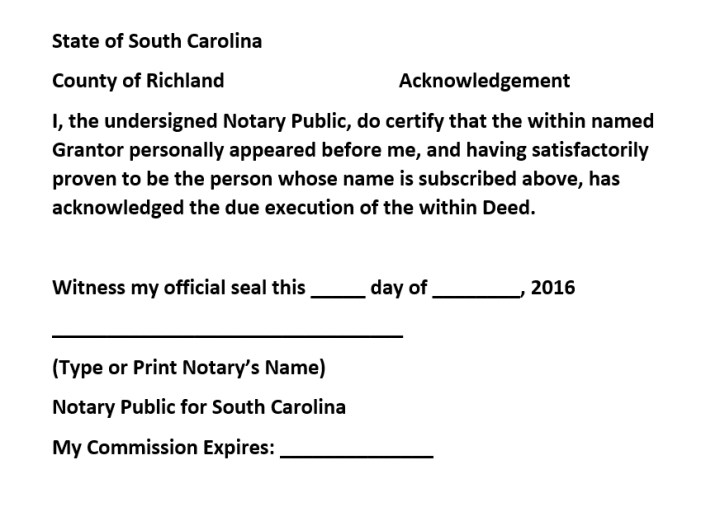
Probates are notoriously difficult to complete correctly, especially for documents sent out-of-state. It is probably always a better idea to use a simple acknowledgement form, particularly in light of the statutory change:Screenshot 2Note that South Carolina Code §26-1-90(B) now requires that the notary legibly type or print his or her name near the signature.

This is a technicality, but a technicality that can cause your documents to be rejected by recording offices. Don’t let that happen!

The SC-NC Boundary Legislation Passed!

Standard

SC law “clarifying” the boundary will be effective at the beginning of the year.

The long awaited and much debated legislation defining the boundary line between The Palmetto State and the Tar Heel State was signed by Governor Nikki Haley on June 10.  The effective date of the law is January 1, 2017.

The purpose of the law is “clarifying the original location of the boundary” with North Carolina along Horry, Dillon, Marlboro, Chesterfield, Lancaster, York, Cherokee and Spartanburg Counties and providing additional information about the plats describing the location along Greenville, Pickens and Oconee counties.  In other words, our legislature doesn’t believe the law establishes a new boundary line.

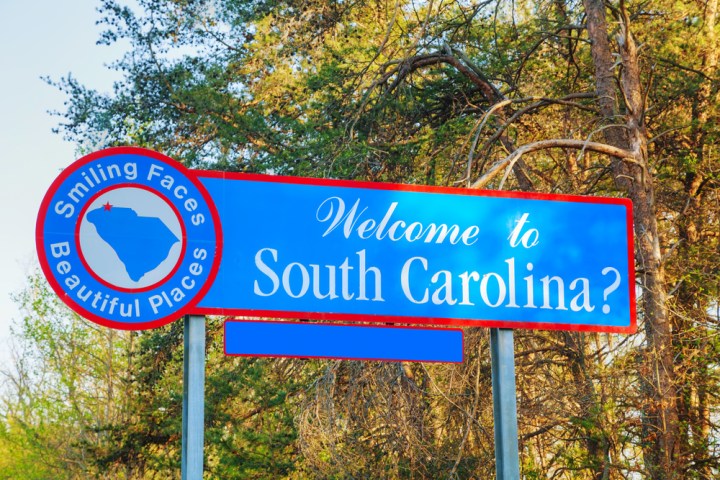
welcome to SC 2

As expected, much of the legislation deals with tax issues. The legislative intent is set out specifically, and includes the thought that no business or residence owner should be liable for back taxes to South Carolina nor refunds from South Carolina as a result of a change from one state to the other. And the Department of Revenue is given the authority to compromise taxes in cases that result in taxation in both states.

Several issues are of particular interest to dirt lawyers. For example, no deed recording fees or county filing fees may be charged for deeds recorded as a result of the boundary clarification.

On the effective date of the legislation, Registers of Deeds (and Clerks of Court in those affected counties that do not have ROD offices) will be required to file a Notice of State Boundary Clarification for each affected piece of property. The form is described specifically in the legislation and requires the legal description, tax map number, derivation (if available), the names of the owners of record and the “muniments of title”, a defined term meaning “documents of record setting forth a legal or equitable real property interest or incorporeal hereditament in affected lands of an owner”.

I’m a dirt lawyer of more years than I like to divulge, but I admit I had to investigate the meaning of that word. The learned source, Wikipedia, indicates a muniment of title is the written evidence a landowner can use to defend title, such as a deed, will, judgment or death certificate.

Apparently, lawyers in states with marketable title legislation may be familiar with this term. South Carolinians have neither the benefit of tidy legislation to correct our title problems nor the knowledge and widespread use of this nifty term, until now.  We will all need to use and pronounce the word, muniment, next year. A North Carolina colleague asked me where the RODs and Clerks of Court will obtain the information to supply the  muniments of title. My best guess is that somebody is going to have to do a lot of title work!

(Note to Professor Spitz:  I apologize if you taught me that term in law school. It’s been a long, long time!)

Also of interest to dirt lawyers are provisions relating to foreclosures. A foreclosing attorney will have to file and serve the summons and complaint along with the aforesaid Notice of Boundary Clarification and an attorneys’ certification “that title to the subject real property has been searched in the affected counties and the affected jurisdictions” on all parties having interest in the real property pursuant to the muniments of title.  Whew! The foreclosure can then proceed after thirty days. I’m not sure how all that will be sorted out. I assume South Carolina foreclosure lawyers will be hiring counterparts across the state line to assist in these title examinations.

How will dirt lawyers and title insurance companies deal with sales and mortgages for properties that change states?  I think we are going to take these issues on a case-by-case basis and work together to sort out the various issues that are surely to arise. Be sure to involve your title insurance underwriter in these decisions rather than going out on a limb alone!