Did your 2019 Bar dues give you sticker shock?

Standard

The United States Supreme Court signals possible First Amendment violation

businessman shock

The United States Supreme Court may be considering upending the system bar associations in about thirty states use to support themselves, mandatory bar dues paid to private associations.  David G. Savage of the Los Angeles Times reported on December 3 that the more conservative high court may have an appetite to address this issue. You can read the article here.

Bar associations in most states regulate the legal profession by licensing and disciplining lawyers. The LA Times article reports: “In a brief order on Monday, the court overturned a ruling last year by the U.S. 8th Circuit Court of Appeals that had upheld mandatory bar dues in North Dakota and sent the case back ‘for further consideration in light of Janus.’”

Janus v. AFSCME is a 5-4 case from June where the Supreme Court struck down California law that required teachers and other public employees to pay fees to support unions.

The current case, Fleck v. Wetch, began when Arnold Fleck, a North Dakota lawyer, sued his state bar association after he learned it had contributed $50,000 to support a state ballot measure. When the 8th Circuit rejected his constitutional argument, the Goldwater Institute assisted him in filing an appeal.

The article quotes Justice Alito as calling it a “bedrock principle” that “no person in this country may be impelled to subsidize speech by a third party that he or she does not wish to support.”

The lawsuit challenges private associations, not state agencies that regulate lawyers. We will always pay bar dues. We just may not pay them to a private bar association.

Deadline approaching for new HOA recording requirement

Standard

“Governing documents” should be recorded by January 10

gavel house

The South Carolina Homeowners Association Act, an amendment to Title 27 of the South Carolina Code which included new §27-30-130, was signed into law by Governor Henry McMaster and became effective on May 17.

The act states that in order to continue to be enforceable, a homeowners association’s governing documents must be recorded in the county where the property is located by January 10, 2019 for associations in place on the effective date of the legislation. For new associations or for amendments to governing documents, recording must take place by January 10 of the year following the adoption or amendment of the documents.

The requirement to record Master Deeds is, of course, not new to South Carolina practitioners. We have recorded Master Deeds and their required attachments since the creation of Horizontal Property Regimes became possible in South Carolina. The new requirement applies to rules, regulations and bylaws of associations, including amendments to rules, regulations and bylaws. Practitioners have not routinely recorded these documents. It is interesting that recording rules, regulations and bylaws will not be subject to the requirement of witnesses and acknowledgements of §30-5-30.

A memorandum from the Register of Deeds of Horry County states that these documents will be accepted electronically and across the counter. Documents recorded across the counter must contain an original wet signature plus the printed name and title of the signatory. Horry County will also require contact information (address, email address or telephone number) of the person recording the document, the Homeowners Association’s name and the physical address or legal description of the property. Horry County also highly recommends, but does not require, the book and page number of the recorded Master Deed. This additional information may be included in a cover sheet.

The law also creates a new duty to disclose whether real property being sold is part of a homeowners association and a duty to disclose the condition of floors, foundations, plumbing, electrical and other components of the property. Real estate practitioners may be called upon to assist with these newly-created disclosures.

Another requirement of the legislation includes a 48-hour notice for meetings that are intended to increase budgets by more than ten percent. A requirement for access to community documents by owners was also added. This requirement was previously in place for associations that are created as non-profit corporations. The new law makes it clear that all homeowners associations must provide similar access to documents for owners. The law also gives magistrate’s courts concurrent jurisdiction for monetary disputes of up to $7,500 involving homeowners association disputes.

SC Court reverses itself on “active energy” judgment issue

Standard

law-books-gavel1

South Carolina dirt lawyers seldom breathe a sigh of relief when our Supreme Court decides a real estate case. But the November 21 opinion in Gordon v. Lancaster* was greeted with a collective “thank goodness”!  We were living with a less-than-exact term for the viability of a judgment, and we didn’t like it.

The question in this case was whether a creditor may execute on a judgment more than ten years after enrollment when the ten-year statutory period for execution** expires during the course of litigation. The Court overturned its 2010 decision in Linda Mc Co. v. Shore***, which held that, despite the passage of more than ten years, the judgment continued to have “active energy” because the judgment creditor had filed for supplemental proceedings.

In the current case, a judgment was enrolled in 2002 against Rudolph Drews, the now-deceased uncle of the Petitioner Donald Lancaster, in connection with a civil action for violating securities laws in an investment scheme for a new business venture in Charleston. Frank Gordon, the creditor, filed a petition for supplemental proceedings in 2006. During the hearing, Gordon’s counsel became suspicious that Drews’ wife and Lancaster were attempting to shield Drews’ assets from creditors. The hearing was continued when Drews failed to produce tax and financial documents.

Drews died in 2007. Gordon sought to continue supplemental proceedings, but there were delays in the estate administration. In 2010, suspicions were confirmed about hiding assets when Lancaster was deposed. Soon after, one day before her scheduled deposition, Drews’ wife died. Gordon filed this action, asserting Lancaster assisted Drews is hiding assets in violation of the Statute of Elizabeth. In 2011, Drews’ estate confessed judgment in the approximate amount of $300,000, and his wife’s estate settled with Gordon for $60,000.

During a bench trial in 2013, Lancaster moved for a directed verdict based on Gordon’s prior concession that the suit was based on the earlier judgment, which was obviously older than ten years. The trial court and the Court of Appeals disagreed, relying on the holding in Linda Mc: If a party takes action to enforce a judgment within the ten-year statutory period of active energy, the resulting order will be effective even if issued after the ten-year period has expired.

The Court noted that Linda Mc represented a departure from its historic approach and created confusion in what was formerly a well-settled area of the law. (To that I would like to very politely reply “duh”.) The Court overruled itself and returned to the bright-line ten-year rule.

In a footnote, the Court stated that it is overruling Linda Mc prospectively. The same footnote referred to Justice Pleicones’ dissent in Linda Mc, which predicted confusion in a previously settled area of the law.

Justice Few concurred in the result but disagreed with overruling Linda Mc, which he said created a narrow exception to the bright-line ten-year rule for the issuance of an execution on a judgment. There was a discussion in the opinion and the concurring opinion about dictum vs. holding, but, thankfully, nothing concrete came out of that. Justice James concurred in part and dissented in part, agreeing that Linda Mc should be overruled, but believing that Gordon should have received relief because of the prospective nature of the decision.

Pennsatucky AmenAs a title insurance lawyer and title examiner from way back, I am happy to see us return to a common sense, bright-line approach to the ten-year rule. Can I get an “Amen”?

* South Carolina Supreme Court Opinion 27847, November 21, 2018.

** South Carolina Code Section 15-39-30.

*** 390 S.C. 543, 703 S.E.2d 499 (2010).

Good news during Thanksgiving week for real estate agents…and us!

Standard

thanksgiving 2

Many real estate lawyers rely on their local real estate agent friends for the bulk of their residential closing business. When business is good for them, it’s good for us! Two recent stories in national publications are good signs for all of us.

First, an article from Housing Wire dated November 12, which you can read here, indicates more Americans are using real estate agents than ever before, including Millennials. The article cites a Harris Insights housing consumer study, which shows a full 90% of consumers use real estate agents to buy and sell their homes. These numbers are higher than those shown in previous similar studies, up 5 points from 2014 and 9 points from 2001.

We have all assumed that Millennials, ages 18 – 34, are replacing real estate agents with technology, but this study found the 91% of them use real estate agents in their transactions. According to this article, that number is higher among the Gen X group, ages 35 – 44, at 94%.

Surprising to me, this study indicates the older generations are more likely to cut real estate agents out of their transactions. Only 81% of consumers ages 55 and older indicate they use real estate agents in their transactions. And, apparently, more educated consumers enjoy the use of real estate agents in buying and selling their homes. High school graduates reported 83% use, while college educated consumers reported 94%. Higher income earners were also more likely to use real estate agents (98% of $75,000 – $100,000 earners vs. 79% of $50,000 or less earners.)

Read the article and the underlying study for more insight.

The second article that caught my attention is from Realtor Magazine on November 7. This article, entitled “Big Night of Midterm Wins for Realtors®”, reported that candidates across the country at federal, state and local levels won elections with the promise to benefit the real estate industry’s goals of strong communities and healthy residential and commercial property markets.

This article reports that the National Association of Realtors® supported hundreds of candidates they considered to be real estate champions, regardless of party affiliations.

It’s budget time for me, and our company is predicting a slight softening of residential and commercial markets in 2019. This positive news for our real estate agent partners makes me feel better about the year to come!

Here’s wishing everyone a very happy Thanksgiving with family and friends!

Brad Pitt foundation sued for faulty post-Katrina construction

Standard

Charitable intent to replace Ninth Ward housing results in extensive legal battles

Brad Pitt construction 2

South Carolinians are no strangers to the extensive destruction caused by hurricanes and floods. Our friends in Conway, Nichols and surrounding areas are in the process of cleaning up from the most recent disaster that hit our state in October. And we look on with empathy as our friends in other parts of the world face similar disasters. I lived in Panama City, Florida during my middle and high school years, and the destruction my friends there are facing at this very moment as a result of Hurricane Michael is unimaginable.

It does not go unnoticed when a celebrity attempts to make a difference in the face of natural disasters. The Make it Right Foundation is a non-profit founded by actor Brad Pitt in 2007 to build environmental friendly homes in New Orleans’ Ninth Ward following the destruction caused by Hurricane Katrina.

The homes were intended to be storm-safe, certifiably green, energy efficient and affordable. The original goal was to build 150 homes in the area hit hardest by Katrina. The homes were available at prices around $150,000 to residents who received resettlement financing, government grants and donations from the foundation. Brad Pitt was apparently proud of the construction, calling the area an oasis of color and solar panels.

More than ten years and $26 million later, construction has stopped 40 houses shy of the goal because of alleged faulty construction including leaky roofs, faulty HVAC systems, sagging porches and rotting and mildewing wood. Residents have reported headaches and illnesses. A New Orleans attorney has brought a class action lawsuit against the foundation, alleging that the construction is substandard and the homes are deteriorating at a rapid pace.

Related claims have been filed by the foundation against the makers of an experimental wood product called TimberSIL which didn’t fare well in the hot and humid south Louisiana environment as well as architects who may be responsible for failure to property waterproof the structures. Insufficiently sloping roofs may be partially to blame.

The original suit was brought in Orleans Parish Civil District Court but has been removed recently to the United States District Court for the Eastern District of Louisiana.

Despite the good intentions of Brad Pitt and his foundation, it appears the lawsuits related to these Ninth Ward homes may linger for years.

A scary Halloween story to keep real estate attorneys up at night!

Standard

This South Carolina man’s criminal conviction will stop you in your tracks!

pumpkin

BOO!

A South Carolina man made a name for himself this year in Washington, DC, and not in a good way. Robert McCloud, a 39-year old former resident of Warrenville, in Aiken County, was sentenced in federal court in Washington, DC, to 18 months in prison followed by three years of supervised release including six months of home confinement. He also forfeited almost $60,000 and will be required to pay restitution in an amount to be determined later. Finally, he will be required to perform 150 hours of community service.

The charges were based on wire fraud statutes and involved real estate transactions. McCloud pled guilty in June in the U.S. District Court for the District of Columbia. His sentence was imposed October 19.

McCloud and co-conspirators identified residential properties that appeared to be vacant and abandoned. They prepared and recorded fake deeds into fictitious names and later fraudulently sold the properties, using fake drivers’ licenses, to legitimate purchasers. McCloud and his co-conspirators involved unsuspecting title and escrow companies in the subsequent closings.

In his guilty plea in June, McCloud admitted to participating in two of these fraudulent transactions in 2015, which generated a total of around $580,000.  Of that total, law enforcement officials were able to seize almost $370,000 in administrative forfeiture proceedings. In both cases, the properties were unencumbered. The true owners of both properties are elderly owners and have been involved in difficult proceedings to have the properties re-titled in their names.

The harm caused to the true owners and the legitimate buyers was covered by title insurance, and the restitution represents funds owing to the title insurance companies. Dirt lawyers, when you need an example of why your clients should be protected by title insurance, you can use this story! And I have many others if you need them.

Can an alley be the basis of an appurtenant easement in SC?

Standard

The Court of Appeals says it can

Charleston houses

Two valuable downtown Charleston residential lots were the subject of an easement case decided by the South Carolina Court of Appeals on September 19.* Much to the dismay of the owners of 45 Lagare Street, the Court held that an appurtenant easement exists in the form of an alley that runs along a boundary of 45 Lagare Street for the benefit of 47 Lagare Street.

Master-in-Equity Mikell Scarborough had granted summary judgment in favor of the owner of 47 Lagare Street, finding an easement appurtenant burdened 45 Lagare Street, and the Court of Appeals affirmed.

In 1911, the properties were considered a single lot known as 47 Lagare Street owned by W.G. Hinson. That year, Hinson divided the property, creating 45 Lagare Street, and conveying that lot to his niece. The 1911 deed established an easement for the benefit of the 47 Lagare Street, which Hinson retained. This language established the easement:

Also, the full and free use and enjoyment as an easement to run with the land of the right of ingress, egress, and regress, in, over, through, and upon the alley-way eight (8) feet wide as a drive way or carriage way, situation, lying, and being immediately to the south of (47 Lagare), and being the southern boundary of said (47 Legare).

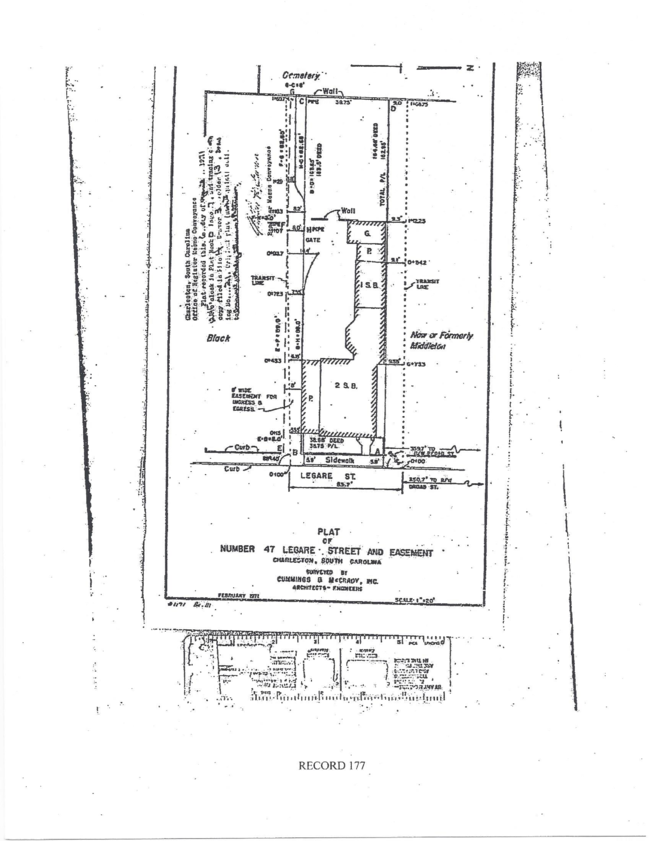
Title to both lots passed to third parties, and in 1971, a new survey was drawn,** and the owners of both properties provided verbatim descriptions of the original easement and covenanted that the no buildings or obstructions would be erected on the easement area. The documents stated that the covenants would run with the land.

The most recent deed of the benefited property recited the existence of the easement, but the most recent deed of the burdened property did not. In 2004, the owner of the benefited property added a chain-link fence and masonry wall along the border with the burdened property.

During the trial, the Appellants argued that the easement had been abandoned and stated that the only time it was used was to allow for the Respondent’s landscapers to walk down the driveway to use the gate. Respondent testified that the easement area is also used by her family members, guests, tradesmen and other permittees to access the rear of 47 Legare for large-scale appliances, equipment, and machinery and to provide access to the only suitable area for off-street parking. She also claimed that she uses the easement to access the back of her property in a golf cart.

The first issue on appeal became whether a terminus existed on 47 Legare, a requirement for an appurtenant easement. Two Supreme Court cases were discussed, Whaley v. Stevens, 21 S.C.221 (1884), which held that the terminus requirement in South Carolina only requires the dominant estate to be contiguous or adjacent to the easement. A later case, Steele v. Williams, 204 S.C. 124 (1944) held that an alleyway was an easement in gross rather than an appurtenant easement because it lacked a terminus.

The Court of Appeals found Whaley controls although no South Carolina case has explicitly defined the terminus requirement. The Court held that the terminus issue is a fact-specific inquiry and that, intuitively, the dominant estate must have access to the purported easement.

In addition, the Court stated, an appurtenant easement might be found if the purported easement (1) at least touches the dominant estate and (2) in cases where the easement is an adjacent boundary between—or runs parallel—to the dominant and servient estates, such as the case at hand, the easement does not extend beyond the dominant estate’s boundary. (At most, the easement ends at the lot line of the dominant estate.) In Steele, the alley extended beyond the appellant’s property.

The intent of the parties was held to be determinative, and the Court held that the 1911 common owner, Hinson, clearly intended that the driveway would be an easement appurtenant.

The Court next discussed the appurtenant easement requirement of necessity. 47 Legare Street obviously has direct public access on Lagare Street, but the Court held that the easement was necessary to reach the rear of the property by large-scale equipment and tools and to provide for off-street parking.

We will wait to see whether our Supreme Court has the opportunity to weigh in on this issue.


* Williams v. Tamsberg, S.C. Court of Appeals Opinion No. 5596 (September 19, 2018)

** Plat of Number 47 Legare Street and Easement surveyed by Cummings & McCrady, Inc., dated February 1971, is attached.

Check out Bloomberg Businessweek’s article about Greenville

Standard

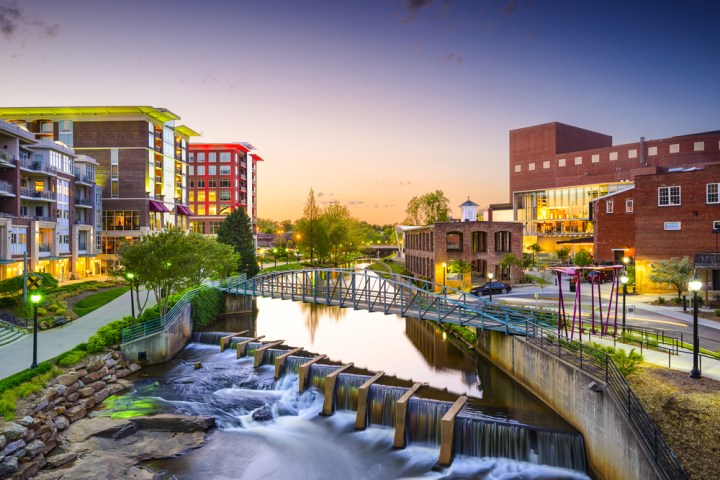
You only have to walk in downtown Greenville to see the phenomenal transformation this lovely city has made over the last two decades. The riverfront, waterfall and pedestrian bridge provide a scenic backdrop for excellent dining and cultural experiences.

My family enjoys season tickets for the Broadway series at the Peace Center which gives us a chance to enjoy top-notch shows and to check out the always-evolving restaurant scene. When we took two five-year old grandchildren to see The Lion King, we had a wonderful time enjoying the children’s fountains and mice-searching game on Main Street.

greenville.jpg

But the city planners were not only planning for culture. They were planning for business! Bloomberg Businessweek published a flattering article about the progress of businesses in Greenville on June 21. You can read it here.

The article points to decades of political commitment to creating a community that appeals to college graduates and highly skilled workers. State-of-the-art manufacturing plants have been built in the area by Michelin ad BMW. Our company has excellent attorney agents in large and small law firms who work on Main Street and surrounding areas. They report to us that they love their Greenville home.

Greenville was once a hub for textile and apparel production, but now, in addition to the manufacturing plants, Greenville supports entrepreneurs who are locating their start-up businesses downtown. One co-working space houses about a dozen start-ups, according to the article.

The author correctly points out that Greenville has excelled at creating an appealing and walkable commercial district. While downtown may have been unappealing twenty years ago, now many new inhabitants (the population has grown by 20 percent from 2000 -2016) are able to live downtown and walk to work.  Greenville has been successful, according to this article, in creating what economists call an “innovation cluster”.

Read the article and visit Greenville! I recently blogged that Charleston is exploding, and Greenville may follow suit! And I am fortunate to live in Columbia, also a great city, and within two hours of each of our sister cities, not to mention the beach and the mountains. South Carolina has so much to offer!

Charleston is exploding!

Standard

The locals are expecting a quarter-million neighbors!

Last weekend, about sixty commercial dirt lawyers attended South Carolina Bar’s Dave Whitener Real Estate Intensive Workshop in Kiawah Island. This workshop is held every-other-year and honors the memory of the late, great real estate lawyer and law school professor who planned and moderated it for many years until his untimely death in 2014. I think Dave would have enjoyed the collaboration and education we all enjoyed last weekend*.

And I think he would have been shocked at changes in the Charleston area!

Charleston Ravenel Bridge

Charleston is exploding! Kiawah Island itself is in the throes of a major renovation anticipating its next PGA tournament in 2021. As we left Kiawah Island early Sunday morning, a time we could survey our surroundings with no traffic, we were amazed at the new subdivisions that have sprung up between the beautiful island and I-26 as well as those in the North Charleston area where the Boeing plant is located. The area is changing so fast it’s hard to recognize even for someone who does business in the area and visits it often.

I was not surprised to see this Charleston Post and Courier article entitled “105,000 homes await construction in the Charleston metro area” by David Slade dated July 18. The article begins with the premise that Charleston-area residents are about to welcome 250,000 neighbors—roughly equal to the population growth Charleston, Berkeley and Dorchester Counties have experienced since 1990. Wrap your brain around that thought! The anticipated housing, according to this report, is nearly enough to accommodate the combined populations of Charleston and neighboring Mount Pleasant, which are the largest and fourth-largest cities in South Carolina.

Traffic is already horrible in the area. We hear from many lawyer friends and their staff members who fight increasing traffic to get into work each morning. When the I-526 bridge over the Wando River was closed recently for emergency repairs, we heard that some lawyers found it easier to take boats to work rather than to deal with the detour around the bridge. The emergency repairs required for this bridge are an example of the challenged infrastructure in the area.

But, as this article points out, area governments will see added tax revenues from the new growth, which will be needed for the roads and other infrastructure. Mr. Slade points out that residents of John Island, Kiawah Island, Seabrook Island and Wadmalaw Island have been waiting for many years for planned improvements to the Maybank Highway and River Road intersection which bottlenecks each day. The islands are beautiful places to live, but getting into Charleston to work can be problematic at best.

Charleston is the number 1 tourist destination in the United States and the number 2 tourist destination in the world. All of us in the real estate business will be looking with interest as this anticipated growth unfolds in the Holy City and its surrounding areas.


*Among the speakers this year was Dave’s widow, also a commercial real estate lawyer extraordinaire, Patricia Wharton Whitener, and two of Dave’s best friends, litigator Robert E. Stepp and USC Law Professor S. Alan Medlin. The line-up was excellent, and I encourage other lawyers who practice in the area of commercial real estate to attend this workshop at each offering!

Beware of new deceptive strains of payroll phishing

Standard

hacker dollar

This blog has recommended KnowBe4 previously as an impressive source of news on cybersecurity. I have subscribed to the newsletter and receive weekly, timely and scary cybercrime updates in my inbox. I recommend to all lawyers that they spend the time and funds necessary to remain safe and vigilant in the arena of cybersecurity. Nothing is more important to us than the safety of our clients’ funds. In this case, however, it is our operating funds and our employees’ funds that are at risk. Those funds are important, too!

The July 10 newsletter was particularly interesting in that it reports a new strain of payroll phishing that has surfaced recently. The bad actors pose as employees and request a specific pay stub from a payroll administrator or corporate executive. KnowBe4 reports that it has seen hundreds of these phishing attempts, all almost identically worded and possibly coming from one set of fraudsters. All of the emails came from an “oddball Comcast.net email address” with nonsense usernames of similar length.

Please read this newsletter carefully and pay attention to the emails and supporting documents. In this particular case, the bad actors opened a bank account, ordered checks for that account and used one of those checks to support the phishing attempt.

Unfortunately, many of the targeted payroll employees, always willing to help employees with their payroll concerns, have responded to the requests. The emails are simple, direct and dispense with any attempt to construct believable backstories or pretexts.  According to KnowBe4, the emails invite an unthinking, reflexive response from targeted users.

Share this information with your staff members and encourage them to avoid those unthinking, reflexive responses!