
Three recent Realtor® Magazine articles explore the rise and fall of our nation’s malls. I highly recommend that you read the interesting articles entitled “Dying Suburbia Malls Become Housing Mecca” (October 7); “Will the Death of Malls Save the Suburbs?” (October 6); and “The Nation’s Malls are Getting Major Redo” (July 19) for the full story. The October 6 article, the most comprehensive, was written by Clare Trapasso.
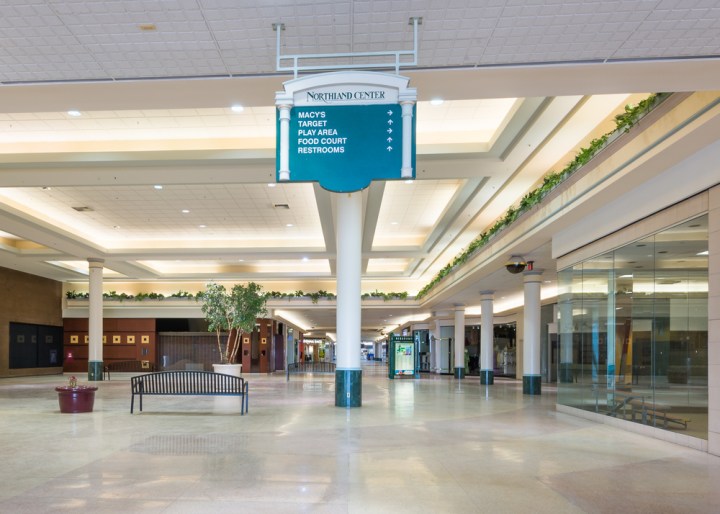
Northland Center, largest mall in the world when it opened in 1954, is now closed.
Summarizing, enclosed malls are basically a post-World War II American phenomenon. These hulking projects vary in size but may be as large as 1.2 million square feet of shopping, dining, movie and other recreation space. In 1970, there were around 300 enclosed malls across the country. By 1996, this number had increased to around 1,040. Now major stores are closing, and many malls are going dark.
The October 7 article quotes Ellen Dunham-Jones, an urban design professor at Georgia Tech, with the statistic that around 200 malls have closed down in the past two years.
What happened to our malls? It’s a simple answer: the internet.
More and more shoppers are skipping brick-and-mortar retailers to shop online. The malls that are surviving appear to be those with high-end shops that provide luxury experiences shoppers can’t get online. Dunham-Jones pointed to valet parking and chic boutiques with fitting rooms that can take pictures from different angles.
Landlords who once courted department store anchors are now looking for funky boutiques and innovative restaurants. The prediction is that more and more enclosed malls will close, and the question becomes, what will happen to the underlying real estate?
These articles, targeting Realtors®, indicate readers may be renting and selling these properties for mixed-use purposes, including housing! Some malls are being converted into public parks, office space, medical complexes, sports facilities, micro-apartments and condominiums. The theory is that a person can live in an apartment or condo in one of these retrofitted malls and walk to shopping, movie theaters and doctors’ offices.
Some developers like the idea of transforming these acres of flat real estate with existing infrastructure. Malls often contain 50 to 100 acres, including the massive parking lots, and that’s the size of many planned communities and subdivisions. In some areas desperate for housing space, malls may provide a sensible solution.
In one California location, a 30-acre “green roof” is being considered, which would include almost 4  miles of public trails, vineyards and a wine bar.
It sounds as if future potential uses of our dying malls may only be limited by the imagination of developers. The developers I know and love have great imaginations, so stay tuned!





 He failed to pay off four mortgages. By his own calculations, the loss was more than $200,000, but the Office of Disciplinary Counsel stated that his financial records and computers had been destroyed, making it impossible to prove the true extent of the financial mismanagement and misappropriation. Apparently, the money from new closings was used to fund prior closings, up until the date of Mr. Samaha’s suspension from the practice of law.